“We delight in the beauty of the butterfly, but rarely admit the changes it has gone through to achieve that beauty.”
~ Maya Angelou
"Beauty is only an herb away", all-natural, holistic, handmade care for families and pets.
Guided by wisdom and knowledge from past generations, information often tucked away in quaint old books resurfaces to remind us that 'simple is best'.
The Butterfly House is part of the childrens' area but with the butterflies, the bird observation area, the ABC garden and all the little extras to attract kids to the plant world, I enjoyed this area as much as any child.
Listed below are some of the numerous types of butterfly species housed within the greenhouse type structure. The attendants for the butterflies watch over them with great care. It is very important that they don't escape so visitors are inspected before exiting for any butterflies hitching a ride. Strollers are not allowed due to space restrictions and also since the butterflies are everywhere it is easy to harm them by accidentally stepping on them. Without predators, these flying flowers float around without a care. They have food, shelter, water, warmth...what a life during their short adult life spans which averages two weeks to a few months depending on the type. Included was a display of all the various types of chrysalis' so amazingly camouflaged to look like leaves and bird droppings.
The buckeye caterpillar is part of the brushfooted family. It is found throughout most of the U.S. except for the Rocky Mt. states. It is found in open areas with low vegetation, such as along roadsides, railroads, fields and meadows. To attract them plant snapdragons as a food source for the larvae and a variety of flowers for nectar for the adults.
The julia is a subtropical butterfly from Brazil to southern Texas, Florida and Mexico. They feed on the nectar of firebush and lantana.
The malachite is a tropical butterfly widespread in Central and South America. In America, they can be found in Texas and Florida. The caterpillars feed on green shrimp-plant and the adults feed on fermenting fruit.
Several types within Hershey's Gardens are from the swallowtail family. This family contains species that are the largest butterflies in North America. Swallowtails get their name from the "tails" on the back edge of their wings that reminded people of the forked tails of Swallows.
The tiger swallowtail butterflies can be found all throughout Alaska, Canada south through the U.S. east of the Rockies. Swallowtails favor broadleaf trees and shrubs. Birds avoid them due to a chemical in its body that makes it distasteful. Very common among gardens, farmland and meadows.
The spicebush swallowtail is such a beauty with its blue and black markings. Sassafras and Spicebush are North American natives and are the needed host plants for the caterpillars. The eyespots and big head make this caterpillar ferocious looking to predators. Adults feed on honeysuckle, butterfly bush, Joe Pye wee, zinnias and coneflowers. Birds avoid this type as well due to its foul taste.
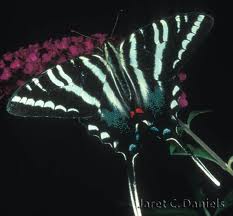
The zebra swallowtail has a favorite location around the Potomac area near Washington, D.C. and into Virginia along rivers, but they do extend westward to the Great Plains. A host plant for the eggs to be laid is the paw-paw tree. Adults dine on a variety of sources with sweet nectar. These butterflies can live for up to six months.
Another swallowtail, the eastern black swallowtail, has a range all the way west to the Rockies and then the western black swallowtail is found. Plant preferences are parsley, carrot and dill and nectar sources include phlox and milkweed. Very common among gardens and farmland but avoids wooded areas.
Viceroy butterfly is often confused with the monarch butterfly. There is an extra black line across the viceroy's hind wings that distinguishes it from the monarch. Milkweed butterflies such as the monarch are distasteful to predators, therefore similar looking types are also avoided. Viceroys live throughout most of the U.S. and Canada. They frequent moist areas as well as open meadows seeking thistles, asters and goldenrod. The larvae eat the leaves of trees such as the aspens, poplars, willows and fruit trees.
Easy to identify because of the stripes and long wings, the zebra longwings are normally found in the south and mid-western U.S. They prefer the edge of forests. Passionflower is the sought after host plant for the larvae. The flowers are toxic but harmless to the longwings and makes them distasteful to predators. This type of butterfly can live up to three months. They are the only butterflies known to eat pollen, which is a form of protein, enabling them to live longer than living on only nectar (sugar) sources.
Being a tropical resident, the white peacock is active throughout the year. They are closely related to the buckeyes and are native to the very southern Florida and Texas areas and like wet, swampy habitats. Caterpillars feed on ruellia and water hyssop plants.
Hershey Gardens included a few moths as well. Moth larvae develop in cocoons rather than chrysalises. Moths can be distinguished from butterflies in that they are night dwellers, have heavier bodies, and have feathery antennae, whereas butterlies' are wiry with clubbed tips.
Lunamoths are widespread across the U.S. and Mexico and often can be as large as 4 inches across. With its long tail and eyespots as a distraction from its head, they can often escape predators. Luna caterpillars feed on the foliage of broad-leaved trees such as birch. As adults they do not feed at all, so only live a few days.
Looking surprisingly like a butterfly, the cecropia moth belongs to the family of silk moths. Its range extends east of the Rocky Mountains of the U.S. and southern Canada. Also known as the robin moth, this moth is the largest in North America with a wingspan of six inches. Having no mouth parts they only survive long enough to find a mate and breed, from one to two weeks. The caterpillars feed on shrubs and trees, such as dogwood, box elder, willow, sugar maple, alder, birch, and fruit trees.
About the same size wingspan as a hummingbird as well as rapidly beating its wings as it feeds, the hummingbird clearwing moth is also called sphinx moth or hawk moth. These moths can reach speeds of 30 miles per hour. Common in the eastern U.S. and Canada these moths feed on hawthorns and flower nectar during the day. Caterpillar food source include shrubs such as the viburnum. Rather than spinning a cocoon, the caterpillar digs into the soil.
I'm not sure if this type of moth was at Hershey Gardens but it frequents our area and it is so cute I had to mention it. Its common name is Rosy Maple Moth The habitat is deciduous forests but its eggs are laid in maple trees. They range from Canada down to Florida over to Texas.
The many plant types throughout the butterfly house included:
Butterfly bushes, lantana, coneflowers, rubeckias, verbena, lobelia, joe-pye weed, salvia, phlox and the shrub called spicebush.
Other valuable plants include dill, fennel, nettles, butterfly weed, milkweed, aster, marigold, zinnia, tithonia and the shrub buttonbush.
Water was supplied by way of a little pond and puddling areas.
Fresh fruit was offered on plates at ground level.
After all the excitement to which we greet spring and the energy we put into our gardens and flowers it can be very defeating to witness the slow demise of our beloved plantings due to extreme heat and too little rainfall.
It is always a good idea to add compost to improve soil quality, mulch to retain moisture, and trap rain water from roofs by means of rain barrels. But after weeks of feeling our plants are so dependent on us, the routine can get old and we get tired. Most established plants can tolerate some water stress and just may not grow and flower as well as they would in better conditions. Plant roots go deep and unless we water enough to soak in deep to the roots, we may be doing more harm than good. You don't want the roots turning upwards towards moisture near the surface. Left on their own, roots go deep and send out feelers in their search for water. Potted plants and new plantings definitely need to be watered but as far as your bedding plants the best thing to do is to plant drought resistant plants right from the start.
Here in the northeastern states some of the tougher annuals we have are easy to grow and often reseed every year. These include spider flower (cleome), cosmos, calendula, kiss me over the garden gate, and nasturtiums.
Calendula is also known as pot marigold and is one of the medicinal plants used for making healing salves for skin conditions and wound care. All season long this plant flowers and matures into easy to gather seeds, all while forming new flowers.
Cosmos is one of those plants that can take a beating and keep on going. Branches broken by the weather will still survive unless broken off completely. It is wild and carefree, and tends to look a bit messy by seasons end. Plant where tidiness isn't an issue. In the fall, the flowers dry and form easy to gather seeds.
Cleome is a beautiful plant but just be aware that should you brush up against it or work around the mature plants they tend to be a 'pricky'. In the fall the flowers form 2 - 3 inch pods that dry and split open to reveal pepper-like seeds to spill to the ground.
Kiss Me Over The Garden Gate is an attractive heirloom which is used as a background planting due to its height (5-6 ft). Its dangling pink tassles add appeal and when they dry they scatter to the ground to pop up in various places next
spring.
Nasturtiums seem to thrive on neglect. They do fine in average soil and little rainfall once established. I have found these old fashioned flowers do much better in the ground than as a potted plant. These edible leaves and flowers add color and a peppery zing to any salad.
Some summer perennials requiring little care are day lilies, phlox, sedums, fall asters, beebalm, globe thistle and helianthis (wild sunflower).
Day lilies are such a pleasant sight growing along roadsides and unmowed meadows. Each bloom only last for one day but for the month of July they greet the world daily with fresh blooms. The clump forming roots of these flowers are very easy to dig up and transplant into your own garden. They establish themselves quickly and will spread.
Phlox is often confused with the roadside wildflower dames rocket. You can tell the difference by the number of petals. Phlox has five petals, dames rocket has four petals. These flowers are a must for attracting butterflies, such as this swallowtail.
Fall asters hang in there all summer and by late september begin to bloom a splendid display of purple or blue depending on their type. Very well behaved, they grown in mounds which increase in size but are not invasive by any means.
Beebalm (Monarda) is beautiful to look at but has many uses, medicinal, tea (oswego) and an attraction for hummingbirds with its brilliant red blooms.
Globe thistle is an awesome visual if you don't mind a prickly plant. By July it delights the onlooker with numerous metallic blue round balls of color, very attractive to bees. Blue isn't very common a color with flowers so it really stands out. It likes full sun, reaches a height of about four feet, and once established is very drought tolerant. Thistles are a great food source if left to go to seed, finches love them, but they will reseed themselves.
Wild sunflowers (helianthis) are so very cheery and their yellow flowers so welcome. Best to use this plant to naturalize as it will spread.
Growing with the sunflowers are a favorite, coneflower (echinacea). These welcome additions to the medicinal flower garden attract butterflies while in bloom and then dry into an attractive seed cone offering food for winter birds.
Sedum (stonecrops) have fleshy, succulant leaves to sustain them in times of little rain. Their attractive fall blooming pink to mauve flowers attract pollinating insects. As the blooms fade they are pretty enough to leave on the plant for awhile.
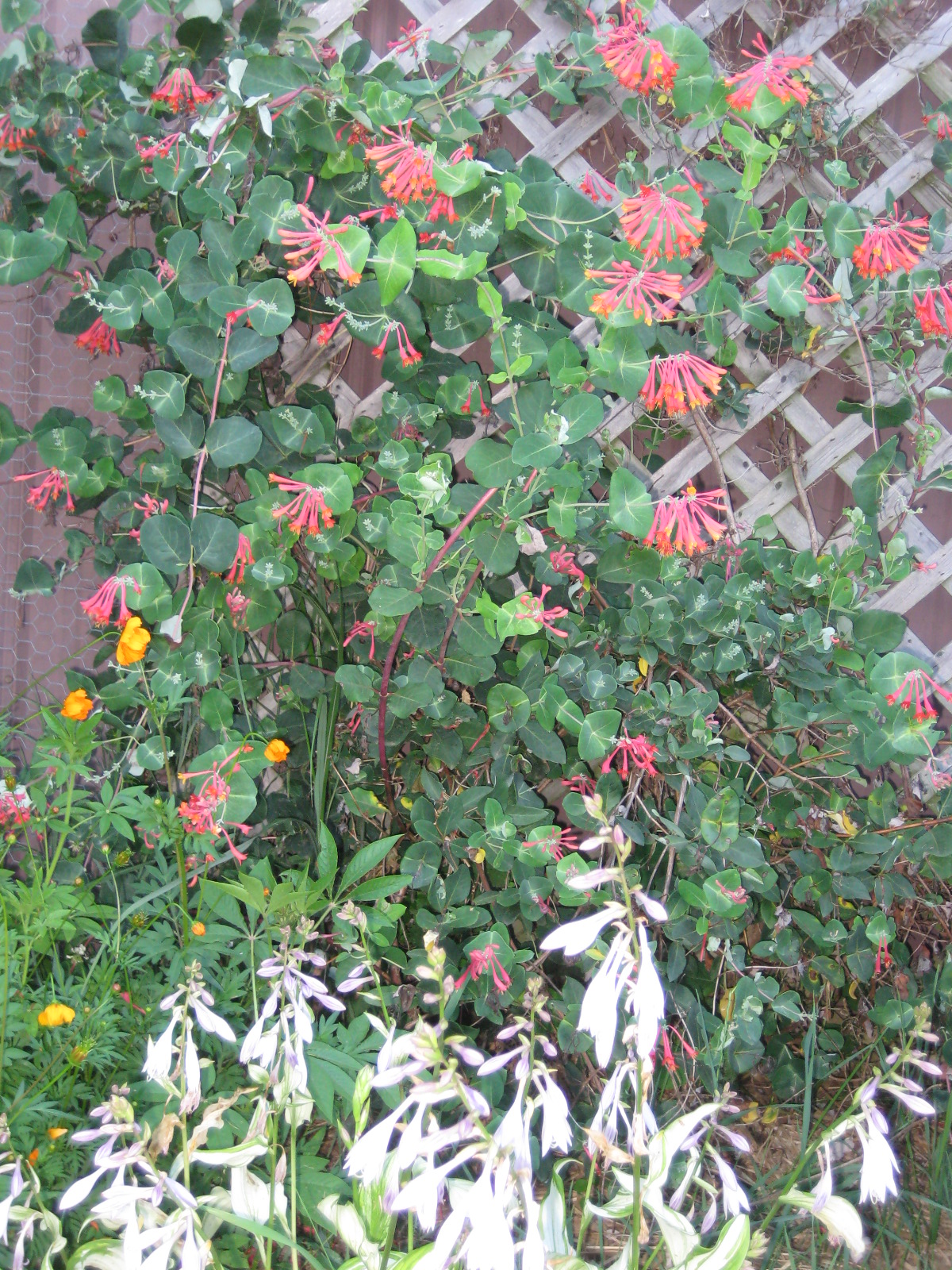
Two vines hardy enough to withstand dry spells are annual morning glories and the perennial American honeysuckle.
Morning glories are fast growing plants eager to climb and are used on trellises, mailbox posts, lanterns or to hide unsightly area.
The American honeysuckle is very well behaved compared to the chinese honeysuckle which can become an invasive. Another good choice for someone with the desire to attract hummingbirds.
Finally, ornamental grasses are a great choice and little maintenance. Here we have Maiden grass which grows to about five feet tall and offers shelter and food to the birds. Very decorative in the fall and looks good right into the winter. Cut it back in the spring and look for new growth from the ground up.
Memories of hay making during the heat of the summer months are a mixture of the good times of family working together and the misery of the heat, sweat and bugs. However, it is with fond memory that we can recall taking breaks and walking the field edges looking for ripe berries. First came the black raspberries, then the red raspberries which are also known as wineberries, and the blackberries with their solid rather than hollow centers.
As children, we knew where the good spots were located along the country roads, and would peddle our bikes with our buckets clamoring from the handlebars. We knew to wear long pants even on the hottest days or we'd pay the price later with unsightly scratches and most likely poison ivy.
As adults, the days just fly by with our daily activities and unless we actually schedule a time slot to pick berries, their season is over before you know it. Eaten right off the bush is best, but if you can gather enough, raspberries are great with ice cream, cereal, smoothies, cobblers as well as this pretty vinegar.
Raspberry vinegar is surprisingly simple to make.
In a large saucepan, combine 4 cups white wine vinegar and 1/2 cup sugar.
Bring almost to a boil over low heat, stirring constantly, until sugar is dissolved.
Do not boil.
Have 3 cups fresh raspberries waiting in a large jar (about 6 cup capacity)
Pour the hot vinegar mixture over the berries and cover the jar with a cap.
Let the jar stand at room temperature for 48 hours.
Strain through several layers of cheesecloth or a jelly bag into a clean bottle or jar.
Seal with a cork or lid and store in a cool dark place.
Yield is about 4 cups.
Raspberries are very healthy for you, as they are loaded with powerful phytonutrients and antioxidants necessary for a healthy immune system. Ellagic acid is an antioxidant which protects your cells from becoming damaged. Anthocyanins are powerful antioxidants that have antimicrobial properties that help fight off Candida. These flavonoid molecules are also what give raspberries their red color.
Ellagitanins are a family of compounds that are reported to have anti-cancer activity. Of all the antioxidants, these are considered the biggest contribution to their antioxidant capacity.
Raspberries are a rich source of vitamin C, manganese, riboflavin, folate, niacin, magnesium, potassium, and copper.
Raspberry vinegar is a great tasty vinegar for any salad greens combination. Especially good is a spinach salad consisting of spinach leaves, dried cranberries, almond slices and fresh diced apples. Topped with raspberry vinegar and olive oil and you have a very nutritious, tasty salad different from the ordinary. Enjoy!
Don't let snags and set-backs let this season become a bummer of a summer!
Things happen, we just have to be prepared for those unexpected occurrences that can sideline the fun. Put together an all-natural "to the rescue" kit.
Below is a list of things to be prepared for during the heat and bustle of summer activities:
1. OVERHEATING
During exertion and exposure to the summer sun and high temperatures it is important to seek methods of keeping the body hydrated and cool. The following three items feel so good to freshen-up during a hot, sweaty day.
Roses contain cooling properties therefore rosewater is a wonderful thing keep on hand.
Roses contain a substantial amount of vitamin C which results in an acidic rosewater wonderful to use as a facial toner or facial mist. Fresh rose petals are allowed to infuse in distilled water under the heat of the sun and then added to refreshing witch hazel. Feels wonderful and smells great.
Roses and Elderflowers can be combined with a good quality apple cider vinegar to bring you an awesome treatment for soothing sunburn or a skin balancing facial astringent. Vinegar restores the natural acid balance to the skin and also acts as an antiseptic.
Utilize peppermint's minty cooling sensation to bring some relief and perk up on those hot, humid days. Also helps relieve the throb of a headache often brought on by the heat.
2. BELLY ACHES Peppermint has a great reputation for aiding in the relief of cramped tummy muscles and well as the headaches and nausea that often accompany motion sickness.
Peppermint tummy oil also contains the essential oils of chamomile and fennel, great aids for calming upset stomachs.
3. POISON IVY We are told about the rule "if 3 leaves, let it be" but still it may seem every time we work outside or go hiking we somehow brush up against this plant. Nature's antidote, jewelweed, can often be found growing nearby but if not, keep a bottle of this Jewelweed Vinegar on hand to spray onto the affected areas to help neutralize the itch of the urushiol.
4. SUNBURN Combine the cooling gel of the aloe vera plant with Lavender essential oil and you have a fantastic antiseptic and pain reducer to help nip sunburn in the bud. Applied as soon as you notice the burn and you just may avoid peeling.
5. OVEREXERTION
Weekends and vacations can be over scheduled with fun activities but overdoing it can result in muscular pain.
Rosemary has long been depended upon for relief from rheumatic and muscular pain. Used as a liniment this sharp, earthy smelling herb helps warm the muscles and increase circulation.
Called the living medicine chest, both the leaves and roots of the comfrey plant are used to stimulate and accelerate tissue repair. Comfrey helps reduce swelling and bruising as it strenthens ligaments and tendons.
6. BUG BITES AND STINGS
Insects, bees and ticks are a part of our natural environment but we'd rather they leave us alone. Help deter them without the potential risk to yourself of bug sprays containing pesticides. There are aromatic plants in nature that insects detest and avoid. Three good ones are Yarrow, Geranium, and Plantain.
Yarrow acts as a bug deterrent and soothing for skin irritations in this alcohol based body spray. Catnip and Citronella essential oils are added for additional repelling action.
Geranium essential oil is detested and avoided by ticks. This aromatic oil is utilized as a body spray to help keep these dreaded parasites off of your family and dogs.
Plantain is amazingly efficient at neutralizing the sting of bugs and bees. It has astringent, soothing, antimicrobial properties that make it a beneficial addition to an herbal bug body spray. Plantain, Comfrey and Yarrow blend well together in this vinegar based body spray.
7. ATHLETE'S FOOT
Public swimming pools, showers, bathrooms, camp facilities
all put one at risk of picking up the fungus, tinea pidas. A few good foot soaks with this salt foot bath containing anti-fungal tea tree, cooling peppermint, and healing lavender essential oils should help with this annoying condition.
As much as we enjoy living in the country, there have been times in the past few years when we feel like moving just to escape the fear that goes with contracting Lyme Disease every summer season. Pennsylvania and nearby Northeastern states are considered to be endemic for ticks, especially the deer tick.
Lyme disease was named for the town of Old Lyme, Connecticut, where it was first identified 20 years ago. It is believed that suburban sprawl is part of the reason for the appearance of this disease, which is caused by the tickbourne bacteria Borrelia burgdorferi. As more and more housing is being built near wildlife areas, people and deer are brought into closer contact. Since natural predators of deer are rare in developed areas, the deer populations have increased.
Some years are worse than others depending on the kind of winter we've had. A wet snowy winter gives the ticks the moisture they need to survive. The life cycle also factors in to the surge in their population. A mature tick can lay 2,000 eggs before it dies. By fall, the tiny larvae are ready for their first meal, which is the blood of a host. The most likely target are rodents. The ticks then hibernate and emerge in the spring as nymphs, ready for a second meal. Over the spring and summer months, mice, cats, dogs and humans are their most likely prey. They attach for three to five days. By the end of the summer they reach their adult size and attach to usually deer or humans for their third meal.
Larvae, nymphs and adults tend to be most prevalent in moist areas. Short grass and areas hit by direct sunlight hinder their survival. Walks in the woods or hiking through unmowed fields are activities that do put a person at risk, but rather than living in fear of the "what could happens" just take necessary precautions. Wear light-colored clothes, tuck your pant legs under your socks, spray your legs, arms and hair with a repellent, and upon returning home, check yourself for ticks, shower, wash your clothes and use the heat of the dryer rather than the wash line.
A great tip to remember:
When you come in from outside or even periodically while on a hike or gardening, take a lint roller and go over your clothing to pick up any ticks. Roll it over your dog or cat to pick up any ticks. Being deer ticks are so small and blend in so well with darker clothing and fur, this tip is genius.
Should you find a tick already attached to you or your pet, rather than just pulling it off, apply a drop of an essential oil such as peppermint, tea tree, geranium or thyme. Deer ticks have a nasty grip and it is easy to leave the head behind still embedded in your skin and not realize it since they are so tiny. Repelled by these oils the idea is that they will retract on their own. Then you can kill them by crushing with a small stone or burning with a lighter.
These parasites can inject infectious agents through its saliva before it would detach on its own, but if you discover and remove it within 24 hours you can have some reassurance that if it was a Lyme carrier you got it off before the bacteria could be transmitted. Keep an eye on the site. If you notice a rash that increases in size and becomes like a bulls-eye, or you start to feel tired and achy, contact your physician.
Natural remedies to booster your immune system include Echinacea and Garlic but when it comes to Lyme disease do not hesitate to take the antibiotics as well. The typical treatment is 21 or 28 days of Doxicycline. This antibiotic is usually successful in knocking out the infection and you'll be amazed how quickly you'll feel better. But don't be tempted to not finish the entire regimen. Doxicyline has its drawbacks such as constipation and sun-sensitivity which is inconvenient but it is very important to finish the 3-4 weeks of antibiotics.
Being there have been such an increase of reported Lyme cases, the fear that eventually Borrelia will develop a resistance to Doxicycline is of concern. Also, people have to educate themselves about the potential severity of what this disease can do to the body. Usually if caught early the Doxycline is successful. If not treated, over time the disease can manifest deep within the nervous system and result in permanent damage such as crippling arthritis.
It is still under debate about the reliability of the Lyme blood test. Doctors feel that if caught in the earliest stages the blood test may be negative because the body has not yet developed the antibodies against the bacteria and if treated the threat is out of your system. It is important that you don't rely only on the blood test results. Just because the test came back negative doesn't mean you don't have the disease brewing. Pay attention to the symptoms and catch it early. Once the antibodies are present in your blood you may always test positive should you have another scare in the future.
Symptoms vary from person to person. When it hit our family six years ago, it was an eye opener. Being a Lupus patient, the headaches, body aches and fevers were contributed to a Lupus flair, and being I didn't develop a bulls-eye or a rash I didn't attribute it to Lyme until I realized my Lupus medications were not working. With an already compromised immune system, letting it go for weeks was not in my favor.
My husband's experience with this disease manifested itself entirely different from my own. He found the tick so Lyme was suspect right from the start but since the symptoms more resembled heat exhaustion (103 fever, dehydration, severe headaches) he was treated with IV fluids and sent home. Only after another two days when he developed a splotchy all over the body rash and symptoms of Bells Palsy, was he put on Doxycyline.
Bell's palsy is a temporary weakness or paralysis of the muscles on one side of the face. These muscles are controlled by the facial nerve. Because there's a facial nerve on each side of a person's face, and Bell's palsy usually affects just one nerve, people with Bell's palsy will most likely notice stiffness or weakness on one side of the face.
When the facial nerve is working properly, it carries a host of messages from the brain to the face. These messages may tell an eyelid to close, one side of the mouth to smile or frown, or salivary glands to make spit. Facial nerves also help our bodies make tears and taste favorite foods. But if the nerve swells and is compressed, as happens with Bell's palsy, these messages don't get sent correctly. The result is weakness or temporary paralysis of the muscles on one side of the face.
Bell's palsy is most often connected with a viral infection such as herpes (the virus that causes cold sores), Epstein-Barr (the virus that causes mono), or influenza (the flu). It's also associated with the infectious agent that causes Lyme Disease. This doesn't mean that everyone who has a viral infection or Lyme disease will develop Bell's palsy — most people don't. But in a few people, the immune system's response to a viral infection leads to inflammation of the nerve. Because it's swollen, the nerve gets compressed as it passes through a small hole at the base of the skull, which causes the symptoms of Bell's palsy.
The symptoms of Bell's palsy usually show up about 1 to 2 weeks after a viral infection. The symptoms tend to come on quickly — usually Bell's palsy reaches its worst point within 48 hours. A few hours or days before Bell's palsy develops fully, some people may have a headache or feel pain behind or in front of their ears. A person may notice one side of his or her face droops or feels stiff. Some people may only notice a slight weakness, whereas others may not be able to move that side of their face at all.
Other symptoms of Bell's palsy include:
difficulty closing one eye all the way
dryness in one eye
trouble tasting at the front of the tongue on the affected side
changes in the amount of saliva or drooling
hearing sounds that seem louder than usual in one ear
This condition is devastating and terrifying to the person suffering from it. It happens so suddenly, seemingly overnight that it is easy to panic. My husband was put on prednisone to reduce the inflammation of the affected nerve and an anti-viral. After a week we are eagerly watching for improvement. The prognosis is that if just the mylene sheath is affected, once the inflammation is reduced, recovery is usually pretty quick. However, all one can do is wait. Nerve repair can take from three months to a year, and in some cases the facial droop can be permanent.
Caring for the eyes is a great concern. When the eye cannot blink properly, the natural lubrication isn't sufficient, putting the cornea at risk of damage from drying out. Gel type drops are needed often throughout the day. The eye needs to be taped shut at night in order to sleep.
We really don't think about the natural functions of our body until we lose them. Blinking, sleeping, eating, talking, noise sensitivity all suddenly become a big deal. Top all that off with the risk of depression, self-consciousness of appearance and the hurdles mount.
The source for information for this post was from lymepa.org
Here is a very informative, personal story of the frustration and struggle to get some answers.
Listed below in an ecofriendly tick repellent body spray utilizing the beliefs of aromatherapy. Ideal for those who would prefer to not utilize repellents containing pesticides.
Ticks can be very stubborn to the typical flea and tick sprays. Rather than dousing yourself and loved ones with pesticides and organophosphates, and then worry about the risks of these toxic ingredients, try an approach these buggers naturally detest and don't build up a resistance. The scent of certain essential oils encourages them to flee. Ticks don't like the smell of the oil therefore try to avoid it.
Rose Geranium, Pelargonium graveolens, is a necessary part of any effective, environmentally friendly tick repellent. This plant is a hardy, evergreen shrub with a lemon-rose scent and pink to purple flowers. The oils are distilled mainly from the leaves. Geranium is composed of terpene alcohols, which explains its many uses as an anti-fungal, an antiseptic as well as as aid in healing wounds and irritated skin conditions.
Emotionally, Rose Geranium has a calming, centering and grounding effect. High-strung people seem to give off signals and are more prone to draw insect pests and the likelihood of getting bitten. The use of this essential oil can help with one's mood and temperament.
Geranium is believed to contain plant hormones, that can help the body's hormone system function properly by being more balanced. The oil is said to help with nervous tension and mood swings. Pregnant woman should check with their physician before using.
This Tick Deterrent Spray is composed of distilled water, alcohol to help with preservation and the essential oil of Rose Geranium. Since everyone's body chemistry is different and the rate of sweating due to activity varies, there is no way to tell how long the effectiveness of each application lasts. Reapply every few hours. As with any new introduction on the skin, test first on a small area of skin to check for irritation.
This spray is ideal for use on your dogs, but don't use on cats. Some essential oils can be dangerous to cats. Cats don't have the enzymes necessary to break down certain components and unless eliminated efficiently their build-up can lead to toxicity.
UPDATED: 9/25/11. Written by Michael Whalen.
TESTIMONY OF TREATMENT
D. Andrew Neville, N.D.
Clymer Healing Center
5916 Clymer Road, Quakertown, PA 18951
It is with great appreciation, much satisfaction, and a huge smile on my face that I take the time to write this testimony for Dr. Andrew Neville of the Clymer Healing Center. That is a significant sentence, not only for the number of words, but more that when I went to see Dr. Neville in July 2011, the last thing I could do, or wanted to do was smile. My visit to Dr. Neville was a desperate measure and the direct result of a deer tick bite which led to a severe case of Lyme's Disease.
My bout with Lyme's had quickly triggered Bell's Palsy in the left side of my face, causing paralysis from above the eye to my chin. My life had suddenly been altered. Critical motions we don't even think about were suddenly beyond my control. Blinking was impossible. I had to tape my left eye shut to sleep and continuously used wetting drops while awake. Antibiotics provided by my primary physician had alleviated the fevers and headaches; concurrently I was told there was no real treatment for the Bell's Palsy except time and that I should consider seeing a neurologist.
When I called the offices of several neurologists explaining my plight, I assured myself that I would get some answers as my case had to be a "really bad one!"; what I received was the reality that every neurologist in my area was booked until late September or October. As a professional in the Pharmaceutical industry, articulate speech is a requirement of my position. The unfolding set of circumstances had significantly impacted my ability to enunciate even small sentences and I was becoming anxiety ridden.
That was when my wife located the Clymer Healing Center. We called Thursday 07 July 2011 and had an appointment the following Monday. I have received non-traditional healthcare in the past and went to see Dr. Neville with an open mind. When we first met, I suspect Dr. Neville detected my anxiety and immediately said "when" we correct this as opposed to "if" or "let's wait and see". His confidence was reassuring as was the time he took to explain the cause of my paralysis and the nature of the treatments. He concluded our first office visit with a heat/energy application to the inflamed nerve area and prescribed an aggressive amino acid and anti-viral treatment plan.
Within 72 hours of my visit with Dr. Neville I began to experience sensation in the left side of my face. By the end of the week I was able to voluntarily move my upper lip. I maintained a two visit per week regimen and by 29 July 2011, I had only minor symptoms. Now in mid-August, I almost forget what it was like. I have returned to 100% facial function and have no signs of headaches or joint pain. Working within a large professional network, I am aware of numerous instances of Lyme's disease where symptoms linger; even after months of treatment. Dr. Neville's treatment plan corrected my left side Bell's Palsy in what my research suggests was much quicker than typical.
The care I received at Clymer Healing Center was exceptional and produced results that exceeded my expectations. This experience has even further strengthened my confidence in holistic medicine, particularly naturopathic treatments. As records like mine begin to reflect the benefits of these alternative treatments, I anticipate integration with allopathic medicine and a greater recognition for homeopathy.
The fourth of July has been the most important secular holiday in America since the 1870's. Independence Day is the birthday of the United States and the anniversary of the day on which the Declaration of Independence was adopted by the Continental Congress on July 4, 1776.
The Constitution provides the legal and governmental framework for the United States. It's assertion that "all Men are created equal" was put on paper but at that time only included the rich, white, landholding men. The writings of the Declaration were influenced by philosophers John Locke and Jean Jacques Rousseau. Since all people are creatures of God, or nature, they should have natural rights that cannot be violated. It is a celebration in itself to fully appreciate the fact that now 200+ years later the privileges of equal rights include women and all other ethnic groups.
John Adams, one of the founders of our new nation, said, "I am apt to believe that it will be celebrated by succeeding generations as the great anniversary festival. It ought to be commemorated as the day of deliverance, by solemn acts of devotion to God Almighty. It ought to be solemnized with pomp and parade, with shows, games, sports, guns, bells, bonfires, and illuminations, from one end of this continent to the other, from this time forward for evermore." Independence Day was first celebrated in Philadelphia on July 8, 1776.
The people of Philadelphia may have celebrated the event since 1776 but due to the ongoing war, slow communication and travel, it only became commonplace after the war of 1812. Congress didn't declare it a legal, public holiday until 1941.
John Adams believed that July 2nd was the correct date on which to celebrate the birth of American independence, and would reportedly turn down invitations to appear at July 4th events in protest. Adams and Thomas Jefferson both died on July 4, 1826--the 50th anniversary of the adoption of the Declaration of Independence.
As Americans we are guaranteed the safety net of our rights as we enjoy the privilege of the freedom to express our opinions on any topic. It seems disrespectful the way people rant about our government leaders, all the while enjoying the comforts and excesses of this rich country. Though people from other parts of the world are very proud of their own birthplaces, our privileges must be enviable at times. America is like a candy store, we are free to have and do whatever we want. Of course, we are responsible for our decisions and pay the price for poor choices but still, those choices are our own to make. No one can force us to follow a certain religion, pursue an expected occupation, limit us from an education, or even whether or not to join the military. We can feel safe in our own homes, enjoy land ownership, and bask in all the availability of modern technology and information at our fingertips.
So enjoy your holiday with the picnics, concerts, the beach, and of course the beautiful fireworks. But take the time to honor and remember those who worked and sacrificed for future generations and send them a silent prayer of gratitude.

 Spending time with my college age daughter now that she isn't living at home has become precious. We had a magical, beautiful summer day visiting Hershey Gardens in Hershey Pennsylvania. http://www.hersheygardens.org/garden_attractions/butterfly_house.php


 The malachite is a tropical butterfly widespread in Central and South America. In America, they can be found in Texas and Florida. The caterpillars feed on green shrimp-plant and the adults feed on fermenting fruit.
 The tiger swallowtail butterflies can be found all throughout Alaska, Canada south through the U.S. east of the Rockies. Swallowtails favor broadleaf trees and shrubs. Birds avoid them due to a chemical in its body that makes it distasteful. Very common among gardens, farmland and meadows.




 I'm not sure if this type of moth was at Hershey Gardens but it frequents our area and it is so cute I had to mention it.