Meadow Muffin Gardens logo
Showing posts with label bugs. Show all posts

Sunday, February 9, 2020

Comfrey, A Living Medicine Chest


Comfrey or Symphytum officinale is a must have for the garden, whether you want it for medicinal healing purposes or for vegetable and flower growing, it is an invaluable plant. A European native and member of the borage family, comfrey acts as a soil conditioner, weed barrier, compost booster and fertilizer.

A hardy perennial to Zone 4, comfrey thrives in just about any type of soil (though moist and fertile is best), is drought tolerant and grows fine in full sun to partly shaded locations. Seldom bothered by disease or insect pests it really is a low maintenance herb. It does need its space, as it can grow to a height and width of about five feet.

The large dark green fuzzy leaves are full of potassium, nitrogen, magnesium, calcium and iron.  A reason for this is it has a long taproot which takes up nutrients from the soil. The deep roots make this plant great for preparing a new vegetable or flower bed. The taproot acts as a clay breaker to penetrate compacted soil. 

The leaves can be spread around garden plants to keep down the weeds or they can be shredded first to form a mulch. To make a liquid fertilizer, steep the leaves in a bucket of water to form a compost tea. Do this outside, since the resulting "tea" can be described as none other than "it stinks". Anyone who infuses comfrey in olive oil to make an herbal oil for salves learns quickly that if they want to use the fresh leaves the resulting salve will have an odor. Taking the time to dry out the leaves a bit before infusing greatly reduces the risk of not only the smell but against spoilage. The fuzzy leaves of comfrey can be irritating to some people and cause contact dermatitis, so it is advised to wear gloves when handling them. 

Add comfrey leaves to the compost bin or pile as an accelerator, and be sure to turn the pile to thoroughly mix and combine everything.

Also, comfrey makes a great trap crop to lure slugs and snails away from other garden plants or flowers. Just remember its size so it doesn't choke out other plants.

The fact that comfrey is also called Knit-bone and Bruisewort makes it easy to remember the medicinal purposes of this herb. Broken bones, pulled muscles, sprained ankles, wound care and bruises can all use this plant to aid and speed up healing. Difficult to heal pressure sores or slow to heal wounds often respond amazingly well to the use of comfrey salves. Just remember to be sure there is no risk of infection and to let the would heal a bit for a day or two before applying. The allantoin in comfrey may cause the skin to close over too quickly, causing the outer skin to heal before the inner wound is ready. Wounds need to heal from the inside out. Don't use it internally because there is controversy about its effects on the liver.

If you have access to the actual comfrey plant, take advantage of those leaves and make a poultice for self-care after a mishap to relieve inflammation, reduce pain and encourage healing.

1. Collect a handful of fresh comfrey leaves.
2. Roughly chop the leaves and add to a blender or Magic Bullet
3. Add just enough water to blend into a mash
4. If you added too much water, an option is to add a bit of flour to thicken it up
5. Lay out cheesecloth or t-shirt or whatever you have and dump the mash out onto the cloth.
6. Fold the edges over the mash to hold it in place and limit drips, but leave enough exposed to have direct contact to the injured area. If you use cheesecloth, it is porous enough that the mash can be completely wrapped. 
7. Lay the cloth containing the mash over the wounded area.
8. Using Saran Wrap, cover the cloth and wrap around the limb or torso to hold it in place and prevent leakage.
9. Leave the poultice in place at least two hours
10. Repeat as needed but prepare a fresh mash each time.

Below is a video with step-by-step instructions:


Lastly, bees and pollinating insects love it! A win win all around!


MEADOW MUFFIN GARDENS


Wednesday, October 4, 2017

Tobacco Flower, Heirloom Nicotiana Alata, Jasmine in the Air


By the end of the summer season when many of our annuals are petering out, the stately tobacco flower will be just coming into its own! A majestic plant named for the 16th century French diplomat Jean Nicot, he once believed it was a cure-all for just about everything. While historically the leaves were used as a relaxant, it is now known to be highly addictive so fell out of favor medicinally. However, it does make for a great pesticide. Soak the dried leaves to make like a tea and then put in a foliage sprayer to apply to your garden plants.

Gardeners looking for the large, old-fashioned heirloom Tobacco Flowers won't find what they're looking for at a nursery. These tall, Jasmine smelling, night blooming beauties need to be grown from seed which can be found through seed banks or catalogs. "Only the Lonely" and  "Perfume White" are good varieties. The seeds may reseed themselves on their own or you can save those seeds and replant in the spring (wait till about 2 weeks after the last frost date for your area).

Technically a perennial, Nicotiana alata, is grown as an annual in areas with a colder winter. Flowering tobacco belongs to the nightshade or solanaceae family. Since it is in the same family as potatoes and eggplant, don't plant near each other or there is a greater chance for the pests, hornworms and flea beetles, to have a feast. Should you have a problem with flea beetles, (pin holes in the foliage) try floating row covers while the plants are young and/or diatomaceous earth. If you have plants that seem to just loose their foliage, it is probably the tobacco hornworm. Large healthy plants won't actually die from these green caterpillars, so if you want the hummingbird moths to later visit your night blooming flowers, you cannot kill all the caterpillars. But if you must kill them, hand pick them off or apply bacillus thuringiensis.

Tobacco Flower at its full size
Tobacco Flower five petaled tubular flowers
Nicotiana seeds germinate quickly in warm soil and being so small, just barely cover when planting. Choose an area with full sun and rich soil. The tall type of tobacco flower grows a good 5 feet tall and don't bloom till late in the season. The garden pack varieties are small, compact and are bred to flower even while still in the nursery packs. What they have in color, they lack in fragrance. If you want the sweet scent of jasmine, you need to plant the heirloom type, Nicotiana alata. The leaves are large as you'd expect from the tobacco plant. Fuzzy and sticky, the flowers look like long trumpets with a flare on the ends which are actually five petals.


Though nicotiana likes full sun for best growth, the flowers tend to droop in the heat and wait to perk up in the cool of the evenings. Some shade is tolerated in areas with really hot summers.
Plant in an area where you can enjoy them at night. Spending time outdoors on summer evenings is wonderful with the intoxicating scent of jasmine in the air.

The flowers are a great attraction to bees, butterflies and hummingbirds during the day and moths during the evening.

Two good sources for getting your seed are Select Seeds and Renee's Garden

Once the flowers fade and go to seed, it is easy to save the seed. Below is a video showing how to gather and save tobacco flower seeds.


Tobacco Flowers going to seed

Sunday, February 12, 2017

Bugs and Butterflies...Where Do They Go For The Winter


There is a cute saying we quote to children, "snug as a bug in a rug". That is very true when it comes to the survival of our backyard bugs and butterflies during the harsh, cold winter months.
Most of us are aware of the long migration south of the Monarch butterlies, but butterflies and other insects do not migrate. They cleverly hidden in the landscape.

Butterflies and other insects slow down their metabolisms in a process called diapause. They rid most of the water from their bodies to avoid freezing and there are certain chemicals in their bodies that act as antifreeze.

Different types of butterflies are in various stages of their life cycles during the winter months. Some will overwinter as an egg or ovum, some as a larva or caterpillar, some as a pupa or chrysalis and some as adults.

In order to accomplish any of this, butterflies need the proper conditions. There is a reason nature seems to be so untidy by late autumn when everything dies back for the winter. Without places of shelter in leaf litter, tree bark, plant stalks, seed heads and brush piles, these insects wouldn't survive.
This is why it is so important to hold off on your garden clean up until spring. Raking, bagging and disposing of all those fall leaves is actually destroying countless insects. If you want your yard and garden to come alive again in the spring, you simply cannot interfere with too much cleaning up and cutting back.

Below are a few examples of where our flying flower beauties go for the winter:

The Viceroys, who look so much like the Monarchs,are in the caterpillar stage. The chew a leaf into a certain shape, roll up inside it to form a tent form and then fasten to a plant stalk.
Viceroy


The Swallowtails are at their chrysalis stage 
Eastern Tiger Swallowtail

Black-tail Swallowtail


Hairstreaks overwinter as eggs
Coral Hairstreak
Fritillaries, Crescents and Skippers hatch from their eggs in the fall and sleep through the winter as caterpillars.
Fritillary
Crescent
Skipper


Cloaks, Question Marks and Commas tuck themselves away as adults in fallen leaves or behind loose bark.

Mourning Cloak
Question Mark


Comma
Here is a more complete list

Pipevine Swallowtail (Battus philenor) - Chrysalis
Zebra Swallowtail (Eurytides marcellus) - Chrysalis
Black Swallowtail (Papilio polyxenes) - Chrysalis
Canadian Tiger Swallowtail (Papilio canadensis) - Chrysalis
Eastern Tiger Swallowtail (Papilio glaucus) - Chrysalis
Spicebush Swallowtail (Papilio troilus) - Chrysalis
Giant Swallowtail (Papilio cresphontes) - Chrysalis

Mustard White (Pieris napi) - Chrysalis
Clouded Sulphur (Colias philodice) - Chrysalis
Orange Sulphur (Colias eurytheme) - Chrysalis

Coral Hairstreak (Satyrium titus) - Egg
Edwards’ Hairstreak (Satyrium edwardsii) - Egg
Eastern Tailed-Blue (Everes comyntas) - Caterpillar
Karner Blue (Lycaeides melissa samuelis) (rare, endangered) - Egg
Spring Azure (Celastrina ladon) - Chrysalis

Monarch (Danaus plexippus) - Migrant

Variegated Fritillary (Euptoieta claudia) - Migrant
Great Spangled Fritillary (Speyeria cybele) - Caterpillar
Aphrodite Fritillary (Speyeria aphrodite) - Caterpillar
Atlantis Fritillary (Speyeria atlantis) - Caterpillar
Silver-bordered Fritillary (Boloria selene) - Caterpillar
Meadow Fritillary (Boloria bellona) - Caterpillar

Silvery Checkerspot (Chlosyne nycteis) - Caterpillar
Harris' Checkerspot (Chlosyne harrisii) - Caterpillar
Northern Crescent (Phyciodes cocyta) - Caterpillar
Baltimore (Euphydryas phaeton) - Caterpillar
Gray Comma (Polygonia progne) - Adult Hibernation
Compton Tortoiseshell (Nymphalis vaualbum) - Adult Hibernation
Mourning Cloak (Nymphalis antiopa) - Adult Hibernation
Milbert's Tortoiseshell (Nymphalis milberti) - Adult Hibernation
American Lady (Vanessa virginiensis) - Migrant
Painted Lady (Vanessa cardui) - Migrant

Red Admiral (Vanessa atalanta) - Migrant
Common Buckeye (Junonia coenia) - Migrant
Red-spotted Purple (Limenitis arthemis astyanax) - Caterpillar
White Admiral (Limenitis arthemis arthemis) - Caterpillar
Viceroy (Limenitis archippus) - Caterpillar

Northern Pearly Eye (Enodia anthedon) - Caterpillar
Little Wood Satyr (Megisto cymela) - Caterpillar
Common Wood-Nymph (Cercyonis pegala) - Caterpillar

Tawny-edged Skipper (Polites themistocles) - Chrysalis
Peck’s Skipper (Polites peckius) - Caterpillar


Thursday, June 9, 2016

Yarrow, Woundwort, A Multitude of Uses


To see Yarrow listed as a common weed is an insult to this plant. For a plant to be known as woundwort makes one wonder just how many lives it saved over the years. Today when we think of illness we figure there must be a physical cause and even if a cure is not yet known, with enough research we'll find a physical cure.

Years and years ago illness was thought to be more mystical and linked to the stars, the humors and even the Devil himself. To discover a plant that could heal was much more than simply a medicine, it had mystical powers.
Dioscorides,(c 40 - 90 AD), the Greek physician who wrote the De Materia Medica, a 5 volume encyclopedia about herbal medicine, claimed that the name "achillea" originated from the fact that Achilles, the Greek hero of the Trojan War, used it to heal his wounded soldiers on the battlefield. Throughout the millennia and much of the world until after the American Civil War, yarrow was part of the battle gear right along with the weapons.

The power of healing was not only physical. The name "yarrow" comes from the Anglo-Saxon (Dutch) gearwe, which is believed to come from gierwan, meaning "to be ready". Considered a defense against other ills, yarrow was burned to protect against evil.


Achillea millefolium, common yarrow, is a member of the aster or composite family (Asteraceae). Achillea is the genus name and millefolium is the species which means "a thousand leaves". Yarrow has flat-topped clusters of small white flowers that are in bloom from June through October. A hardy perennial, this fern-like, feathery plant with it's clusters of tiny daisy-like florets making up each flower head, is an important pollinator plant for butterflies, bees and many other insects.

If you want a plant the deer will leave alone, yarrow fits the bill. It spreads quickly and being it is so bitter, (the leaves contain tannin),animals won't touch it, domestic or wild.

All parts of yarrow are useful, whether its fresh, dried, in tea form, poultices, steamed vapors, alcohol tinctures, herbal oils and vinegars.
It's reputation as woundwort comes from it being a styptic, or stops bleeding. On the battlefield, most wounds were a result of the types of weapons used back then, resulting in deep gashes and puncture wounds. These types of wounds were very high risk for infection if the soldier didn't bleed to death first. Yarrow leaves and flowers were crushed and chewed to add saliva which formed a poultice and then  packed into the wounds. This method was used to stop the bleeding, act as an antiseptic for infection, and as an analgesic to help lessen pain.

Yarrow has so many uses the list could go on and on. It's best known for wound care, but it is also used to sweat and break a fever. Drinking hot yarrow tea does this by relaxing the circulation, allowing the body to sweat and get rid of infection.In fact, the original formula for cold tea is a combination of peppermint, elderflowers and yarrow.
By the way, this blend should not be used by pregnant women.

Since yarrow is so good for the circulatory system, it tones the blood vessels, dilates capillaries and gets the blood moving. People with spider veins, varicose veins and hemorrhoids find yarrow balm massages very soothing and effective.

The effects on the circulatory system along with it being one of the "bitters", yarrow is very useful for stimulating the digestive juices, excellent for the liver and pancreas.

Maria Treben considers yarrow an "herb for women". An aid for reproductive troubles, yarrow can help everything from heavy bleeding, clotted blood during menstruation and painful periods, as well as spotting between cycles.
Women with recurrent bladder infections could benefit from the anti-septic properties of yarrow tea.

Cosmetically, yarrow's astringent properties make it an excellent herb to use for a facial steam or astringent for oily skin and blackheads.

As a bug repellent, yarrow works. Infused in 100 proof vodka is creates the base for a very effective insect deterrent.

Below are some very good ways this amazing plant has been put to use. For therapeutic purposes, the white flowers from the wild yarrow plants are used rather than the yellow and pink hues from the nursery.
Click on the link below each picture for more detailed information on each of these items.


Spider Vein Massage Oil

Biting Insect Deterrent

Healing Yarrow Balm/Salve

Men's Aftershave
Facial Astringent/Toner
Pet Flea Powder
Information for this post came from sources: Whispering Earth, 100 Flowers and How They Got Their Names and a post by Ryan Drum.


Friday, August 21, 2015

The Battle of the Flea is Not just what's On your Pet


Fleas are tenacious critters and their ability to persevere regardless of all of our ways to get rid of them is amazing. We cannot solely blame our pets for the presence of fleas in our homes. Being attracted to warm blooded animals they will make your pet their temporary home for a food source, but there is also a very real possibility they are hitching a ride into your home by way of your shoes or clothing.

The key to flea control is quick action. If you see signs and ignore them, even for a few days, the situation could become a nightmare. Telltale signs of the presence of fleas go beyond actually seeing the buggers. Observe your pet. If he starts with the twitching and sudden jerks to lick, especially areas like the belly, groin area, under the neck and behind the tail along the backbone, it is time to pay attention. 
If you see black specks laying on the areas where your pet spends its time sleeping, that is a good sign that your pet has fleas even if they don't appear to be bothering him. Those specks are "flea dirt" which is actually dried pre-digested blood. 
If you see little, rice shaped worms on your pets back end or on their bedding, that means they have tapeworms (Dipylidium caninum).  Fleas are notorious for transmitting  tapeworms to your pets. When your pet itches, they lick and when they lick they ingest the flea, and once the flea is ingested the tapeworm can complete it's life cycle. Adult tapeworms can be several inches in length living in your pet's intestinal tract. What you see are the sections that break off.

It is important to understand the life cycle of the flea. There are four stages: egg, larva, pupa, and adult. The typical life cycle will take anywhere from a couple weeks to months. It depends on the temperature in their environment and humidity levels. Fleas like conditions between 70 to 85 degrees Fahrenheit and 70% humidity.

So let's start with the females that hitch a ride into your home. Those adult females lay eggs following a blood meal from the host animal. Without blood the flea is unable to reproduce and being that is their goal in life they can very quickly make your pet miserable. The eggs are slightly smaller than a grain of sand and white in color. They are laid in the fur in bunches of about 20. One adult female flea can lay about 40 eggs every day. As your pet moves around those eggs fall off which is how the problem can suddenly appear all over the house. Eggs represent 50% of the entire flea population in a home.

With optimal conditions the eggs can hatch in only two days. If the temperatures are cold and dry it'll take a bit longer, perhaps up to two weeks. If the temperatures are warm with high humidity, the eggs will hatch in a few days.

The larvae that emerge from those eggs need to avoid light, so will nestle in carpets, dark corners, clothing lying around and upholstery. What they live on is the flea dirt that is found amidst other organic debris in their environment. The larvae make up about 35% of the population. This is why it is ultra important to wash all bedding your pet uses and to have a good vacuum cleaner. Strongly recommended is a vacuum with a microfiber bag or the type of vacuum using water such as a Rainbow. With a bagless vacuum there is good chance that when you empty the canister into your trash, you will just release those fleas and eggs back into your home. Microfiber bags are made to trap allergens, dust and fleas debris with no escaping. Water canisters need to be emptied each time but the fleas are dead from drowning.
If left to their own devices, those larvae will spin cocoons in 5 to 20 days from the time of hatching from their eggs.

The cocoon or pupae stage is the last developmental stage before the adult emerges that we usually see. The purpose of the cocoon stage is to protect the pupae for as long as it takes for conditions to be ideal for the adults to emerge. This can take from just a few days to years. The cocoons have a sticky coating that allows them to attach to carpet fibers so having a powerful vacuum cleaner is paramount.

What triggers the adult flea to emerge once developed is a rise in nearby body heat, higher levels of carbon dioxide and vibrations. All these are associated with the nearby presence of a warm-blooded body nearby, be that a pet or a person. Once fleas emerge they need to eat within a few hours. After feeding they'll begin to breed, lay eggs and the cycle starts all over again. Adult fleas account for only about 5% of the entire population in the house, but while on your pet they'll continue to feed, breed and lay eggs.

Before dousing your home with toxic flea bombs and chemicals there are other safer weapons of destruction against them: Borax, Diatomaceous Earth and Vinegar and the all important Vacuum Cleaner!


Use borax, Not boric acid!
What you want is Disodium Tetraborate or Sodium Tetraborate which is Borax. Borax is mined from the earth as a complex form of boron bound with other minerals. Boric acid does not occur naturally in nature, but is made from borax by adding hydrochloric acid and water. This increases the toxicity level so it is not a good thing to have around your pets or children.

Borax looks like salt, has no smell and doesn't get absorbed by the skin when touched. It kills fleas by dehydrating them as it makes small cuts in their exoskeleton. This works on the larvae but won't help you get rid of the eggs. Vacuum, vacuum, vacuum to get rid of the eggs.

Borax is also good for killing ants, bed bugs and roaches.
Borax is safe to have in your home and is much less toxic than insecticides.
If you are pregnant, avoid using any Borate substance which includes borax.
You don't want small children crawling around on the floor if there is borax still in the carpet.
Keep your cats away from the borax powder. Breathing in the fumes could cause health problems.
Don't put borax directly onto your pets. You don't want prolonged skin contact.
Keep borax away from your plants.

How to use:
Sprinkle borax liberally all around your carpeted areas.
Use a stiff brush or broom to work the borax down into the carpet fibers.
Wait at least six hours before vacuuming up the borax.

An alternative to borax is Diatomaceous Earth. 


Borax may give quicker results, but diatomaceous earth (DE) is completely natural and much safer for the family and pets. It is a simple mineral-silica. The steps for application are the same as for the borax. It kills similar to the borax by cutting into the exoskeleton and sucks the fluids out of the fleas' bodies. The action is physical rather than chemical. Hundreds of microscopic DE get all over the insect's body, and as the bug moves the DE scratches off their waxy coating and they dehydrate.  
Diatomaceous earth comes in two forms, pool grade and food grade. The type you want is food grade! 

Diatomaceous earth is formed from algae with siliceous shells. When extracted, they are already dead, but the shells remain. Though these shells are sharp they are too small to have any effect on humans. A totally safe, non-toxic method to kill not only fleas but bed bugs and chiggers.

If you don't have carpets, diatomaceous earth can also be used on hardwood floors. Don't forget to apply to the corners and along baseboard edges. 

Don't use in areas with fans blowing. A high draft will send the fine granules all over into the air and may be irritating to breathe it in.

When purchasing diatomaceous earth, read the label and besides making sure it is food grade and not pool grade, also check to make sure the concentration is around 99%. Any other formulation may not be as pure and safe for your family and pets. The other blends may kill fleas faster, but may contain insecticides.

Once the fleas come into contact with the powder, they usually die about 4 hours later. If possible, leave the powder on the floor overnight to ensure the fleas are dead before vacuuming.

Since flea eggs hatch after about a week after the eggs had been laid, it is best to repeat the process once a week for a month. You need to get to all four stages of the flea's life cycle.

Don't be concerned if you feel you did breathe in some of the DE powder. Unless you are dusting a garden and expect to be exposed to the dust for a period of time (in which case you should wear a mask) you should be fine. However, those with asthma may want to wear a face mask.
Diatomaceous earth is also used internally to treat for parasites, so don't be concerned as long as you are using food grade DE.

DE can be used as a way of flea treating your dog, but in moderation. If applied to your pet on a daily basis it can cause dry skin. Also, don't use on kittens, puppies, rabbits, guinea pigs or hamsters. Their small body mass could be a problem. 
To use on a pet for fleas:
Once a week application.
Put a towel over the head so the powder doesn't get into their eyes irritate their lungs.
Rub about 1 Tbsp into the fur of a dog over 35 pounds.
For dogs less than 35 pounds or for cats use about 1 Tsp.

To use on a pet for worms:
Add to food once a day till see no more signs of worms (stool, vomit, coughing, on bedding)
Add 1 Tbsp to the food for dogs.
Add 1 Tsp to the food for cats.

Diatomaceous earth can also be used in chicken bedding boxes to help with mites and lice.
Just sprinkle around the bedding inside the boxes.


Don't let the DE get wet. Moisture will reduce the effectiveness.

Good sites to visit for more information about DE are:


Last we have yet another use for vinegar!
Vinegar has been used for centuries to clean and deodorize. It has been used to get rid of ants and fruit flies in the kitchen. It has its use in the garden to prevent aphids from destroying plants. Weeds can be controlled with vinegar. 
Our beloved pets can smell fresher with a vinegar rinse and then towel dried. Kill two birds with one stone and send fleas packing as well.

To use as a flea bath:
Use Dawn Dishsoap to lather up your pet. Pour vinegar over your pet and massage it in. Let this mix stay on the pet for at least 10 minutes while you massage it throughout the fur down to the skin. Then rinse it all out.

To repel fleas:
Add a bit of vinegar to your dog's drinking water. This makes the pet's blood and skin more acidic and unfavorable to a flea's taste. 
Vinegar added to a cat's water may be too acidic for a cat's system. 
Another option is to spray vinegar (dilute if too strong) on the fur and massage to distribute it all over your pet.
This is a good method for both dogs and cats.
Spray vinegar onto pet bedding to deter fleas.
It doesn't matter whether you choose to use white or apple cider vinegar for spraying onto the pet or it's bedding. 
But for adding to the drinking water, use apple cider vinegar.

Good prevention also must include a good flea comb. Long-haired dogs and those with thick undercoats can be a challenge to flea comb but for short-haired dogs and cats it is a wonderful, very practical tool. Get in the habit of going over your pet on a regular basis and make it part of your pet's grooming. Flea combing is the best method for cats. Since cats' systems are so touchy with toxins, just running a flea comb over them is ideal. The cat loves the attention, it gets its grooming and you can nip any problems in the bud. Have a bowl of water next to you with a dash of dish soap and drop the fleas into the water as you find them.

Here we have a pet safe flea powder consisting of Diatomaceous earth, Yarrow flower and leaf powder, Neem powder, and Geranium essential oil. The link below the picture takes you into the shop with all the details about this item.

Natural Dog and Cat Safe Flea Powder

Pictured below are two herbal vinegar blends useful for people and their pets to help deter not only fleas but pesty bugs as well. Click on the link below the pictures for more information on them.

Herbal Vinegar Insect Repellent, Plantain, Comfrey, Yarrow

Herbal Vinegar Insect Repellent, Lavender and Plantain

Your dog will enjoy these flea repellent, homemade dog treats! 
Click on this link to take you to the blog post with the recipe.


Thanks to Jennifer Kvamme, DVM for her informative article on flea control
Thanks to Natasha Anderson for her informative article on Diatomaceous Earth and Borax
Thanks to the article from FleaBites on the use of vinegar and as a great source for information and supplies.


Saturday, August 15, 2015

Ironweed and Joe Pye-Weed, Late Summer Native Beauties


Bees on Joe Pye-Weed

Turns out I'm not the only one who had some confusion in the difference between the majestic New York Ironweed (Vernonia noveboracensis) and Joe Pye-Weed (Eutrochium purpurem). There are numerous perks for including these plants in our landscaping. The fact that they both are natives to North America means that they are low maintenance plants and have long adapted to weather and water conditions to be hardy perennial plants. You'll be pleased to discover that they'll propagate with little help from you, without being invasive. If they seem to be crowding out other plants, it is easy to just thin them out.

Joe Pye-Weed is a wetland plant with several other  names. It can be called by it's genus name which is Eupatorium, or common names Gravel root, Trumpet weed and Queen of the Meadow. There are two stories of how this plant got its name. Some say that an 18th century Native American medicine man named Joe Pye, traveled around New England treating typhoid fever with an infusion made from the plant's leaves. The other version is that the name is a form of the Native American word for typhoid, which is jopi.

Ironweed often can be found growing in the same vicinity as Joe Pye-Weed. There are over 30 species of this beautiful plant. The origins of this name may be because after blooming, the seed heads turn a rusty brown, similar to the color of iron. Other people suggest that the plant gets its name from its tough stems and long taproot, touch as iron.

Planted to the rear of a garden or as a background accent plant, these plants look beautiful with other natives which are blooming at the same time, July and August. The yellows of Helianthus (wild sunflowers), Goldenrod and Black-Eyed Susan look stunning with the mauves and purples of Joe Pye-weed and Ironweed.

The similarities in these two plants are that they both grow in damp, sunny areas. They can be seen in wetlands but also along roadways, utilizing the water that collects in the roadside ditches. Both bloom in July and August and both grow taller than most plants around them.

The differences include Ironweed usually grows to a taller height of up to 8 feet, has slightly darker leaves, and the flowers aren't as spread out or plumy. Ironweed has purple blooms, whereas Joe Pye-Weed has pinkish, mauve flower heads. Once these facts are pointed out, telling these plants apart becomes easy.

 If you want to encourage butterflies, bees and other pollinators, these are ideal choices. By late summer you'll be fascinated by the amount of insect activity taking advantage of these wonderful sources of pollen.

For those of you who try to choose landscaping plants based on which are deer resistant, you'll be pleased to know that deer generally leave these bitter tasting plants alone.

Grab your camera and enjoy the beautiful shots of color you'll be able to get!

Easter Tiger Swallowtail on Ironweed

Wednesday, March 11, 2015

The Dandy Dandelion, The Remedy for Disorders

The stress people put on themselves in their battle to get rid of the dandelions in their yards is only getting a laugh from this tough, determined to survive plant. It may as well be saying "Wherever you go, I will follow". Dandelions propagate not only by way of the seeds that go wherever the winds blow, but by their roots. The taproots go so deep that when you pull the plant out of the ground, you are breaking the roots which readily regrow into new plants.

So rather than seeing the dandelion as ruining the perfection of a manicured green carpet of a lawn, why not rethink that there may be advantages to this "weed" and perhaps there is a good reason it can be found all over the world.

Before we get into the health benefits of this herb, lets look at it from an environmental perspective. Dandelions start popping up in early spring, a time of year when insects, birds and wildlife are returning to a limited food supply. The flowers are an important element of the diets of many flying and ground insects. Bees, wasps, grasshoppers, fireflies and butterflies all use the flowers as a food and in return serve the plant in its pollination.

Once the flowers go to seed, they are eaten up by the birds, in particular the American Goldfinch, the Lark Sparrow, Sparrows, Indigo Buntings, even wild turkeys, Bobwhites and Canada geese.

The leaves are sought out by mammals such as rabbits, chipmunks, deer and other wild animals who graze on greens. After a long, hungry winter, spring vegetation is a key to survival and supporting their young.

Spring is the rainy season and without deep rooted plants, soils become compacted and the runoff causes erosion of good topsoil. Dandelions deep roots create drainage channels in compacted soil, restore minerals to depleted soil, and aerate the ground which then attracts earthworms.

If that isn't enough to soften hearts for this plant, then perhaps just knowing it is considered an official medicinal plant may earn it a little respect. The botanical name of the dandelion is Taraxacum officinale, taraxos is Greek for 'disorder' and achos is Greek for 'remedy'. Put them together and we have taraxacum which means 'I am the remedy for disorders'.

The entire plant is edible and used not only as a nutritious food source but as a remedy for various ailments. The roots are known as a supreme ally and tonic to the liver and valued for helping with gallbladder problems. The plant is rich in vitamins, minerals, amino acids, natural sugars, carotenes and many phyto nutrients. Referred by many as a liver cleanser and blood purifier, dandelion helps to stimulate the flow of bile, strengthens the immune system, glandular, circulatory and lymphatic systems. When our systems are functioning properly many of our complaints with stiffness and skin problems clear up on their own. Since the liver has more than 500 functions, it's health is vital for a person to feel good. Good nutrition helps us be more resilient to stress and who doesn't need help with stress relief.

The leaves act as a diuretic to get rid of excess fluids. It is considered one of the best natural sources of potassium. After a long winter of too much rich food and not enough fresh air and physical activity, eating what are called digestive bitters helps get rid of that blah, bloated feeling. By increasing the hydrochloric acid in the stomach, digestion is improved, elimination is more regular and we generally just feel better. Get the kidneys, liver and bowels moving the way they should and many problems with kidney stones, indigestion and constipation resolve themselves.

The flowers are considered a beautifier. Herbal wisdom uses the flowers to tone oily skin, fade freckles and age spots, and soften rough skin. The flowers are gathered and made into herbal oils, wines, tinctures and elixirs. Balms and salves are used to for breast health by aiding the lympthatic system, as a balm for stiff joints and muscles, even menstrual cramps.

Acclaimed herbalist, Susan Weed, says "When the liver works well, the kidneys work better, and tissues no longer bloat." She also praises the dandelion to help with the menopausal years. "When we consume phytoestrogen-rich plants we allow our bodies to create the hormones we need for our menopausal journey." What a wonderful thing to keep in mind to prepare for hot flashes and night sweats. She does say we have to be patient. Herbal medicine doesn't show results overnight. It has to be a part of our lifestyle before the benefits are fully realized.

Dandelions are just one of the many spring greens we should add to our diets. Here are two informative blog posts regarding the benefits of adding wild bitters to our diets:
Herbal Allies talks about bone health
Healthy Vinegars talks about making herbal vinegars

If you do forage for spring greens be sure to know the identification of these plants. Also be sure you are picking plants that have not been sprayed with herbicide or pesticide.
A good source for wild edible plant identification is "Identifying and Harvesting Edible and Medicinal Plants in Wild (and not so wild) Places.  Written by Steve Brill and Evelyn Dean. 

Since the entire plant can be used there is much more flexibility for ways to use it. Some people love their teas, others add drops of the tincture to a glass of water, some love it as a sweet wine, others utilize the fresh leaves for their salad, and then we can always get loved ones to eat it by sneaking the leaves into soups. Below is a balm made from the infusion of dandelion flowers in olive oil. Very useful for stiff joints, chapped skin and sore breasts.

Two wonderful books by Susan Weed for anyone interested in the holistic, natural approach:
  Her books include "The Menopausal Years" and "Healing Wise"


Dandelion Salve/Balm


Wednesday, July 30, 2014

What is Eating my Blueberry Bushes?!

Another blog post found out what was eating my Dogwoods and now I searched for what is eating my poor blueberry bushes. They are still small and at the moment, they look quite pitiful.

Notice the cluster of caterpillars clinging to the branch on the left


I found that the culprit is from the genus Datana and is one of four moth species that feed as caterpillars on the leaves of blueberry. Yellownecked caterpillars are found throughout the southeastern United States and feed on a variety of hard woods such as blueberry, apple, cherry, basswood, birch, witch-hazel, and oak.

Yellownecked Caterpillars
The telltale markings include a black head, a yellow neck, a body marked with 8 thin yellow lines against a black background, and long sparse hairs. Fully grown, they reach a length of about 2 inches. When disturbed, they cling with both ends lifting up to form a U shape.

The pupae stage passes the winter months in the soil and emerge in early summer. They lay their eggs on the undersides of leaves. The hatch larvae feed together on nearby foliage. Once development is complete in late summer, they drop to the ground and pupate in the soil under these host plants. There is only one generation a year.

Notice what is left of this leaf
They are voracious eaters and can defoliate smaller bushes to the point where they look like skeletons. Groups of 30 - 100 feed together for protection. Natural predators such as the Tachinid flies and parasitic wasps keep caterpillar populations in check, therefore it usually isn't necessary to spray. Females lay their eggs on the host caterpillar larvae, and the young flies that hatch feed internally on the host.

In forests where the trees have abundant coverage of foliage, the cycles of growth may pass and only a few branches are stripped. But on smaller trees and bushes, the damage may be very obvious. The growth of the bush may be slowed, but the plants are seldom actually killed. This is because the feeding occurs late in the growing season when the bush has already given fruit.

 Often, the problem isn't noticed until the damage is done. Beginning in June and July, if blueberry bushes are inspected every week or two, severe defoliation can be prevented by manually removing the caterpillars and dropping them into a jar of soapy water.

If the trees are weak or of high value, the least toxic insecticide Bacillus thuringiensis k. is a good choice, but only if applied when the larvae are still small. If used on fully mature caterpillars, it won't be effective. Also, keep in mind that pesticides may also kill the predators you want to naturally keep the numbers down.

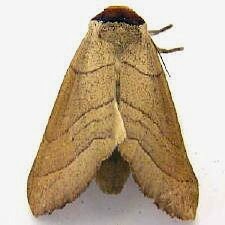
Adults are light brown moths with a wingspan of 1.5 to 2 inches. The fore wings have dark brown lines and darker in color than the hind wings. Since moths are active at night, they are seldom seen.
Pictured below is the adult Yellowneck Caterpillar moth. Photo credit goes to Bob Patterson.


Blueberry bushes are grown for their fruit. Keeping blueberry bushes healthy is key to fruit production. Blueberry bushes are susceptible to caterpillar infestations that feed on the leaves and damage the plant. Early detection and identification are important to managing these damaging pests.


  1. Types

    • The yellownecked caterpillar is found in many areas of the United States. It commonly feeds on blueberry, cherry, apple, birch, oak, witch-hazel and basswood. The yellownecked caterpillar is a voracious feeder causing extensive damage to blueberry bushes. Another leaf-feeding pest of blueberry bushes is the azalea caterpillar. This pest prefers feeding on azaleas, but has recently been discovered feeding on blueberry bushes. Azalea caterpillars often defoliate large portions of blueberry bushes before discovery.

    Identification

    • The yellownecked caterpillar has a black head capsule, orange or yellow rings around its neck and yellow lines along its sides. Long white hairs cover caterpillar that measures approximately 2 inches in length. Light-brown moths are its adult form. The azalea caterpillar is yellow with lines along is sides and a black head capsule. As this caterpillar ages, its colors brighten. Azalea caterpillars measure 2 inches in length at maturity, and its adult form is a light-brown moth.

    Effects

    • The yellownecked caterpillar young larvae skeletonize blueberry leaves, feeding together on leaves. Older yellownecked caterpillar larvae can completely defoliate a blueberry bush. Blueberry bushes with heavy infestations are stunted from feeding injury, but rarely die. The azalea caterpillar feeds on blueberry foliage, causing it to become skeletonized, dry and brittle. Young larvae skeletonize leaves, while the older larvae completely consume blueberry leaves.

    Control

    • Both the yellownecked caterpillar and the azalea caterpillar have several natural enemies that feed on them. Tachinid flies and parasitic wasps are two predatory insects that feed on caterpillars. If light infestations of caterpillars are found on blueberry bushes, remove them by hand and drop them into a bucket of soapy water. Heavy infestations are controlled with insecticidal sprays purchased at your local garden center.


Read more : http://www.ehow.com/info_8147177_caterpillars-eat-blueberry-leaves.html
At least the birds got a few blueberries off of these bushes before this invasion. 
Well, everything has to eat and we all must share in nature's bounty.
We just have to accept the cycle of life and that what eats foliage then becomes a food source for something else and the rise in the food chain continues.
yyellBlueberry bushes are grown for their fruit. Keeping blueberry bushes healthy is key to fruit production. Blueberry bushes are susceptible to caterpillar infestations that feed on the leaves and damage the plant. Early detection and identification are important to managing these damaging pests.


  1. Types

    • The yellownecked caterpillar is found in many areas of the United States. It commonly feeds on blueberry, cherry, apple, birch, oak, witch-hazel and basswood. The yellownecked caterpillar is a voracious feeder causing extensive damage to blueberry bushes. Another leaf-feeding pest of blueberry bushes is the azalea caterpillar. This pest prefers feeding on azaleas, but has recently been discovered feeding on blueberry bushes. Azalea caterpillars often defoliate large portions of blueberry bushes before discovery.

    Identification

    • The yellownecked caterpillar has a black head capsule, orange or yellow rings around its neck and yellow lines along its sides. Long white hairs cover caterpillar that measures approximately 2 inches in length. Light-brown moths are its adult form. The azalea caterpillar is yellow with lines along is sides and a black head capsule. As this caterpillar ages, its colors brighten. Azalea caterpillars measure 2 inches in length at maturity, and its adult form is a light-brown moth.

    Effects

    • The yellownecked caterpillar young larvae skeletonize blueberry leaves, feeding together on leaves. Older yellownecked caterpillar larvae can completely defoliate a blueberry bush. Blueberry bushes with heavy infestations are stunted from feeding injury, but rarely die. The azalea caterpillar feeds on blueberry foliage, causing it to become skeletonized, dry and brittle. Young larvae skeletonize leaves, while the older larvae completely consume blueberry leaves.

    Control

    • Both the yellownecked caterpillar and the azalea caterpillar have several natural enemies that feed on them. Tachinid flies and parasitic wasps are two predatory insects that feed on caterpillars. If light infestations of caterpillars are found on blueberry bushes, remove them by hand and drop them into a bucket of soapy water. Heavy infestations are controlled with insecticidal sprays purchased at your local garden center.


Read more : http://www.ehow.com/info_8147177_caterpillars-eat-blueberry-leaves.html
Blueberry bushes are grown for their fruit. Keeping blueberry bushes healthy is key to fruit production. Blueberry bushes are susceptible to caterpillar infestations that feed on the leaves and damage the plant. Early detection and identification are important to managing these damaging pests.


  1. Types

    • The yellownecked caterpillar is found in many areas of the United States. It commonly feeds on blueberry, cherry, apple, birch, oak, witch-hazel and basswood. The yellownecked caterpillar is a voracious feeder causing extensive damage to blueberry bushes. Another leaf-feeding pest of blueberry bushes is the azalea caterpillar. This pest prefers feeding on azaleas, but has recently been discovered feeding on blueberry bushes. Azalea caterpillars often defoliate large portions of blueberry bushes before discovery.

    Identification

    • The yellownecked caterpillar has a black head capsule, orange or yellow rings around its neck and yellow lines along its sides. Long white hairs cover caterpillar that measures approximately 2 inches in length. Light-brown moths are its adult form. The azalea caterpillar is yellow with lines along is sides and a black head capsule. As this caterpillar ages, its colors brighten. Azalea caterpillars measure 2 inches in length at maturity, and its adult form is a light-brown moth.

    Effects

    • The yellownecked caterpillar young larvae skeletonize blueberry leaves, feeding together on leaves. Older yellownecked caterpillar larvae can completely defoliate a blueberry bush. Blueberry bushes with heavy infestations are stunted from feeding injury, but rarely die. The azalea caterpillar feeds on blueberry foliage, causing it to become skeletonized, dry and brittle. Young larvae skeletonize leaves, while the older larvae completely consume blueberry leaves.

    Control

    • Both the yellownecked caterpillar and the azalea caterpillar have several natural enemies that feed on them. Tachinid flies and parasitic wasps are two predatory insects that feed on caterpillars. If light infestations of caterpillars are found on blueberry bushes, remove them by hand and drop them into a bucket of soapy water. Heavy infestations are controlled with insecticidal sprays purchased at your local garden center.


Read more : http://www.ehow.com/info_8147177_caterpillars-eat-blueberry-leaves.html
Blueberry bushes are grown for their fruit. Keeping blueberry bushes healthy is key to fruit production. Blueberry bushes are susceptible to caterpillar infestations that feed on the leaves and damage the plant. Early detection and identification are important to managing these damaging pests.


  1. Types

    • The yellownecked caterpillar is found in many areas of the United States. It commonly feeds on blueberry, cherry, apple, birch, oak, witch-hazel and basswood. The yellownecked caterpillar is a voracious feeder causing extensive damage to blueberry bushes. Another leaf-feeding pest of blueberry bushes is the azalea caterpillar. This pest prefers feeding on azaleas, but has recently been discovered feeding on blueberry bushes. Azalea caterpillars often defoliate large portions of blueberry bushes before discovery.

    Identification

    • The yellownecked caterpillar has a black head capsule, orange or yellow rings around its neck and yellow lines along its sides. Long white hairs cover caterpillar that measures approximately 2 inches in length. Light-brown moths are its adult form. The azalea caterpillar is yellow with lines along is sides and a black head capsule. As this caterpillar ages, its colors brighten. Azalea caterpillars measure 2 inches in length at maturity, and its adult form is a light-brown moth.

    Effects

    • The yellownecked caterpillar young larvae skeletonize blueberry leaves, feeding together on leaves. Older yellownecked caterpillar larvae can completely defoliate a blueberry bush. Blueberry bushes with heavy infestations are stunted from feeding injury, but rarely die. The azalea caterpillar feeds on blueberry foliage, causing it to become skeletonized, dry and brittle. Young larvae skeletonize leaves, while the older larvae completely consume blueberry leaves.

    Control

    • Both the yellownecked caterpillar and the azalea caterpillar have several natural enemies that feed on them. Tachinid flies and parasitic wasps are two predatory insects that feed on caterpillars. If light infestations of caterpillars are found on blueberry bushes, remove them by hand and drop them into a bucket of soapy water. Heavy infestations are controlled with insecticidal sprays purchased at your local garden center.


Read more : http://www.ehow.com/info_8147177_caterpillars-eat-blueberry-leaves.html
Blueberry bushes are grown for their fruit. Keeping blueberry bushes healthy is key to fruit production. Blueberry bushes are susceptible to caterpillar infestations that feed on the leaves and damage the plant. Early detection and identification are important to managing these damaging pests.


  1. Types

    • The yellownecked caterpillar is found in many areas of the United States. It commonly feeds on blueberry, cherry, apple, birch, oak, witch-hazel and basswood. The yellownecked caterpillar is a voracious feeder causing extensive damage to blueberry bushes. Another leaf-feeding pest of blueberry bushes is the azalea caterpillar. This pest prefers feeding on azaleas, but has recently been discovered feeding on blueberry bushes. Azalea caterpillars often defoliate large portions of blueberry bushes before discovery.

    Identification

    • The yellownecked caterpillar has a black head capsule, orange or yellow rings around its neck and yellow lines along its sides. Long white hairs cover caterpillar that measures approximately 2 inches in length. Light-brown moths are its adult form. The azalea caterpillar is yellow with lines along is sides and a black head capsule. As this caterpillar ages, its colors brighten. Azalea caterpillars measure 2 inches in length at maturity, and its adult form is a light-brown moth.

    Effects

    • The yellownecked caterpillar young larvae skeletonize blueberry leaves, feeding together on leaves. Older yellownecked caterpillar larvae can completely defoliate a blueberry bush. Blueberry bushes with heavy infestations are stunted from feeding injury, but rarely die. The azalea caterpillar feeds on blueberry foliage, causing it to become skeletonized, dry and brittle. Young larvae skeletonize leaves, while the older larvae completely consume blueberry leaves.

    Control

    • Both the yellownecked caterpillar and the azalea caterpillar have several natural enemies that feed on them. Tachinid flies and parasitic wasps are two predatory insects that feed on caterpillars. If light infestations of caterpillars are found on blueberry bushes, remove them by hand and drop them into a bucket of soapy water. Heavy infestations are controlled with insecticidal sprays purchased at your local garden center.


Read more : http://www.ehow.com/info_8147177_caterpillars-eat-blueberry-leaves.html
Blueberry bushes are grown for their fruit. Keeping blueberry bushes healthy is key to fruit production. Blueberry bushes are susceptible to caterpillar infestations that feed on the leaves and damage the plant. Early detection and identification are important to managing these damaging pests.


  1. Types

    • The yellownecked caterpillar is found in many areas of the United States. It commonly feeds on blueberry, cherry, apple, birch, oak, witch-hazel and basswood. The yellownecked caterpillar is a voracious feeder causing extensive damage to blueberry bushes. Another leaf-feeding pest of blueberry bushes is the azalea caterpillar. This pest prefers feeding on azaleas, but has recently been discovered feeding on blueberry bushes. Azalea caterpillars often defoliate large portions of blueberry bushes before discovery.

    Identification

    • The yellownecked caterpillar has a black head capsule, orange or yellow rings around its neck and yellow lines along its sides. Long white hairs cover caterpillar that measures approximately 2 inches in length. Light-brown moths are its adult form. The azalea caterpillar is yellow with lines along is sides and a black head capsule. As this caterpillar ages, its colors brighten. Azalea caterpillars measure 2 inches in length at maturity, and its adult form is a light-brown moth.

    Effects

    • The yellownecked caterpillar young larvae skeletonize blueberry leaves, feeding together on leaves. Older yellownecked caterpillar larvae can completely defoliate a blueberry bush. Blueberry bushes with heavy infestations are stunted from feeding injury, but rarely die. The azalea caterpillar feeds on blueberry foliage, causing it to become skeletonized, dry and brittle. Young larvae skeletonize leaves, while the older larvae completely consume blueberry leaves.

    Control

    • Both the yellownecked caterpillar and the azalea caterpillar have several natural enemies that feed on them. Tachinid flies and parasitic wasps are two predatory insects that feed on caterpillars. If light infestations of caterpillars are found on blueberry bushes, remove them by hand and drop them into a bucket of soapy water. Heavy infestations are controlled with insecticidal sprays purchased at your local garden center.


Read more : http://www.ehow.com/info_8147177_caterpillars-eat-blueberry-leaves.html