Meadow Muffin Gardens logo

Tuesday, July 24, 2012

Flying Flowers, the love of the Butterfly


Butterfly Haven

Hershey Gardens in Hershey Pennsylvania is the home of a magical butterfly sanctuary.

The Butterfly House is part of the children's area but with the butterflies, the bird observation area, the ABC garden and all the little extras to attract kids to the plant world, this section is a fascination at any age.

Listed below are some of the numerous types of butterfly species housed within the greenhouse type structure. The attendants for the butterflies watch over them with great care. It is very important that they don't escape so visitors are inspected before exiting for any butterflies hitching a ride. Strollers are not allowed due to space restrictions and also since the butterflies are everywhere it is easy to harm them by accidentally stepping on them. Without predators, these flying flowers float around without a care. They have food, shelter, water, warmth...what a life during their short adult life spans which averages two weeks to a few months depending on the type. Included was a display of all the various types of chrysalis' so amazingly camouflaged to look like leaves and bird droppings.


The buckeye caterpillar is part of the brushfooted family. It is found throughout most of the U.S. except for the Rocky Mt. states. It is found in open areas with low vegetation, such as along roadsides, railroads, fields and meadows. To attract them plant snapdragons as a food source for the larvae and a variety of flowers for nectar for the adults.


The julia is a subtropical butterfly from Brazil to southern Texas, Florida and Mexico. They feed on the nectar of firebush and lantana.


The malachite is a tropical butterfly widespread in Central and South America. In America, they can be found in Texas and Florida. The caterpillars feed on green shrimp-plant and the adults feed on fermenting fruit.


 Several types within Hershey's Gardens are from the swallowtail family. This family contains species that are the largest butterflies in North America. Swallowtails get their name from the "tails" on the back edge of their wings that reminded people of the forked tails of Swallows.


The tiger swallowtail butterflies can be found all throughout Alaska, Canada south through the U.S. east of the Rockies. Swallowtails favor broadleaf trees and shrubs. Birds avoid them due to a chemical in its body that makes it distasteful. Very common among gardens, farmland and meadows.


The spicebush swallowtail is such a beauty with its blue and black markings. Sassafras and Spicebush are North American natives and are the needed host plants for the caterpillars. The eyespots and big head make this caterpillar ferocious looking to predators. Adults feed on honeysuckle, butterfly bush, Joe Pye wee, zinnias and coneflowers. Birds avoid this type as well due to its foul taste.

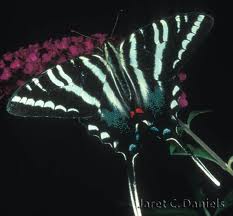


The zebra swallowtail has a favorite location around the Potomac area near Washington, D.C. and into Virginia along rivers, but they do extend westward to the Great Plains. A host plant for the eggs to be laid is the paw-paw tree. Adults dine on a variety of sources with sweet nectar. These butterflies can live for up to six months.


Another swallowtail, the eastern black swallowtail, has a range all the way west to the Rockies and then the western black swallowtail is found. Plant preferences are parsley, carrot and dill and nectar sources include phlox and milkweed. Very common among gardens and farmland but avoids wooded areas.


Viceroy butterfly
is often confused with the monarch butterfly. There is an extra black line across the viceroy's hind wings that distinguishes it from the monarch. Milkweed butterflies such as the monarch are distasteful to predators, therefore similar looking types are also avoided. Viceroys live throughout most of the U.S. and Canada. They frequent moist areas as well as open meadows seeking thistles, asters and goldenrod. The larvae eat the leaves of trees such as the aspens, poplars, willows and fruit trees.


Easy to identify because of the stripes and long wings, the zebra longwings are normally found in the south and mid-western U.S. They prefer the edge of forests. Passionflower is the sought after host plant for the larvae. The flowers are toxic but harmless to the longwings and makes them distasteful to predators. This type of butterfly can live up to three months. They are the only butterflies known to eat pollen, which is a form of protein, enabling them to live longer than living on only nectar (sugar) sources.


Being a tropical resident, the white peacock is active throughout the year. They are closely related to the buckeyes and are native to the very southern Florida and Texas areas and like wet, swampy habitats. Caterpillars feed on ruellia and water hyssop plants.


Hershey Gardens included a few moths as well. Moth larvae develop in cocoons rather than chrysalises. Moths can be distinguished from butterflies in that they are night dwellers, have heavier bodies, and have feathery antennae, whereas butterlies' are wiry with clubbed tips.


Luna
moths are widespread across the U.S. and Mexico and often can be as large as 4 inches across. With its long tail and eyespots as a distraction from its head, they can often escape predators. Luna caterpillars feed on the foliage of broad-leaved trees such as birch. As adults they do not feed at all, so only live a few days.


Looking surprisingly like a butterfly, the cecropia moth belongs to the family of silk moths. Its range extends east of the Rocky Mountains of the U.S. and southern Canada. Also known as the robin moth, this moth is the largest in North America with a wingspan of six inches. Having no mouth parts they only survive long enough to find a mate and breed, from one to two weeks. The caterpillars feed on shrubs and trees, such as dogwood, box elder, willow, sugar maple, alder, birch, and fruit trees.


About the same size wingspan as a hummingbird as well as rapidly beating its wings as it feeds, the hummingbird clearwing moth is also called sphinx moth or hawk moth. These moths can reach speeds of 30 miles per hour. Common in the eastern U.S. and Canada these moths feed on hawthorns and flower nectar during the day. Caterpillar food source include shrubs such as the viburnum. Rather than spinning a cocoon, the caterpillar digs into the soil.


I'm not sure if this type of moth was at Hershey Gardens but it frequents our area and it is so cute I had to mention it.
Its common name is Rosy Maple Moth
The habitat is deciduous forests but its eggs are laid in maple trees.
They range from Canada down to Florida over to Texas.


The many plant types throughout the butterfly house included:
Butterfly bushes, lantana, coneflowers, rubeckias, verbena, lobelia, joe-pye weed, salvia, phlox and the shrub called spicebush.
Other valuable plants include dill, fennel, nettles, butterfly weed, milkweed, aster, marigold, zinnia, tithonia and the shrub buttonbush.
Water was supplied by way of a little pond and puddling areas.
Fresh fruit was offered on plates at ground level.

A great source for more information:
Host plants for caterpillars 
Nectar plants for butterflies 


Saturday, July 21, 2012

Raspberry Pickin' to Fingertip Lickin'

Homemade Raspberry Vinegar

Memories of hay making during the heat of the summer months are a mixture of the good times of family working together and the misery of the sweat and bugs. However, it is with fond memory that we can recall taking breaks and walking the field edges looking for ripe berries. First came the black raspberries, then the red raspberries which are also known as wineberries, and the blackberries with their solid rather than hollow centers.

As children, we knew where the good spots were located along the country roads, and would peddle our bikes with our buckets clamoring from the handlebars. We knew to wear long pants even on the hottest days or we'd pay the price later with unsightly scratches and most likely poison ivy.

As adults, the days just fly by with our daily activities and unless we actually schedule a time slot to pick berries, their season is over before you know it.

Raspberry vinegar is surprisingly simple to make.
In a large saucepan, combine 4 cups white wine vinegar and 1/2 cup sugar.
Bring almost to a boil over low heat, stirring constantly, until sugar is dissolved.
Do not boil.
Have 3 cups fresh raspberries waiting in a large jar (about 6 cup capacity)
Pour the hot vinegar mixture over the berries and cover the jar with a cap.
Let the jar stand at room temperature for 48 hours.


Strain through several layers of cheesecloth into a clean bottle or jar.
Seal with a cork or lid and store in a cool dark place.
Yield is about 4 cups.


Raspberries are very healthy for you, as they are loaded with powerful phytonutrients and antioxidants necessary for a healthy immune system. Ellagic acid is an antioxidant which protects your cells from becoming damaged. Anthocyanins are powerful antioxidants that have antimicrobial properties that help fight off Candida. These flavonoid molecules are also what give raspberries their red color.

Ellagitanins are a family of compounds that are reported to have anti-cancer activity. Of all the antioxidants, these are considered the biggest contribution to their antioxidant capacity.

Raspberries are a rich source of vitamin C, manganese, riboflavin, folate, niacin, magnesium, potassium, and copper.

Raspberry vinegar is a great tasty vinegar for any salad greens combination. Especially good is a spinach salad consisting of spinach leaves, dried cranberries, almond slices, feta cheese and fresh diced apples. Topped with raspberry vinegar and olive oil and you have a very nutritious, tasty salad different from the ordinary. Enjoy!


Tuesday, July 17, 2012

Trash or Treasure? Junk or Jewels?


Losing our parents is heartbreaking enough but when faced with a deadline to clean out a house to settle the estate, it can be overwhelmingly exhausting, emotionally and physically.

Our parents were raised with the belief that to throw anything out was wasteful, that everything will have a use one day. Children of the Depression era, they knew how to make due with what they had and taught that way of living to their children. We are proud of that part of their character but now that we are suddenly faced with such an array of  treasures accumulated over a period of fifty years, it can feel like drowning, and there is the very real temptation to just heave rather than take the time to sort through everything.

 I am certainly not wasteful but in managing my own home I cannot tolerate clutter and want to live as though if we had to move quick it wouldn't be overwhelming. I rarely actually throw things out, I donate to our local thrift shop. Most of my things are secondhand anyway so rarely feel guilty when I get tired of something and subsequently come out of the thrift shop with as much as I took in. 

We already had the walk through of the home with a realtor to give us a real estate appraisal. She had so many pointers for us it made my head spin. To say we have a lot of work to do is putting it mildly. But one very important thing she made clear was to not be in too much of a hurry to throw stuff out. There will be an upcoming auction and we were told many of those things we may consider trash are a prize find to someone. People get very creative in their homes and gardens with gathering "stuff" to use as planters or in craft projects. Cooking pots, tea kettles, tea cups, flower pots, mens' work boots, baskets, even if cracked or chipped
are reused for such things as planting containers or bird baths and feeders.
 
If it was just the main rooms to sort through it wouldn't be so bad, but once you throw in the attic, basement and garage it is enough to send one over the edge. However, once we sorted through all the stuff that really was worn out trash we began to visualize the potential treasure cove. So many finds are either great for collectors, valuable as antiques or sought out by those who take vintage jewelry and clothes and repurpose them into amazing ideas of creativity. 


Pictured above are ways I took other peoples' trash and turned them into my own treasures. The wrought iron arch was brought to me by my sister who found it set out for the trash truck. The cement mushroom is really a flower pot and a bird bath stand my creative father had put together for my mother at one time years ago. The metal frog was found at a flea market and fit right in with my husbands passion for music. And the flower collection pictured below is my way of utilizing a bunch of old galvanized pots and buckets I retrieved while sorting through my parents' possessions.

The things that we've saved from the homes of our parents are not always those pieces of financial value. My mother-in-law's cross stitches are precious to me. Knowing the work that goes into needlecraft, it breaks my heart to see those pieces end up at thrift shops. Not a fly fisherman himself, my husband now treasures the beloved fly rods and hand-tied flies of his father. My own Dad had quite an assortment of tools and gadgets amassed over the years. Pocket knives, watches, favorite books, so many things that suddenly hold sentimental value. He was very creative at taking pieces from either the farm equipment or scrap yard and coming up with something very unique for the yard or garden.


So as we children approach that period in our adult lives where we are the older generation, we have attained a new level of maturity. As long as we had our parents, a part of us always felt a tad childlike in their presence. Not that they did anything to warrant that in us, but I suppose that is normal. If anything, the roles were reversed as our parents' health declined and they needed us to make decisions for their welfare.

Now aware more than ever of how our behavior appears to our own children, many deep seated issues can be put into perspective. Our parents did the best they could with what they had at the time. Whatever tensions were between parent and child should be put to rest. Everyone walks their own unique path in life and deals with things at that time. We may never understand why a person was the way they were. Not many people are an open book to be able to read the details behind their story. We are all faced with the good times and challenged with the bad. We make decisions and later deal with either the rewards or the regrets.

What I do know about our parents, and probably most people, is that their biggest fear with death is that their lives hadn't enough meaning or that their memory will be forgotten. How reassuring for them to be told that to have the blessing of being someone's son or daughter, sister or brother,  husband or wife, Mom or Dad, and finally Mom Mom or Pop Pop, there is little chance they will ever be forgotten. Their spirit lives on through every one of those lives they have touched.


Monday, July 9, 2012

Salt of the Earth


'We are tied to the ocean. And when we go back to the sea, whether it is to sail or to watch - we are going back from whence we came. "
By John F. Kennedy

Neil Shubin, a paleontologist, wrote the book "Your Inner Fish: A Journey Into A 3.5 Billion Year History Of The Human Body".

A paleontologist is a scientist who studies prehistoric life. He claims that the bodies of sea creatures are just simpler versions of our own and to understand their anatomy will cause us to rethink what it means to be human. His mother was a surgeon who had always told him that our own anatomy is unintelligible without a knowledge of its evolutionary origins. She believed all creatures are linked.
One of his discoveries was the unearthing of a fish with elbows and a neck, a long-sought evolutionary "missing link" between creatures of the sea and land-dwellers.
He explains what evolutionary science, i.e. paleontology, comparative anatomy, genetics, embryology and developmental biology have to tell us about the human body, and how it came to be the way it is.
He is careful to say that he see's science and religion in two different spheres, that he is involved in the study of DNA, not getting into the discussion of evolution vs. creation.

Interesting is the fact that the water content of our bodies is a salty water solution very similar to seawater. Below is a link to an article with interesting information as to how seawater is so very beneficial to us.

http://www.spatrade.com/spa-business/benefits-sea-water-therapy


Hippocrates, the Father of Medicine, discovered the therapeutic qualities of seawater by noticing the healing affects it had on the injured hands of fishermen. The seawater not only restricted infection risks, but patients who followed treatments involving the use of seawater found that it also promoted pain relief. It is now known that sea salt therapy is an effective treatment that assists in the rejuvenation of the cells and also induces a healthy exchange of minerals and toxins between the blood and the water.

 Thalassotherapy is the medical use of seawater as a form of therapy. It is based on the use of the ocean and its products such as salt, seaweed and mud as a means to help restore the body's natural chemical balance.  The name comes from the Greek words thalassa ("the sea") and therap ("treat").
The principle behind thalassotherapy is that repeated exposure to sea air and immersion in warm seawater, mud, clay, and protein-rich algae helps restore the body's natural chemical balance. Seawater and human plasma are very similar. When immersed in warm seawater the body absorbs the minerals it needs through the skin.

Benefits of Sea Water Therapy
1) Immune system: immunity refers to the natural healing power and defense power that is inherent to human beings. In other words, it refers to resistance against virus and bacteria, or the resistance against malignant neoplasms. This means the improvement in natural healing power and resistance serves as an important health promotion indicator.

2) Endocrine system: The endocrine system refers to adjustment of bodily functions that are critical for sustaining life.  Research revealed that thalassotherapy has a potential to recover a low responsiveness of hypothalamic-adrenal endocrine system, which is caused by stress

3) Relaxation: Effects for mind and sleep: our study on the mental changes brought by the stay in a marine environment for the thalassotherapy showed that positive psychological effects were noted such as peace of mind, vibrant life, increased energy level, stability and self control, regain of self confidence, better introspection, and improvement of response behavior against stress. As to sleeping, improvement in the quality of sleep was obtained.

4) Metabolism: Seaweed helps to balance circulation that improves oxygenation and nutrition of the connective tissues. Thus, it can be stated that seaweed: Speeds up local metabolism allowing the body's own lipolytic (fat-burning) enzymes to access fat in hard to reach places. This is characteristic of cellulite and other figure disorders where the atrophying of the connective tissue prevents proper irrigation of interstitial fluid via the Circulatory and Lymphatic Systems. Laminaria, Ascophyllum and Fucus Algae are rich in organic iodine, which stimulates metabolism.

5) Skin allergies: Sea-bathing gives an antiseptic effect to the skin and reduces histamine that causes inflammation and itching sensation. The National Pediatric Hospital, allergy section, has been giving the therapy since 1988 many successful results. The balancing effects of seaweed on circulation leave the skin's complexion radiant with an even tone and coloring.

6) Anti-inflammatory: Seaweed flushes out toxins and by-products of metabolism via the lymph system. This is valuable in the elimination of trapped fluids around the thighs, knees and ankles. White Algae, which is rich in calcium and magnesium, plays an important role in the elimination of fluids and acts as an anti-inflammatory agent.

Below are the listings for sea salt products found within Meadow Muffin Gardens!

These links will take you within the Etsy shop www.meadowmuffin2010.etsy.com but they can also be found within the Zibbet shop www.zibbet.com/meadowmuffin2010 or the website www.meadowmuffingardens.com


citrus blend bath salts

fungal fighter foot salts

bath salts/massage oil combination for cellulite 
lemon zest body salt polish

peppermint bath salts

basil/lavender/rosemary/frankincense body salt polish

ylang ylang/lavender bath salts

 lavender bath salts

 patchouli/lavender/sandalwood bath salts


mandarin cream bath salts

Salt baths are so common that we often forget the fact that "the simpler the better". A soak in warm salt water has long been used for achy joints and muscles as well as periodic detoxification. The addition of essential oils add their own therapeutic value as well as the pleasure of the aroma.

Epsom salts are not the same as regular table salt. Epsom salts are known as magnesium sulfate. Magnesium and sulfur are naturally present in sea water. Modern diets consisting of primarily processed foods are often deficient in these minerals. When you soak in a salt bath containing epsom salts your body will benefit as these minerals are absorbed through your skin.

Magnesium is important for combating stress by producing serotonin, which is a mood-elevating chemical that creates a sense of calm. By lowering the effects of adrenaline, blood pressure comes down, sleep is improved and basically the nerves and muscles function properly.

Sea salt is also different from table salt in that rather than being pure sodium chloride which is refined from mined rock salt(halite), sea salt is evaporated sea water. It still contains natural minerals.

Examples of the minerals in salt are calcium, potassium, bromides and magnesium. Calcium increases circulation and combats fluid retention. Potassium energizes the body, and bromides ease stiff muscles.

Dead sea salts originate from the Dead Sea, which is a salt lake located in the Middle East. The saline and mineral rich marshes have been used since ancient times for therapeutic and beautifying purposes.
Adding these luxurious salts to your bathing experience will help you understand why even the beautiful Cleopatra demanded rights to these mineral rich natural salts.

Being soluble in water, bath salts leave behind no residue therefore help keep your tub clean. Those of us with water softeners are aware that salt is what softens the water so it only makes sense that bath salts create soft water which enables any soap you use to clean better. And last, the addition of salt compared to a bath without salts is warmer for a longer period of time.

Enjoy!

Tuesday, June 26, 2012

Deal With The Pit Falls of Summer, Naturally


Don't let snags and set-backs result in this season becoming a bummer of a summer!
Things happen, we just have to be prepared for those unexpected occurrences that can sideline the fun. Put together an all-natural "to the rescue" kit.

Below is a list of things to be prepared for during the heat and bustle of summer activities:

1. OVERHEATING
During exertion and exposure to the summer sun and high temperatures it is important to seek methods of keeping the body hydrated and cool. The following three items feel so good to freshen-up during a hot, sweaty day. Rosewater, Herbal vinegar, and Peppermint all make wonderful body mists.

Roses contain cooling properties therefore rosewater is a wonderful thing keep on hand.
Roses contain a substantial amount of vitamin C which results in an acidic rosewater wonderful to use as a facial toner or facial mist. Fresh rose petals are allowed to infuse in distilled water under the heat of the sun and then added to refreshing witch hazel. Feels wonderful and smells great.
Rosewater facial toner 


Roses and Elderflowers can be combined with a good quality apple cider vinegar to bring you an awesome treatment for soothing sunburn or a skin balancing facial astringent. Vinegar restores the natural acid balance to the skin and also acts as an antiseptic.
Rose & Elderflower facial toner

Rose & Elderflower sunburn soother


Utilize peppermint's minty cooling sensation to bring some relief and perk up on those hot, humid days. Also helps relieve the throb of a headache often brought on by the heat.
Peppermint body spray


 2. BELLY ACHES
Peppermint has a great reputation for aiding in the relief of cramped tummy muscles and well as the headaches and nausea that often accompany motion sickness.
Peppermint tummy oil also contains the essential oils of chamomile and fennel, great aids for calming upset stomachs.
Peppermint belly massage oil


 3. POISON IVY
We are told about the rule "if 3 leaves, let it be" but still it may seem every time we work outside or go hiking we somehow brush up against this plant. Nature's antidote, jewelweed, can often be found growing nearby but if not, keep a bottle of this Jewelweed Vinegar on hand to spray onto the affected areas to help neutralize the itch of the urushiol.
Jewelweed vinegar body spray


 4. SUNBURN
Combine the cooling gel of the aloe vera plant with Lavender essential oil and you have a fantastic antiseptic and pain reducer to help nip sunburn in the bud. Applied as soon as you notice the burn and you just may avoid peeling.
Aloe & Lavender sunburn body spray


St. Johnswort, Comfrey and Lavender are wonderful for healing minor burns caused by sunburn or an accident. This balm is very healing for damaged skin but needs to be applied only after the skin has been cooled from the heat of the burn. Anything beyond a first degree should be seen by a physician.
Minor burn, sunburn salve


  5. OVEREXERTION
Weekends and vacations can be over scheduled with fun activities but overdoing it can result in muscular pain.

Rosemary has long been depended upon for relief from rheumatic and muscular pain. Used as a liniment this sharp, earthy smelling herb helps warm the muscles and increase circulation.
Rosemary herbal liniment 


Called the living medicine chest, both the leaves and roots of the comfrey plant are used to stimulate and accelerate tissue repair. Comfrey helps reduce swelling and bruising as it strenthens ligaments and tendons.
Overexertion balm


6. BUG BITES AND STINGS
Insects, bees and ticks are a part of our natural environment but we'd rather they leave us alone. Help deter them without the potential risk to yourself of bug sprays containing pesticides. There are aromatic plants in nature that insects detest and avoid. Three good ones are Yarrow, Geranium, and Plantain.

Yarrow acts as a bug deterrent and soothing for skin irritations in this alcohol based body spray. Catnip and Citronella essential oils are added for additional repelling action.
Herbal deet free insect deterrent body spray


Geranium essential oil is detested and avoided by ticks. This aromatic oil is utilized as a body spray to help keep these dreaded parasites off of your family and dogs.
Herbal tick deterrent body spray


 Plantain is amazingly efficient at neutralizing the sting of bugs and bees. It has astringent, soothing, antimicrobial properties that make it a beneficial addition to an herbal bug body spray. Plantain, Comfrey and Yarrow blend well together in this vinegar based deet free bug deterrent body spray.
Herbal vinegar bug deterrent body spray


7. ATHLETE'S FOOT

Public swimming pools, showers, bathrooms, camp facilities
all put one at risk of picking up the fungus, tinea pidas. A few good foot soaks with this salt foot bath containing anti-fungal tea tree, cooling peppermint, and healing lavender essential oils should help with this annoying condition.
Fungal Foot Salts


8. BUMPS AND BRUISES
Summer activities and the occasional boo boo are inevitable. Herbs are nature's medicine chest for aiding and healing those skinned knees and elbows, or irritating mysterious rashes. They also make great healing lip balms for the tender skin around the mouth. Calendula, Comfrey, Plantain and Chickweed are all wonderful for first aid salves and balms.
Comfrey, Calendula Healing Balm


Chickweed, Plantain, Comfrey Healing Balm


Friday, June 22, 2012

Don't Let The Garlic Scapes Escape!


Growing up my father always had a large garden, known then as a "truck patch". Yet, I don't ever remember growing garlic. Hard to imagine now since I can't imagine cooking without garlic.

Though many healing herbs can be labeled "wonder drugs", garlic deserves a special distinction. It is the second oldest medicine (after ephedra)and is even in the world's oldest surviving medical text, the Ebers Papyrus, an Egyptian medical papyrus dating to circa 1550 BC.

Before the Age of Antibiotics with the discovery of penicillin in 1928 by Alexander Fleming, garlic was relied heavily upon for the treatment of infection. The source ingredient in this wonder herb was discovered in the 1920's when researchers at Sandoz Pharmaceuticals in Switzerland isolated alliin. When garlic is chopped or chewed, the alliin comes in contact with a garlic enzyme, allinase, which transforms it into another chemical, allicin, a powerful antibiotic.

Known to reduce blood pressure, lower cholesterol, reduce the chance of blood clots, garlic's allicin and ajoene content stand the test of time for a healthy heart.
Diabetics use garlic to reduce blood sugar.
There is growing evidence that garlic can be used in the treatment of cancer.
AIDS patients can even see an improvement in immune function by taking daily galic cloves.

Those who grow hard-neck garlic know to snip off the flowering tops which encourages more energy to go to the growing bulbs beneath the ground. These tops are called scapes. They are considered a gourmet delicacy by chefs with their short 2-3 week season. By the end of June, farmer's markets have a good supply of these scapes, but since they are eagerly sought out by cooks, they soon sell out.

These young spikes have a very mild garlic flavor and can be used in any of the ways we typically use garlic. Sauteed, grilled, chopped for omelettes, chicken, fish, pizza, delicious all the way around. They can be frozen fresh for later use if desired.

If you grow your own garlic and time slips by and those scapes flower, you'll still get a good crop of garlic, though they may not be as large. The flowering tops are also edible or you can let them dry up along with the rest of the garlic leaves and then save them to plant for spring garlic greens (like scallions).

Three popular recipes to use these scapes are in a pesto, a pizza, and pickled:

GARLIC SCAPE PESTO
1/2 pound scapes chopped into 1 inch pieces
1 cup olive oil
2 cups parmesan cheese

In a blender, combine the scapes and olive oil. Pour mixture into a bowl and blend the cheese in by hand. Serve on crackers, pasta, pita, or potatoes.


GARLIC SCAPE, RICOTTA AND ZAATAR PIZZA
Toss the scapes with olive oil and sea salt and grill.
Spread ricotta cheese over a pizza dough shell.
Arrange the grilled scapes over the ricotta.
Optional is additional mozzarella or cheese of your choice.
Bake at 400 degrees for 18 - 20 minutes
Sprinkle with zaatar (a middle eastern herbal blend)


PICKLED GARLIC SCAPES
2 pounds garlic scapes
1/4 cup canning salt
2 1/2 cups vinegar
2 1/2 cups water
1 tsp. cayenne pepper, divided
4 tsp. dill seed, divided
optional is one whole cayenne pepper per quart

Trim flower pods off of the garlic scapes and chop so that they will fit in the jars. To make it easier to fill the jars, separate the straight from the curly sections.

Combine salt, vinegar and water in a large saucepot.
Bring to a boil. Pack scapes into hot jars, leaving 1/4 inch headspace
Add 1/4 tsp cayenne pepper and 1 tsp dill seed to each pint.
Ladle hot liquid over beans, leaving 1/2 inch headspace.

Remove air bubbles by dipping a chopstick around edges.
Adjust metal caps and rings.
Process pints and quarts 10 minutes in a boiling water bath canner

Yield: about 4 pints or 2 quarts

Wednesday, June 20, 2012

Summer Solstice, St Johnswort

June 21st is the summer solstice and it is time to celebrate the peak of the season with all its life and energy. click here for a neat post about summer solstice rituals and ways to use symbolism as a means to connect with the sun, the source of our light.

A solstice is when the rays of the sun directly strike one of the two tropical latitudes. There's 24 hours of daylight at the North Pole and areas north of 66°30' N, and there's 24 hours of darkness at the South Pole and areas south of 66°30' S. The equator receives twelve hours of daylight.
This marks the start of summer in the Northern Hemisphere and also their longest day of sunlight. The Southern Hemisphere begins their winter along with their shortest day of sunlight.

Traditionally the summer solstice was known as "midsummer", but our modern society now uses it as the first official day of summer.
The word solstice derives from the Latin sol sistere - "sun stand still". The sun is associated with life and the first harvest of crops has always been a reason to celebrate.

Prior to Christianity, pagan celebrations were very symbolic throughout many traditions and cultures.
Fire was seen as an honor to the sun and symbolically encouraged and strengthened it.
Stonehenge on Wiltshire has an entranceway aligned with the solstice sunrise and is a popular gathering point for modern druids and others on midsummer's day.

Shakespeare's play "A Midsummer Night's Dream" has Oberon and Titania as the fairy king and queen. Such spirits were thought to make an appearance on the solstice.

Tolkein's "Lord of the Rings" celebrates the marriage of Aragorn and Arwen in Minas Tirith on midsummer's day.

In the Christian faith, the summer solstice is close to the feast day of St. John the Baptist.
Combining the pagan and Christian celebrations was the result of the early church's attempts to put a stop to the pagan festivals. The people continued to celebrate them regardless of the church's efforts, therefore the solution was to substitute Christian meanings and Saints to the holidays and continue to celebrate them.
Therefore, the celebration of the summer solstice became the Festival of St. John the Baptist and the celebration of the winter solstice became the Festival of St. John the Evangelist.


St. Johnswort is a summer solstice-blooming yellow wildflower that blooms around June 21st here in the Northeast. The buds and flowers contain hypericin, a treasure responsible for the plants healing powers. You know you have the correct plant if the buds bleed red when squeezed.
St. Johnswort oil is used for nerve related conditions, sore muscles, abrasions and as a sunburn remedy.


St. Johnswort herbal infusions result in a wonderful red healing oil used extensively in natural remedies.

Below are three such remedies utilizing this wonderful plant.
The listings below will take you into the Etsy.com site or you can find them at http://www.meadowmuffingardens.com


Sunburn and Minor Burn Care Salve can significantly aid in healing damaged skin and help prevent the likelihood of peeling, but if you suspect your burn is deeper than first degree consult your physician before treating it yourself.

This St. Johnswort based salve is also wonderful for your pets. Not all breeds have the skin protection of thick body fur and are susceptible to sun burn. Very healing for those tender noses and ears if over exposed to the sun. Check with your veterinarian before using on cats. Essential oils can be toxic to a cat's liver if ingested.

First step is to cool the damaged skin with wet, cold compresses. Once the burn is cool, it is ok to apply applications of this soothing salve. You don't want to apply it before the skin is completely cooled or you'll be trapping in the heat. The advantage of a salve is that it stays put and provides protective coverage without needing a bandage, therefore the burn has needed exposure to the open air.

Radiation cancer treatment usually results in reddened, painful skin at the site of the exposure. The healing, anti-inflammatory properties of this herbal salve can help relieve and heal such irritation.


An herbal anti-inflammatory liniment can be very effective at relieving the swelling, discoloration and pain resulting from strains, sprains or chronic inflammatory conditions.

St. Johnswort helps you recover when your nerves are inflamed or damaged, as this herb is a nervous system relaxant.
For sore, stiff muscles, St. Johnswort acts as a cellular oxygenator that helps remove lactic acid build-up in muscles and can release nerve tension.

Herbs and essential oils work as a team to help relieve pain during the healing process of bruised and strained muscles or to help manage chronic conditions with or without the use of prescription medication.


That time of the month can easily be describes as mensus misery.  St. Johnswort infused in sweet almond oil combines with an essential oil blend for a very relaxing abdominal, back or legs massage oil to help relax the tight muscle cramping associated with PMS.