Meadow Muffin Gardens logo

Thursday, May 24, 2012

Deal With Pet Anxiety Over Fireworks, Thunderstorms

With the accessibility of  fireworks available for home use, the booming might be a little too close. The unexpected explosion of noise may send your pets scurrying with fear for the nearest place to disappear from perceived danger.

Don't overdo it with the fussing in trying to console your pet. That just sends the message that he/she has good reason to be so anxious. And never show anger or raise your voice in your own frustration over thinking you have a wimpy dog.

The best thing to do is use the power of distraction. Offer a favorite toy or perhaps one of those toys you can fill with small snacks or peanut butter; something that will take a while to eat.  Have soft music playing or just the sound of the normal atmosphere of family conversation.

Linen sprays are great to keep on hand for those times when we want our pets to calm down from fearful anxiety, whether real or imagined. Or perhaps just to settle down a high energy pet.


The Anxiety Relief, Sleep Aid Mist and Linen Spray consists of a combination of essential oils therapeutically known for their value in relaxing nervous excitability and emotional conflict.

Lavender, chamomile, sweet orange, and ylang ylang are an excellent combination for anxiety, trouble sleeping, settling down overstimulated children, and calming the fears in your dogs from such things as thunderstorms, fireworks, gunshots, and even separation anxiety.

Spray the linens of your sleeping area or pet bedding but do so sparingly at first in case you find the aromatics too strong. The spray can always be diluted by adding distilled water. Spritz a bit onto your dog's paws and massage it in to help him/her relax. Essential oils are easily absorbed by way of the feet, be it people or pets. Spritz a bit right onto the fur and give your pet a rub down. The power of touch has amazing therapeutic value.


Rescued pets have no way to actually tell us the origins of their fears and anxieties. We try to help these emotionally based behavioral disorders by offering secure, safe havens free of stress. But past traumas are buried deep and all it takes is the loud bang of gunfire, fireworks or even door slamming, to send a shaking pet under the bed. Or perhaps with your companion it is dealing with separation anxiety, and our dog exhibits inappropriate chewing, either of his own tail or paws or your home furnishings. Before relying on anti-anxiety medication, try the power of herbal remedies. Lavender and chamomile are safe for pets and are great for calming fears.


A remedy great to have on hand, though you hope never to have to use it for an emergency, is Bach Flower Rescue Remedy. It is a remedy to give in situations of shock and fear, such as in the case of an accident, or to calm down pets who getting to the veterinarian is usually a stress-filled ordeal, or for those with extreme anxiety over things like fireworks or gunfire.  It is made up of five flower essences known for their calming properties: Impatiens, Clematis, Rock Rose, Cherry Plum and Star of Bethlehem. Found at a health food store, this remedy developed by Dr. Edward Bach, should be in every first aid kit and every car glove compartment. Preventing shock at the time of an emergency can save lives. Give two to four drops on the tongue or gums every 10 - 15 minutes en route to the veterinarian.

Being prepared is the key to nip a problem situation in the bud before it escalates to the next level of stress for everyone.

Tuesday, May 22, 2012

Catnip, Entertain Kitty, Deter Mosquitoes

Catnip Kitty
Our cats are primarily kept indoors but are much more content if allowed a little time outside once in a while to enjoy a chew on some grass (unsprayed) and a romp in the herb garden's catnip.

This is a case where one species' intoxicant is another's relaxant. In people, catnip helps to soothe the digestive tract, relieve cramps and calm one down. A colicky baby can be consoled by offering a weak catnip tea from a bottle. Catnip can also help bring down a fever and help a child sleep.

If you have no reason to plant catnip for a cat's delight, plant it anyway for your own purposes. Catnip (any mint for that matter) deters pesky mosquitoes. Placed near entrance ways to your home or near outdoor seating areas, the plants should help keep biting insects out of the house.

Catnip has no history as a human intoxicant, but with felines it is another matter. All cats are attracted to the plant, buy only about two-thirds show euphoria. 

Polo in her element
Catnip is a gray-green perennial with an aromatic smell you'll soon learn to distinguish from other plants in the mint family. It grows to about 3 feet tall with a square stem and fuzzy leaves. It thrives in any well-drained soil under full sun to partial shade. Kept on the dry side produces more aromatic plants. Even though catnip won't spread like your typical mints by way of underground runners, it will pop up here and there if it finds a location to its liking. It grows in a clump so it is easy to control.

Plants that are unbroken or bruised may not hold any attraction for cats, but bruising releases the aromatic oils, and then the entire plant may be at risk for destruction. Let your cat have a little fun, the plant will bounce back.

The best time to gather the leaves and flower tops is when the plants are in bloom. What gives the plant its aroma are the essential oils, and the leaves are at their most potent when the plant is in flower. Once cut back, the plant will  regrow and bloom again a few times over the summer season. If it isn't cut back, the plant will eventually get somewhat lanky and woody.
Using a sharp shears, cut the stems down to about 3 - 4 inches above the ground. Gather the stems into small bunches and tie with a piece of twine for hanging. Hang in an airy place, such as a garage, attic or shed. Somewhere with nice circulation but not in direct sunlight, you don't want to destroy the essential oils. Once dry, strip off the leaves with your fingers, crumble and store in a tightly sealed container to keep out moisture.

Catnip is so easy to grow and one plant can supply your cat with an entire winter's supply. So grow your own for a very inexpensive, you'll know it's fresh, kitty treat. We just scatter a small pile on the floor and let the cats have a ball. Eventually the aromatics will evaporate and the cats won't bother with it any more. Then just vacuum or use a dust pan to clean it up.

Take it one step further and make little cat toys utilizing fabric scraps. Make them small enough for kitty to grab and toss around. For each toy, cut out two pieces into your desired shape, lay the printed sides together so the wrong sides face outwards. Add a few straight pins to hold them still. Hand sew with tiny stitches to avoid leakage of the plant material or machine sew all around leaving just enough of an opening to stuff in the dried herb. Turn the fabric right side out again by carefully pushing the fabric through the opening. Use a spoon to add the dried catnip. Once the catnip is inside close up the hole with additional stitches. There you go!
A moment when Pearl actually gets along with other cats

Saturday, May 19, 2012

A Canvas of Color with Container Planting

There is just something about wandering around a nursery this time of year when it is finally safe to plant shop till you drop!

Resist the temptation to just grab whatever catches your fancy. Have in mind what you want or make a list before you make the trip. Have an idea where you'll be putting these plants. Will they be in full sun or partial shade? Will they be in containers, bedding plants, window boxes?

Pictured here are ideas for container plantings. When you plan container or window box plantings, keep in mind three things: thrillers, fillers, and spillers.

 You can get creative with the arrangement utilizing various containers for your plants. Keep an eye out at farm sales or flea markets for old galvanized pots and wash tubs. I save those flexible black nursery pots that young trees come in to use inside the larger tubs. You can just fill the tub itself with potting soil and plant directly in them but realize how heavy those tubs will be to move around. Also, come the end of the season it is so much easier to just lift the smaller pots out then to try to empty the tub to store for the winter. To leave the dirt in the tub encourages the bottom to rust and eventually break through. As the plants grow and fill in the plastic pots will be hidden from view.


The plants shown in these two pictures like sun to partial shade.

This old wash tub contains four types of heat tolerant annuals requiring full sun. I used one spike and two each of the other three types.

In the center is the accent plant, Dracaena spike, a tall, upright growing, grassy annual.

Around them are Calibrachea, trailing 1 inch petunias that bloom profusely until they slowly peter out by late summer. They come in a choice of colors ranging from yellow, peach, pink and purple.

Trailing Verbena, a trailing perennial often planted as an annual can grow to 12 inches tall and 2 feet wide. The leaves are medium to dark green, ovate in shape with coarse toothed margins and grow to one inch long and half as wide. Beautiful plant as it spills over the edges of its pot, basket or over rocks. Colors options are in the red, pink and purple range.

Diamond Frost Euphorbia is a light airy plant with little white flowers great to use to fill in the gaps. Tiny, delicate leaves and flowers adorn this 12 to 18 in. plant which looks a bit like Baby's Breath.


 In addition to the Calibrachea, Verbena and Euphorbia, this arrangement includes Sweet Potato Vine, Nemesia, Lantana, Lobelia, Bidens and Nicotiana.

Lantana can tolerate neglect. If put right into the ground this butterfly, bird and hummingbird attraction will grow into shrub like proportions. In a pot you'll have to pinch and prune to keep it shapely.

Nemesia prefers a cooler climate, so once the heat of summer kicks in, blooming will decrease. Chop them back by one-third and they will bounce back. Available in a wide array of colors, they are red in the picture.

Actually a tender perennial, Lobelia looks beautiful for a while then will peter out by midsummer. You can cut it back by half and it will rebound, or you can just let the neighboring plants fill in the gaps as they grow. Lobelia prefers more shade if grown in very hot and sunny climates such as the South. Color shades range from blue to purple to pink and white. Pictured here it is blue.

Bidens is a trailing yellow flowered plant that is both heat and drought resistant. Looks great with many container plantings. Deadheading will encourage continuous bloom. In mild climates Bidens easily reseeds itself.

Sweet Potato Vine is grown for its trailing green or magenta foilage, both of which blend beautifully with other plants for container planting. These ornamental types will not produce actual sweet potatoes.

Nicotiana, or Tobacco flower, are wonderful night bloomers to attract Sphinx moths. Shown here is the smaller type not known for its scent. If you want the type with the large white tubal flowers that emit a wonderful sweet fragrance in the evening, plant N. sylvestris directly in the soil, as these are much bigger plants.


This assortment consists of aromatic cooking herbs. Great combination to have near the kitchen door. Herbs are heat and drought tolerant, requiring sun and well drained soil.

Garden oregano does best in the ground due to its size so for this arrangement I used Greek Oregano. A much smaller plant, this oregano smells as you'd expect and is perfect for snipping as needed.

There are several choices of basil. Typical Garden Basil also does best in the ground. Here we have Thai Basil which has smaller leaves, with purple stems and flowers.

Purple Sage looks great with the Thai Basil as it has a purple tinge to the leaves.

There is a difference between Marjoram and Oregano. Though similar, marjoram is actually a member of the mint family. It is considered a meat herb, complimenting many types of dishes. Marjoram is a bit sweeter than oregano.

Lemon Thyme is a favorite for those who love to add these sprigs to fish or just enjoy the citrus aroma of the leaves. There a many types of Thymes in which to choose.


Lemon Verbena is a wonderful plant for snipping the leaves to add to teas, cooking and making toiletries. For those who love lemon this plant is a favorite to just have around. It will grow into a 2 - 3 foot shrub unless pruned throughout the season.

Rosemary is a favorite woody perennial that can overwinter in cold climates if the potted plant is brought indoors. Known as the plant of remembrance these aromatic needles are loved in cooking, soapmaking as well as medicinal and cosmetic herbal treatments.

Last there is Parsley which is always handy to have nearby for cooking as well as a quick breath freshener.


Potted herbs need to be trimmed regularly or the plants get leggy and woody. Trimming helps them get bushier which is more attractive as a grouping.

For shady spots needing a splash of color, think Colelus. These attractive plants are grown for their beautiful foliage. Coleus or Painted Nettle, offer a variety of leaf shapes from smooth to deeply cut, and color from green to purple to red to white, from solid to splotched Coleus will survive in the sun but the color of the leaves is most enhanced in the shade. Small flower spikes appear in late summer. Pinch off these blooms and growing shoots of young plants to encourage bushier plants.

The center spike plants add a bit of height and are available in green or magenta. The magenta type is called Cordyline Australis and it blends very well with the other plants, though doesn't get as tall as the green type.

The trailer for this pot is known as Ipomoea or Sweet Potato Vine. Deeply veined dark magenta leaves drape over the edge.


Finally we have the old standby for easy color, Impatiens. These plants will let you know when they need water, but then quickly bounce right back. Impatiens bloom the entire season right up to frost, which turns them to mush, requiring little effort in fall clean-up.

Tuesday, May 1, 2012

The Marvels of May

When people think of Spring flowers often times they don't think about the trees and shrubs filling the air with their color and perfumes. The month of May is wonderful as everything bursts back into life and the air is filled with the buzz of insects and chatter of excited birds.


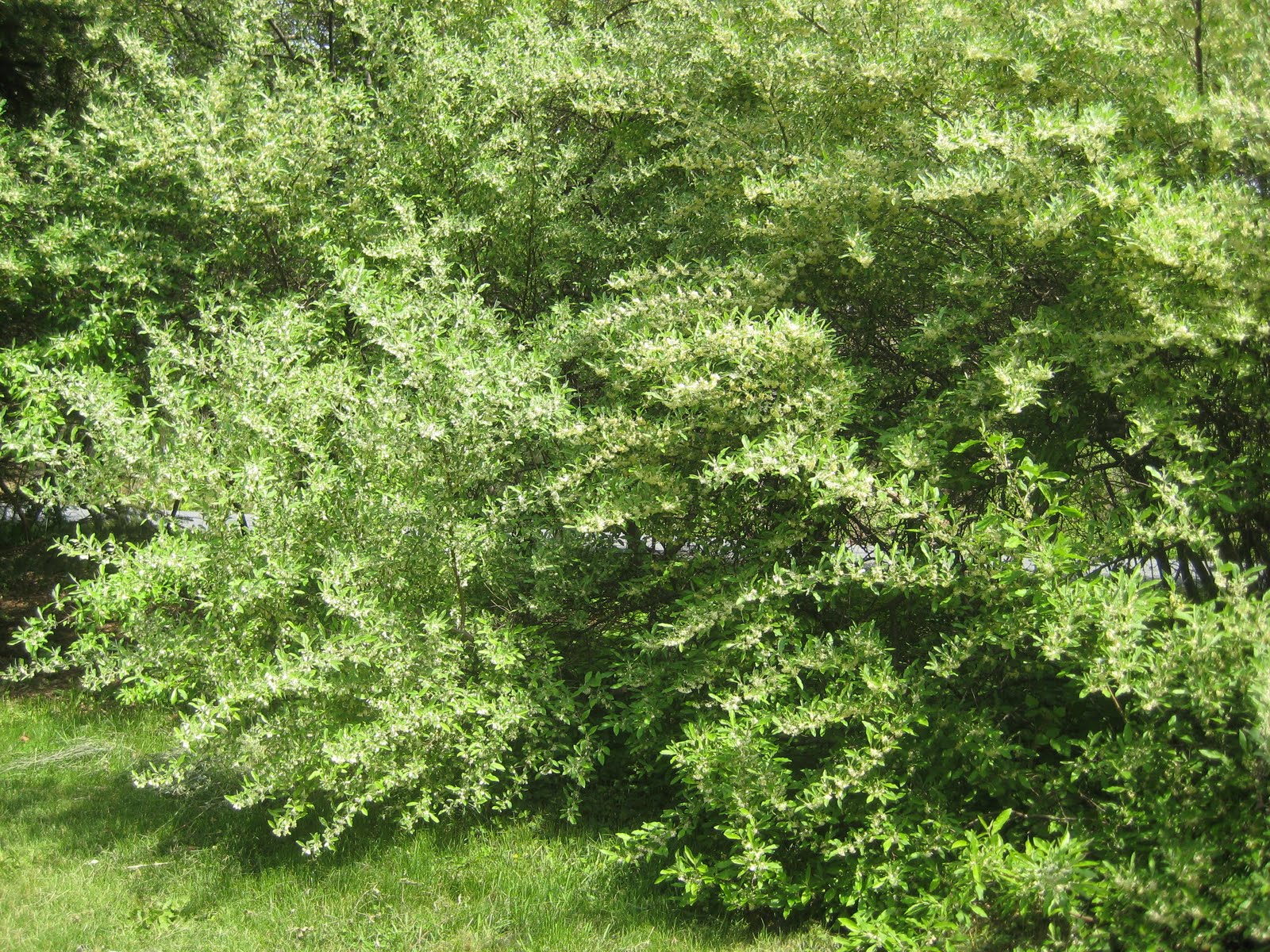
Autumn olive, Elaeagnus umbellata, is a deciduous shrub from 3-20 ft. in height. It is easily recognized by the silvery, dotted underside of the leaves. In early May, small, yellowish flowers are abundant and give off an exotic honeysuckle sweet aroma. Come September the fruits begin to ripen but are much too sour until they develop a speckled look to the red berries. Autumn olive invades old fields, woodland edges, and other disturbed areas. Autumn olive is native to China and Japan and was introduced into North America in 1830. Since then, it has been widely planted for wildlife habitat, mine reclamation, and shelterbelts. Though the Autumn Olive is ideal for a hedgerow shrub, (it grows every which way forming an intertwining safe haven of cover for wildlife and birds), it is now considered an invasive. The birds love its berries and therefore spread the seeds through their droppings. These bushes are tough, spiny to handle and hard to kill if you do want to get rid of them. If you do choose to plant this bush be aware that it will pop up elsewhere, much to the irritation of farmers.


Highbush cranberry, Viburnum trilubum, is not related to true cranberries; the name comes from its tart, edible red fruits. This northeast native grows best in sunny (does tolerate some shade), moist areas. In ideal conditions this shrub can grow 10 to 15 feet tall as well as broad.
A delight for every season, the show begins in May with dainty white flower heads that look like a delicate pinwheel. By late August the shrub is loaded with clusters of dark red berries. These are edible though very sour. They usually hang on throughout the winter supplying a great food source for winter birds. Any remaining berries are usually stripped clean in March by migrating cedar waxwings.
One of my favorites, this trouble free shrub is ideal for naturalizing. This species is hardy, doesn't outgrow its bounds, looks great as a yard specimen plant as well as out in the field for the wildlife. A visual display for every season, this shrub is a must for providing food and shelter to the birds.

Often confused with the much taller Chokecherry, the Chokeberry (Aronia arbutifolia), only grows to about 6 ft. Tolerant of poor or wet soil conditions, this deciduous shrub provides plenty; fruit for the birds, nectar for insects, cover for wildlife and multi-season beauty. Clusters of spring blooming white to pinkish flowers provide loads of nectar for pollinators. Dense clusters of glossy red fruit follow the flowers. The fruit ripens in late summer and persists through winter. The glossy foliage turns brilliant red in autumn, a wonderful visual.


The American Plum, also known as Wild Plum, (Prunus americana) are members of the Rose family and are also native to eastern and central United States. Its white, sweet blossoms emerge in early spring before the foliage breaks bud. It easily forms colonies and thickets in fields, fence rows, and along roadsides and woodland edges, where its suckers from roots and its germinated seeds create mass plantings. These small trees can reach 20 ft tall, grow best in moist, well-drained soils but do tolerate various conditions. Its fruits are sweet when fully ripe and are loved by the birds as well as those inclined to make jam.


You know it is spring when the early flowering Redbud, (Cercis canadensis), bursts into bloom with its bright pink blossoms. A relatively small tree, it has spreading brances and a small short trunk. Delightful heart shaped leaves are sure to please if you choose to plant this ornamental.
Redbud is also known as Judas-tree. According to legend, Judas Iscariot hanged himself from a branch of the European species Cercis siliquastrum.


The Cornaceae family of dogwoods has up to 110 types. The Common Dogwood, (cornus sanguinea), is a very popular ornamental planting but it is also a great understory tree grown in the wild or in naturalized settings.

There is a beautiful story about the dogwood tree being the wood used for the crucifixion of Jesus Christ. The story, generally told at Easter when the dogwoods flower, adds that Christ caused the flowers of the dogwood to be a reminder of the cross on which He died. He allegedly did this by giving the flower two long and two short petals, and to have what look like nail prints on the petals to remind us that Christ suffered on the cross with nails through His hands. The story is quite remarkable, but unfortunately the legend is not true.

“When Christ was on earth, the dogwood grew
To a towering size with a lovely hue.
Its branches were strong and interwoven,
And for Christ's cross its timbers were chosen.
“Being distressed at the use of the wood,
Christ made a promise which still holds good:
'Never again shall the dogwood grow
To be large enough for a tree, and so,
Slender and twisted it shall always be,
With cross-shaped blossoms for all to see.
“'The petals shall have bloodstains marked brown,
And in the blossom's center a thorny crown.
All who see it will think of me,
Nailed to a cross from a dogwood tree.
Protected and cherished this tree shall be,
A reflection to all of my agony.'”


Thursday, April 26, 2012

May is Lupus Awareness Month

The month of May is Lupus Awareness month, awareness about a chronic disease that affects at least 1.5 million Americans alone, 5 million worldwide, yet the majority of people know little to nothing about it. As a means to get the word out, below are a few options:
the usual textbook explanation, links to wonderful books, the link to purchase a touching movie, and a video to view on YouTube.
  
Lupus is a chronic, autoimmune disease that can damage any part of the body (skin, joints, and/or organs inside the body). Chronic means that the signs and symptoms tend to last longer than six weeks and often for many years. In lupus, something goes wrong with your immune system, which is the part of the body that fights off viruses, bacteria, and germs ("foreign invaders," like the flu). Normally our immune system produces proteins called antibodies that protect the body from these invaders. Autoimmune means your immune system cannot tell the difference between these foreign invaders and your body’s healthy tissues ("auto" means "self") and creates autoantibodies that attack and destroy healthy tissue. These autoantibodies cause inflammation, pain, and damage in various parts of the body.
  • Lupus is also a disease of flares (the symptoms worsen and you feel ill) and remissions (the symptoms improve and you feel better). Lupus can range from mild to life-threatening and should always be treated by a doctor. With good medical care, most people with lupus can lead a full life.
  • Lupus is not contagious, not even through sexual contact. You cannot "catch" lupus from someone or "give" lupus to someone.
  • Lupus is not like or related to cancer. Cancer is a condition of malignant, abnormal tissues that grow rapidly and spread into surrounding tissues. Lupus is an autoimmune disease, as described above.
  • Lupus is not like or related to HIV (Human Immune Deficiency Virus) or AIDS (Acquired Immune Deficiency Syndrome). In HIV or AIDS the immune system is underactive; in lupus, the immune system is overactive.
  • Lupus strikes mostly women of childbearing age (15-44). However, men, children, and teenagers develop lupus, too.
  •  
 Here are links to three very informative books:
Positive Options for Living with Lupus
Lupus Alternative Therapies That Work
The Sun is my Enemy

Writer/director Mark von Sternberg and producer John Casey wrote their movie, Love Simple, as a means of bringing attention to a disease that is anything but simple. Set in Brooklyn, N.Y., Mark chose to have his female lead portray a young woman in love, a young woman who also happens to have lupus. A serious autoimmune disease, lupus is so complicated that the FDA has only approved one drug to treat the disease in the last 50 years. The film takes the viewer into the lives of people struggling to seek out a future while having to deal with this haunting presence constantly interfering with their plans for a normal life.

Mark received his introduction to lupus when he was working in the nursing office in a Brooklyn, NY hospital. While there in 2003, he learned about a young patient with lupus. To his horror, she died. Fresh out of school, he wondered how he could not have heard of such a serious illness that could take the life of someone so young. He began to research lupus, discovering a mysterious disease that causes the immune system to turn from protector to betrayer. He also learned lupus causes a multitude of problems that vary from patient to patient, including some that can be managed and some that are life threatening.


Click here for a personal perspective on how this condition affects one's present life and outlook for the future for herself and her family. Very touching piece of work.

Wednesday, April 18, 2012

COPD as the New Normal, a Caregiver's Plea


The next time your loved one annoys you with the nagging about your smoking, take a moment to fast forward in time before you impatiently snap and tell that person to mind their own business.

Take a moment to consider who you will rely upon to help with the simplest of everyday tasks. Who will you call in the middle of the night or first thing in the morning when your shortness of breath causes anxiety ridden panic?  To whom will you vent when your doctor sends you home with an arsonal of inhalers, supplemental oxygen, anti-anxiety medication, and a pat on the shoulder? Who will you cry with when it fully sinks in that you will be tethered to an oxygen tank and there is no magic pill to fix it? Where will you go when you fear being left alone, can no longer drive and totally lose your independence? Which of your children will be the one with the brunt of the responsibility, who loves you dearly yet silently simmers with guilt ridden anger over this unwelcome disruption in their own busy lives? How will your loved ones handle the additional burden on their own busy schedules while maintaining their health and marital relationships?

COPD, chronic obstructive pulmonary disease, is the fourth major cause of death in the USA.
The early symptoms of chronic obstructive pulmonary disease (COPD) may be confused with asthma or acute bronchitis. They have common symptoms that many people may have felt at one time or another.
But, while the symptoms of a cold or acute bronchitis usually go away in a few days or weeks, COPD symptoms last a long time. They can make you feel as though there was a heavy weight on your chest that just won't let up.
People with COPD may experience:
  • Chest tightness
  • Shortness of breath, especially during activity
  • Persistent cough
  • Excessive mucus (phlegm)
  • Wheezing, whistling, or squeaking when you breathe
  • Trouble keeping up with your normal activities
  • Lung infections more than once a year
 When you have COPD associated with chronic bronchitis, your airways are both inflamed and constricted. The inflammation produces extra-thick mucus and narrows your airways, making it difficult to breathe. Most of the time, this is the result of a long history of smoking or breathing in other irritants such as pollutants, dust, or chemicals.

 To understand COPD it is necessary to know how the lungs work. When you breathe in, the air goes down your windpipe into tubes in your lungs - these tubes are called bronchial tubes or airways. The airways look like upside down trees or broccoli, with several branches. At the end of the branches are tiny air sacs called alveoli.

The airways and alveoli are flexible (elastic). When you breathe in they fill up with air like a balloon, when you breath out they deflate. Over time irreversible damage is done to the lungs and it becomes harder to get air into and out of the lungs.
Free radicals are produced through normal metabolism in the body, but with exposure  to the toxic chemicals in cigarettes free radicals steal healthy electrons from the lining of the lungs, thereby oxidizing lung tissue. When lung tissue is oxidized, cells break down and die.

  • The airways and alveoli become less elastic
  • The walls between many of the alveoli are destroyed
  • The walls of the airways swell up (they become inflamed)
  • The airways become clogged up with excess mucus
  • The walls between many alveoli are damaged when a patient has emphysema. This causes them to lose their shape and become floppy. As the walls become totally destroyed, the patient ends up with a few large alveoli instead of many small ones
  • In chronic obstructive bronchitis, the patient's airway lining is permanently irritated and inflamed. The lining consequently thickens. Thick mucus builds up in the airways, making it harder for the patient to breathe.
  • The majority of COPD patients suffer from both chronic obstructive bronchitis and emphysema. In such cases the term COPD is more accurate.
 If you're 40 or older with a history of smoking and have any of these symptoms for more than a few weeks, it's time to talk to your doctor about taking a breathing test for COPD. It's called spirometry and it measures the breathing capacity of the lungs.

There is no cure for COPD, but there are methods to deal with an irreversible condition that will become a person's "new normal". A progressive disease, treatment begins with various inhalers to use when needed. Eventually, it may be necessary to have home oxygen in order to keep the blood oxygen at an acceptable level. During COPD flares, steroids such as prednisone may be prescribed in an attempt to alleviate the inflammation. Continuous use of steroids carry their own risks but eventually a person has to choose between the plus side of one drug with the down side of another. We do have to breathe, which puts the focus on the now rather than worry about the long haul.
 
 As with many medical issues, people often don't change their lifestyles until faced with their own mortality by losing their health. So what is in tobacco anyway? Tobacco plants evolved the ability to make a nerve gas against insects. That ability is called nicotine, an alkaloid pesticide that plants evolved to defend themselves against insect pests.

Cigarettes are the source of many irritants and poisons such as: reactive metal fragments, ammonia fumes, the paint stripper chemical acetone, hydrogen sulfide, methane, hydrogen cyanide, nitric oxide and formaldehyde. That certainly is not an inclusive list. According to David Bodanis in his book, "The Secret House", the reason cigarettes are the source of all these is because once lit the cigarette makes them itself.  During inhalation the glowing tip of the cigarette can reach 1,700 degrees F. That heat rips the tobacco and paper compounds into their constituent parts and from those basic parts, builds them up again into the poisonous, complex chemicals we started with. This is possible because under the intense heat hydrogen and oxygen come together to form water, which then superheats into steam and condenses as it cools. The chemicals have time to form in between the puffs on the cigarette which starts that process again and again. All that is going on just inside the cigarette, the dim glow behind the red hot tip.

Now imagine what is really in that smoke stream anyone around you has no choice but to breathe. The newly created chemicals of poison clot together in extremely small balls. By the time the cigarette is burned half-way down those little hydrogen cyanide balls are falling, ready to stick to whatever or whomever they land. In addition to that, the exhalation from the smoker is spewing out ammonia, cyanide, formaldehyde and mucus constituents from the nasal lining.

According to Dr. Mehmet Oz, "Nicotine is one of the most toxic addictions-especially because of its physiological effect on the rest of the body. But the addiction itself is manifested in not only an emotional need for the drug but also a physical need; your brain tells your body it needs nicotine to prevent the symptoms of withdrawal. One reason that nicotine is addictive is that it creates pleasure in the brain, causing a feeling of relaxation. Over time, nicotine keeps your brain from supplying these chemicals that create these good feelings, and you end up craving more nicotine and the feeling it produces."

Dr. Rachel Norwood of the National Jewish Medical and Research Center in Denver, states that depression is more prevalent in people with COPD than in those with other chronic conditions. 
Aside from the understandable anxiety, and hopelessness felt in dealing with the daily fear of not being able to breath, it has been found that there is a connection between depression and smoking. That component is the nicotine. It is called the "double-barreled situation". Depressed and anxious people tend to smoke to better handle whatever is going on in their lives, smoking can cause COPD,  the damage and impairment from the disease makes a person even more depressed, which can lead to more smoking. The body craves the nicotine and a person seeking relief from the "blues" feels relief by smoking. Yet smoking only aggravates the COPD and the vicious cycle goes round and round. Once diagnosed with COPD, those people who do manage to give up the smoking habit, not only suffer from the depressing reality of their future, but also suffer from the symptoms of withdrawal.

Controlling one's anxiety is the key to dealing with life with COPD. The fear of suffocating is very real and it is so easy to go into a panic when short of breath. Patients are instructed on Pursed Lip Breathing which is to breathe through the nose and exhale slowly through pursed lips to fully empty the lungs and avoid the tendency to hyperventilate. But even so, anti-anxiety and anti-depressant medications are very often part of the treatment program. These medications have their own side effects and strain on already overburdened bodily systems, but in many situations, they are necessary just to cope.

Everyone is told not to smoke. So why do people continue with such a harmful habit?  In his book, "The Secret Family", David Bodanis claims that nicotine works on the limbic system cells in the brain. By giving a boost in self-confidence many people crave, they soon think they need the stress relief cigarettes appear to offer.  Another reason that people, especially girls, enjoy their smokes is because the nicotine slows the stomach's usual movements which diminishes an appetite. Supposedly ideal for anyone trying to stay slim or lose weight. Women don't seem to realize that their idealistic body image could become an oxygen starved, wrinkled figure with thinning bones prone to fracture. Little is more harmful for maintaining a youthful facial complexion than the damage from free radicals caused by cigarettes.

The tobacco industry understands human nature. Young people vulnerable to peer pressure and normal insecurities are at a higher risk for poor decision making. Once the addictive properties of nicotine take hold, often people smoke for years until they can finally break the habit. Truth be told, many smokers claim to actually enjoy their cigarettes. Reaching for a cigarette while under emotional stress can be like having a good friend. Only true friends don't haunt you down the road.


Thursday, April 5, 2012

Healthy Vinegars from your Plant Allies

Next time you reach for the oil and vinegar as dressing for your salad, think about a wonderful way to increase the nutritional value of that dressing. A good quality extra-virgin olive oil is the oil of choice but did you know you can turn an ordinary vinegar into an extraordinary source of minerals?

In the Wise Woman tradition ("Healing Wise" by Susan Weed), it is claimed that we can improve our health by allying ourselves with common, abundant wild plants, the weeds. Called the green allies because they can become our closest friends in terms of supplying our bodies with what we need for good metabolism, strong bones and vitality. They grow naturally, are not an agricultural crop, therefore their genetic forms have not been altered and our bodies easily recognize their chemical makeup.

One of the most amazing attributes of the plant kingdom is it's ability to extract metallic compounds (minerals) from simple dirt and rocks and, with the help of the sun, rain, and soil bacteria, transform those metallic minerals into crystalline, water-soluble forms of the same pure minerals, and in doing so, make them usable to the animal life on the planet, including humans!  The minerals in plants are water soluble therefore in a form easily absorbed by our bodies.

Herbal vinegars are a wonderful way to put up herbs for later use.  Natural vinegars, preferably raw with the mother (Bragg's vinegar is a good one), are especially effective for extracting the mineral richness of plants.  Be sure pesticide or herbicide hadn't been used on the area you choose to gather your plants. Wait until late morning after the sun has dried the night dampness and using a kitchen shears snip the leaves leaving behind the plant to regrow (if desired). You don't want to pull the whole plant out of the ground and have the mess of dirt clinging to the leaves.

When you have enough plant material to fill a mason jar spread it out on a baking sheet for an hour or so to not only dry a bit more but to give any bugs a chance to exit. Using the kitchen shears cut the leaves, stems and flowers into smaller pieces to expose more surface area to the vinegar.  Pour the vinegar over the plant material to fill the jar and cover the plant material. Using a chopstick or wooden spoon (vinegar reacts with metal so don't use a metal spoon), push down the herbs to fully mix and release air bubbles. Then top off with more vinegar. Cap tightly with a plastic lid (don't use a metal lid) and let sit  for about six weeks. The location for the jar should be somewhere you won't forget about it since the jar should be shaken daily, but in a cool spot away from exposure to direct sunlight.

By six weeks the plant material will be pretty much used up and it is ready to strain. The easiest way to strain is to put a funnel into the opening of another jar or bottle and lay cheesecloth or a metal strainer over the funnel. Then pour the vinegar through and discard the plant material. You will be left with an ideal salad dressing loaded with goodness from the plants themselves. Herbal vinegars don't have to be refrigerated but it is best to use up within a year for the greatest potency from the herbs. Besides, you will probably want to make a fresh batch every spring anyway.
Spring is an ideal time to gather your greens since the plants are young and tender and not yet bitter.  
When gathering wild plants be sure you are able to properly identify them. A good source you could use is "Identifying and Harvesting Edible and Medicinal Plants in Wild (and not so wild) Places.  Written by Steve Brill and Evelyn Dean.  Below are a few of the common plants you can find in the typical yard or garden landscape. Again don't pick unless you know the area hadn't been treated with herbicides or pesticides.
Plantain

Nettles

Chickweed

Dandelion leaves

Dandelion flower
Lamb's Quarters

Violet flowers and leaves


Chicory

Red Clover

Sorrel