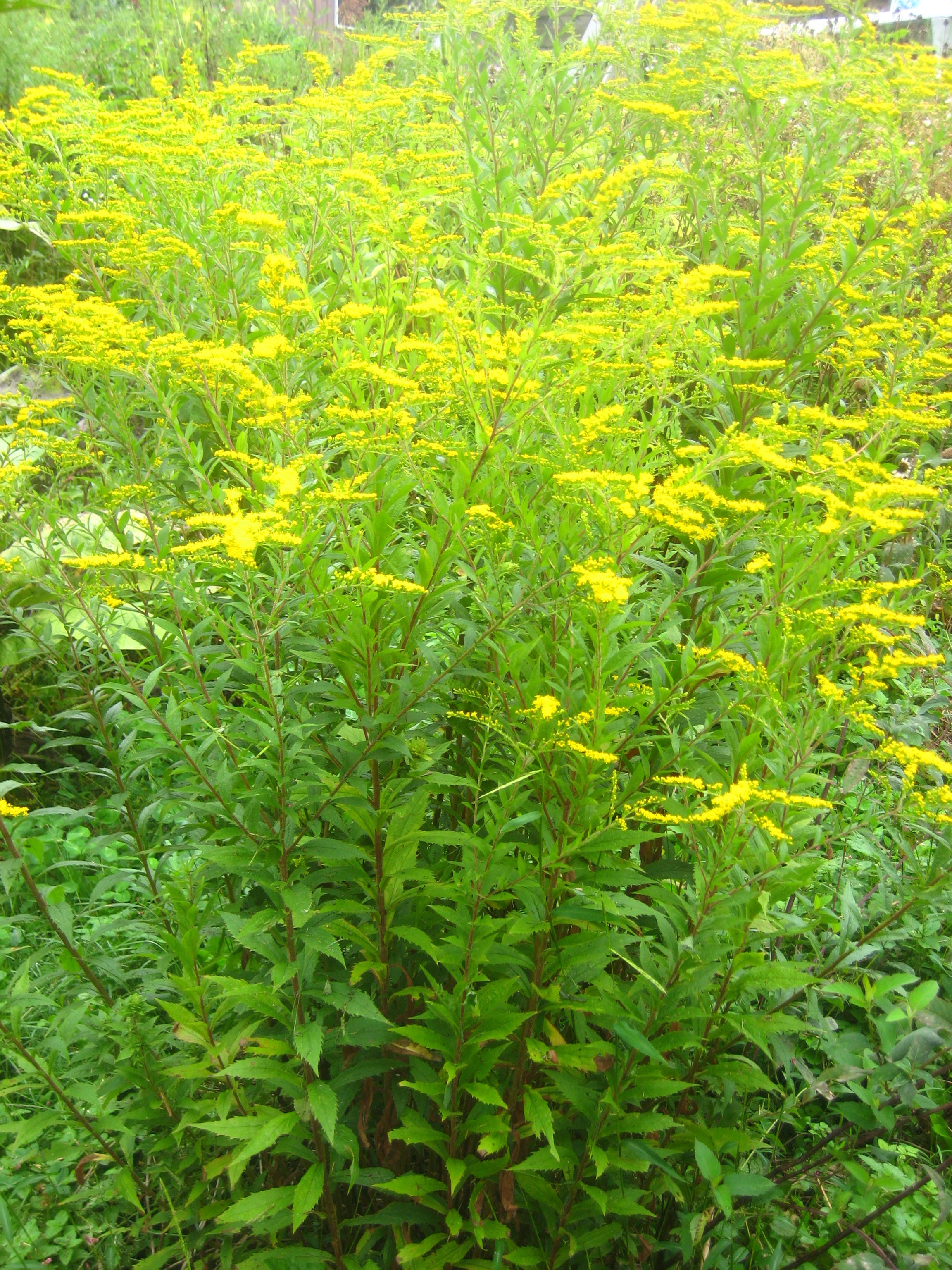
"Afire'
Willow trees are turning,
Maple leaves are burning,
Goldenrod's afire!
Fairy torches glimmer,
Woods are in a shimmer
And the flames leap higher!
November rain is all in vain
Down, down, it dashes.
O goldenrod! Goldenrod!
You've burned the woods to ashes.
Angelina W. Wray
Throughout the world, there are 125 species of goldenrod and 90 of these are found throughout North America. The top-to-bottom flowering of the spike-shaped goldenrods may be connected with their competition for attracting the attention of insects. As the autumn season progresses and flowers become sparse, the goldenrod is one of the few flowers left.
The fascinating praying mantis can often be found amidst this perennial plant. In fact, it is said that the best place to find mantis egg cases is on the dead stalks of goldenrod. This is due to the fact that goldenrod is such a magnet for many flying insects drawn by the color, scent and nectar in these small aster-like flowers.
Interesting is the fact that white-tailed deer have no desire for the taste of goldenrod, which is great since so many native plants are at risk for decimation from the overpopulation of deer.
The generic name, Solidage, means "to make whole". In the world of plant medicine goldenrod certainly has its place. The Chippewas called it gizisomukiki which means "sun medicine".
It has been used for stomach issues, kidney health, pass stones, help with nausea, heal wounds and help with bronchitis and diphtheria. The leaves were chewed to help soothe a sore throat.
The roots were made into a poultice for toothaches.
The leaves were used for teas and wine and the more aromatic species were sought after at a high price back in the 19th century.
People used to use the flowers to make yellow dyes for cloth.
For people who see this wildflower as just another weed should know that it is actually the state flower of Kentucky and Nebraska. Perhaps the fact that it is so common and grows along the roadside, in meadows and fields is why people don't appreciate it. Or it could be because it is often blamed for contributing to the misery of hay fever, when in reality it is ragweed that is the culprit. They both just happen to be in bloom at the same time.
In the 19th century, goldenrod was a symbol of the United States. It was said to symbolize a country where the people rule, for many tiny flowerets are needed to make a prefect head, just as in our country there are many races to form this wonderful nation.
"The Last Walk in Autumn"
Along the rivers summer walk,
The withered tufts of asters nod,
And trembles on its arid stalk
The hoar plume of the golden-rod
John Greenleaf Whittier
And last, for those who enjoy plant stories:
All Summer long, while other plants are flowering, goldenrod is steadily raising its single stalk towards the sky. Finally, around the middle of August the golden-yellow spires appear. Both a staff and a spire are included in the picture. It is like the tarot card showing a man walking along a road with a heavy burden upon his back, a walking staff in his hand. His head is bent down, so that he does not see a church spire rising in the distance which shows that is destination is within reach. The massage of goldenrod is to endure in order to reach the goal.
by Matthew Wood
"The Book of Herbal Wisdom"