Meadow Muffin Gardens logo
Showing posts with label May. Show all posts

Thursday, April 13, 2017

Annual Flowers for Container Gardening


By the time spring rolls around, many of us are more than ready to jump full swing into the planting season. Just don't be overly anxious and not pay attention to the end frost dates for your zone. Though we have some beautifully warm days, it is the nighttime temperatures you have to worry about. Plants that get nipped by frost may be killed outright or be stunted. If you do want to get a jump start on your plants, at least pay attention to frost warnings and cover your plants at night with a sheet to protect them.

Here in zone 6 the general rule for gardening is to wait till April 15th and for those tender annuals to wait till around Mother's Day.

Yard sales, flea markets and estate sales start up again with warmer weather and offer the perfect opportunities to take advantage of searching out inexpensive "finds" for your planting containers.
You can get creative with the arrangement utilizing various containers for your plants. Keep an eye out at farm sales or flea markets for old galvanized pots and wash tubs. I save those flexible black nursery pots that young trees come in to use inside the larger tubs. You can just fill the tub itself with potting soil and plant directly in them but realize how heavy those tubs will be to move around. Also, come the end of the season it is so much easier to just lift the smaller pots out then to try to empty the tub to store for the winter. To leave the dirt in the tub encourages the bottom to rust and eventually break through. As the plants grow and fill in the plastic pots will be hidden from view.


Though tempting to just go to the nursery and buy a little of everything, it is best to have a plan. Below are photos and a little info about several great annuals for container gardening. When you research your container or window box plantings, keep in mind three things: thrillers, fillers, and spillers.

First shown here is the African Daisy, a tough plant that can tolerate drought and poor soil. It has a profusion of brightly colored flowers all season.  Pinching early in the season encourages a bushy plant and deadheading as the season progresses encourages new growth. Full sun to partial shade. Grows to about 1 foot.
     Osteospermum or African Daisy

Ageratum or Floss Flower does well in sun to partial shade. They don't like to dry out so water regularly. Very pretty in mass plantings, these bushy flowers get anywhere from 6 to 24 inches tall, depending on their type. Pinching them back will encourage branching out and remove the spent flowers to keep them producing new flowers.

            Ageratum or Floss Flower

Lantana can tolerate neglect. If put right into the ground this butterfly, bird and hummingbird attraction will grow into shrub like proportions. In a pot you'll have to pinch and prune to keep it shapely. Preferring slightly acidic soil, pine needles added to the pot will help.

                          Lantana

Heliotrope not only smells wonderful, but is loved by hummingbirds and beneficial insects. Deer leave it alone. Prefers sun to partial shade. Will follow the sun like does the sunflower. Heat brings out the fragrance so put where it'll get the hot afternoon sun. Pinch in the spring and deadhead as the season goes along. Gets 1 - 2 ft high and wide. Heliotropes can be brought indoors over the winter.

              Heliotrope or Cherry Pie plant

Nicotiana, or Tobacco flower, are wonderful night bloomers to attract Sphinx moths. Shown here is the smaller type not known for its scent. If you want the type with the large white tubal flowers that emit a wonderful sweet fragrance in the evening, plant N. sylvestris directly in the soil, as these are much bigger plants. Tubular flowers attract hummingbirds. Prefers sun to shade and well drained soil. If ingested the plant is toxic. Reseeds easily.

           Nicotiana or Tobacco flower

Salvia blooms it spiky flowers all season, attracts butterflies and pollinators, and the deer leave it alone. Grows 1 - 2 feet tall and likes sun to partial shade. If plant looks tired by midsummer prune it back by a third.

            Salvia or Sage for some types

Nemesia prefers a cooler climate, so once the heat of summer kicks in, blooming will decrease. Chop them back by one-third and they will bounce back. Available in a wide array of colors, they are one of the fillers. Keep it well watered and cut back to keep the blooms coming.

                              Nemesia

Actually a tender perennial, Lobelia looks beautiful for a while then will peter out by midsummer. You can cut it back by half and it will rebound, or you can just let the neighboring plants fill in the gaps as they grow. Lobelia prefers more shade if grown in very hot and sunny climates such as the South. Color shades range from blue to purple to pink and white. Pictured here it is blue.

                             Lobelia

New Guinea Impatiens have beautiful foilage and flowers. They love the sun, unlike the impatiens we select for shady areas. Low maintenance flowers that reach about a foot tall and wide. Great for containers.

               New Guinea Impatiens

Calibrachea, trailing 1 inch petunias that bloom profusely until they slowly peter out by late summer. They come in a choice of colors ranging from yellow, peach, pink and purple. Keep them well watered. Like the ever popular annual petunias of which we are so familiar, these beautiful flowers prefer full sun and offer a fabulous array of color.

                        Calibrachoa

Bidens is a trailing yellow flowered plant that is both heat and drought resistant. Looks great with many container plantings. Loves the sun. Deadheading will encourage continuous bloom. In mild climates Bidens easily reseeds itself.
                               Bidens

Diamond Frost Euphorbia is a light airy plant with little white flowers great to use to fill in the gaps. Tiny, delicate leaves and flowers adorn this 12 to 18 in. plant which looks a bit like Baby's Breath.

Euphorbia

Trailing Verbena, a trailing perennial often planted as an annual can grow to 12 inches tall and 2 feet wide. The leaves are medium to dark green, ovate in shape with coarse toothed margins and grow to one inch long and half as wide. Beautiful plant as it spills over the edges of its pot, basket or over rocks. Colors options are in the red, pink and purple range.

Trailing Verbena

Bacopa is one of the spillers. It is low growing, reaching no more than 6 - 12 inches. Great for trailing over baskets or rock walls and filling in gaps under larger plants. Likes sun to partial shade.

                           Bacopa

Sweet Potato Vine is grown for its trailing green or magenta foilage, both of which blend beautifully with other plants for container planting. Does well in sun or some shade. These ornamental types will not produce actual sweet potatoes.

                         Sweet Potato Vine

Thumbergia or Black-Eyed Susan Vine is such a colorful and well-behaved trailing vine. The yellow to orange flowers with their dark brown tubular centers are interesting to look at. This plant is great when a vine is desired but not one that is overly aggressive. Does best in full sun.

Thumbergia or Black - Eyed Susan Vine

Last we have the accent plants, such as Fountain Grass, Bloodgrass or Dracaena Spikes. Planting either of these in the center of a pot can really add the height and focal point to the arrangement.
Utilizing height, filling in the gaps, and the spilling effect brings it all together.

                               Bloodgrass


                           Dracaena Spike


Thumbergia
Bacopa
Calibrachoa
Ageratum
Osteospermum
Nemesia
Heliotrope
Sweet Potato Vine
Fountain Grass
Blodgrass
Dracaena spikes
New Guinea Impatiens
Verbena
Salvia
Petunias
Euphorbia
Bidens
Lantana
Lobelia
Nicotiana


Tuesday, June 2, 2015

Butterflies and the Nettle Patch


 The reduction in butterfly sightings has been disturbing. Pesticides, herbicides, loss of their natural habitat, air and water pollution all contribute to the survival threats against these flying flowers.

Rather than feel helpless and hopeless amidst the vast problems with environmental issues, we can turn what land we have into habitat havens.                                                                                           

When you plan your flowerbeds and landscaping, try to be aware of not only how pretty are your flowers, bushes and trees, but in how environmentally beneficial they will be. Try to plant native species for your area to supply both caterpillar food sources as well as the nectar plants for the adult caterpillars. For a successful butterfly garden you have to remember to provide food sources for both the caterpillars as well as the adults. Though the butterfly bush can be a butterfly magnet, these plants are not natives, and are now discouraged for butterfly garden plantings because they can become invasive.

Stinging nettles can be a valuable food source for not only our butterflies and moths but for us as well. Stinging Nettles (Urtica dioica), a herbaceous perennial found almost worldwide is an undervalued and misunderstood plant. Many of us discovered this plant the hard way and probably cursed its very existence. Brushing up against stinging nettles results in a sting you won't soon forget. The leaves and stems are covered with brittle, hollow, silky hairs that contain three chemicals, a histimine that irritates skin, acetylcholine which causes the burning feeling and serotonin. But once one learns the plant's value and proper ways of handling it, it can become a medicinal and vegetable dish favorite. 

Nettles prefer rich, somewhat moist soil in part shade to full sun. They can be found in garden beds as well as part of the understory beneath deciduous trees like maples. They are perennials which means they die back in autumn and return in the spring. They spread through their rhizomatous roots, therefore depending where they are located you may have to keep their spread under control with either your weed trimmer or lawn mower. You don't want them growing where there is the constant risk of people brushing against their stings.

Early in the spring, when the plants are young and tender, wear gloves and cut the plants for a very nutritious boost to your diet. Nettles cannot be eaten raw, but are delicious when cooked like spinach or made into a tea. Wonderful boost for a weakened immune system, the chronically ill, and those who feel tired all the time.

 By the time summer rolls around, the nettle plants are going into flower and become too tough to be enjoyable. Some people cut them back so they regrow new tender stalks, but if not interested in that, let them alone and they'll be a welcome, important food source for the large number of caterpillars on their way to becoming our beautiful butterflies.

Lepidoptera or, in other words, butterflies and moths, is one of the most popular insect orders.
The name Lepidoptera, derived from the Greek words "lepido" for scale and "ptera" for wings, refers to the flattened hairs (scales) that cover the body and wings of most adults.

The order Lepidoptera is divided into groups. One of these groups is the group we call butterflies and all the other groups are called moths. There are over 100,000 moth species. To tell the difference between butterflies and moths, just remember a few basic facts:
Most all adult butterflies fly during the daytime and the majority of moths are only out at night (that is a generalization being there are some types of moths out during the day).
Butterflies fly much more gracefully than moths. This is because moths have a structure called the frenulum, that hooks the forewing to the hindwing. The result of that is the flight pattern is stiff and jerky. Butterflies don't have the frenulum, therefore fly with more graceful movements.
Another difference is with the antennas. Think of golf clubs to remember the look of butterfly antennas. There is a long shaft with a little club on the end. Moth antennas are either fuzzy filaments tapering to a point or have crossbars, like little TV antennas.

There are six families of butterflies found in the United States.
Each family has characteristics to help you recognize their name.
Swallowtails
These butterflies are large, have tails and are not the color orange. An exception to that rule are the parnassians who don't have tails.Very familiar is the Tiger Swallowtail, Black Swallowtail and Spicebush.

Whites and Yellows
Almost all members of this family are either white or yellow with black markings. Always on the move, they don't hang out on the same nectar source for very long. Perhaps you are familiar with the pesky white cabbageworm fluttering around your garden vegetables.
Gossamer-wings
These are small, delicate butterflies with fluted hind wings. Blues, coppers and hairstreaks are in this family.

Metalmarks
Similar to the gossamer-wings, these New World butterflies aren't very common and can be recognized by their green eyes.

Brushfoots
This family contains many of our best-known butterflies, such as the Monarchs, Mourning Cloaks, Viceroys, Fritillaries, Buckeyes, Crescents, Coma, Peacocks, Snout, Satyrs, Admirals, Emperors, Tortoiseshells and Painted Ladies. Characteristic is their front legs are reduced in size. This is due the front pair of legs ( which are much smaller than the other two pairs and so not used for walking ) being covered in tufts of hair like scales. Most color combinations are brownish, orange and black.

Skippers
Seen are likely to be a spread-wing skipper or a grass-skipper. The antennal club is hooked at the tip.  The Silverspotted skipper, a spread-wing, is a common species. The Checkered skipper is also common. These species are often difficult to tell apart.

On a side note, people often confuse swallowtail caterpillars and monarch caterpillars. First clue is that monarch caterpillars will be found on milkweed and swallowtail caterpillars are found on plants like not only nettles but fennel and dill. Here is a good post about their differences.


 Butterflies of the nettle patch are usually members of the Brushfoot family (Nymphalidae). The caterpillars depend on nettles for their growth in order to transform into the beautiful creatures we certainly don't want to see disappear. Below are a few you may see in your nettle patch.


Tortoiseshell

Hoary Comma
Red Admiral

Fritillary

Monarch

Buckeye

White Peacock

Viceroy


Wednesday, March 25, 2015

Stinging Nettles, an Herbal Pharmacy


Stinging Nettles (Urtica dioica), a herbaceous perennial found almost worldwide is an undervalued and misunderstood plant. Many of us discovered this plant the hard way and probably cursed its very existence. Brushing up against stinging nettles results in a sting you won't soon forget. The leaves and stems are covered with brittle, hollow, silky hairs that contain three chemicals, a histimine that irritates skin, acetylcholine which causes the burning feeling and serotonin. But once one learns the plant's value and proper ways of handling it, it can become a medicinal and vegetable dish favorite. 

Nettles are a foraging favorite for those seeking out the nourishing spring greens. They cannot be eaten raw, but used in tea form or cooked like spinach, you can just taste the green energy. The stingers are deactivated by cooking, steeping, or drying, but not by juicing. 


According to food forager, "Wildman" Steve Brill, this natural source of green energy is good for rebuilding the system of chronically ill people. Many of the benefits are due to the plant's very high levels of minerals, amino acids and they're 10 percent protein, more than any other vegetable. For health purposes, nettles are known as a kidney and adrenal ally, great for removing toxins from the blood, reducing inflammation, help with eczema, and are a traditional food for people with allergies. When skin and hair are a problem, nettles can come to the rescue for restoring balance and vitality. Tired all the time? Add nettles to your diet.

To gather nettles, you must wear long pants and use gloves so when you touch them you can avoid the nasty sings. Best when gathered while tender and young, April and May are the best months to cut and harvest the plant. After they flower, the leaves may be bad for the kidneys. If you cut the plants back midsummer, you will have time for another harvest before frost. Just take a hedge shears and cut down to about six inches off the ground. It will grow right back.

As with most greens, nettles will cook down a great deal, so for eating as a cooked vegetable you need to cut a large quantity. A good way to gather such an amount is to use one of those circular, collapsible, mesh hampers. Cut and toss the plants into the hamper for as little chance of skin contact as possible.

Below is a tasty recipe borrowed from Matt and Betsy who have the very informative site: DIY Natural. 

SAUTEED NETTLES WITH ONIONS AND PASTA
(makes 2 - 3 servings)

Gather 8 cups fresh stinging nettles, rinse and chop into smaller pieces
  (wear gloves when handling nettles and use tongs to rinse them)
1/2 cup spring onions
2 - 3 crushed garlic cloves
2 tbsp butter
2 tbsp bacon fat
  (Bacon adds a great taste to greens. Fry bacon and save for another time or use bacon in this recipe in place of the ham)
1/2 cup ham cubes (optional)
1 cup noodles, uncooked
salt, pepper, additional garlic powder to taste
freshly grated parmesan cheese


Boil water and cook the noodles. Strain, add a little olive oil to prevent sticking, and set aside.
Melt butter and bacon fat in large skillet. Over medium heat, saute onions and garlic gloves until soft (add garlic after onions are half cooked to avoid burning them)
Rinse the nettles in a strainer.
Using tongs, carefully add nettles to skillet with onions and garlic and saute until cooked down. 
The water clinging to the greens is all the moisture needed.
Add ham, if desired, and noodles. Toss together to combine.
Season with salt, pepper and additional garlic powder if desired and top with parmesan cheese.


Next time you are feeling run down or miserable with spring allergies, think of this delicious dish as an idea for dinner. Follow with an energy restoring cup of hot nettle tea.

For more food recipes utilizing nettles

Nettles are good for you inside and out!

 Next time you reach for the oil and vinegar as dressing for your salad, think about a wonderful way to increase the nutritional value of that dressing. A good quality extra-virgin olive oil is the oil of choice but did you know you can turn an ordinary vinegar into an extraordinary source of minerals?

In the Wise Woman tradition ("Healing Wise" by Susan Weed), it is claimed that we can improve our health by allying ourselves with common, abundant wild plants, the weeds. Called the green allies because they can become our closest friends in terms of supplying our bodies with what we need for good metabolism, strong bones and vitality. The minerals in plants are water soluble therefore in a form easily absorbed by our bodies.


Herbal vinegars are a wonderful way to put up herbs for later use.  Natural vinegars, preferably raw with the mother (Bragg's vinegar is a good one), are especially effective for extracting the mineral richness of plants.  Be sure pesticide or herbicide hadn't been used on the area you choose to gather your plants. Wait until late morning after the sun has dried the night dampness and using a kitchen shears snip the leaves leaving behind the plant to regrow (if desired). You don't want to pull the whole plant out of the ground and have the mess of dirt clinging to the leaves. Remember to use gloves when dealing with nettles.

When you have enough plant material to fill a mason jar spread it out on a baking sheet for an hour or so to not only dry a bit more but to give any bugs a chance to exit. Using the kitchen shears cut the leaves, stems and flowers into smaller pieces to expose more surface area to the vinegar.  Pour the vinegar over the plant material to fill the jar and cover the plant material. Using a chopstick or wooden spoon (vinegar reacts with metal so don't use a metal spoon), push down the herbs to fully mix and release air bubbles. Then top off with more vinegar. Cap tightly with a plastic lid (don't use a metal lid) and let sit  for about six weeks. The location for the jar should be somewhere you won't forget about it since the jar should be shaken daily, but in a cool spot away from exposure to direct sunlight.

By six weeks the plant material will be pretty much used up and it is ready to strain. The easiest way to strain is to put a funnel into the opening of another jar or bottle and lay cheesecloth or a metal strainer over the funnel. Then pour the vinegar through and discard the plant material into the compost bin if you have one. Herbal vinegars don't have to be refrigerated but it is best to use up within a year for the greatest potency from the herbs. Besides, you will probably want to make a fresh batch every spring anyway.

 Besides using your nettle vinegar on your salad, it makes for a wonderful herbal hair rinse to remove build-up of styling products and restore shine.
The addition of herbs to the vinegar allows the rinse to enhance hair color, help bring out desired highlights, and condition hair at the same time.

 Many of our hair care products are strongly alkaline and cause a dulling buildup on the hair shaft.
Healthy hair is on the mildly acidic side of the pH scale between 4.5 and 5.5. Apple cider vinegar has an acidic pH of 2.9. Apple cider vinegar rinses help to balance the pH and remove buildup, giving you a softer, shinier, easier to detangle head of hair. Rinsing will close the hair shafts resulting in a smoother surface. By closing the cuticles of the hair, light reflects off of it, which means shiny hair.


Below are two hair rinses available from the Meadow Muffin Gardens shop. These include not only nettles but other wonderful herbs known for their beneficial properties with hair and skin care.


Vinegar rinse for lighter hair
Chamomile and Calendula have long been used for home hair rinses to condition and try to keep that lovely blonde color from turning what we know as "dirty blonde".
Nettles are full of minerals, chlorophyll and antifungal properties used to prevent and treat scalp funk. Nettle is also a stimulant used to enhance hair growth.
Lemongrass and grapefruit essential oils are additional antimicrobial aides as well as offering their fresh citrus aroma.


Vinegar rinse for darker hair
Sage and Rosemary are often used to help darken greying hair and bring out auburn tones.
Sage, rosemary and nettles are a tonic for dry hair and itchy, flaky scalp. It is also said that these invigorating herbs enhance hair growth.
Basil and lavender essential oils combine for an uplifting, refreshing aroma.


Even if you have no interest in dealing with a nettle patch for food or medicinal purposes, let it alone to help out the butterflies. Members of the Nymphalidae or Brush-footed butterflies, depend on nettles for the growth of their caterpillars. Look for Red Admirals, Tortoiseshells, Peacocks, and Commas.

Nettles also make a great fertilizer for the gardener. Soaked in a bucket of water, the resulting tea once strained is great for the plants and can be used as a spray for aphids and black flies. Add chopped up nettles to the compost heap to act as a natural activator which speeds up decomposition.

For those who don't have access to the fresh plants or have no interest in dealing with it, stinging nettles can be purchased as a dried herb. Teas, cold infusions and herbal vinegars are easily made using dried stinging nettles. 


For those who suffer from hayfever, here is a delicious syrup recipe to help support the immune system so you can enjoy the joy of being outdoors. The credit for this recipe is from:


You will need:
Several large handfuls of Nettle tops (go for at least two loosely packed pints if possible)
Lemon zest and juice of one lemon
Spices if preferred – cinnamon, ginger and star anise work well.
Brown sugar – an equal amount to the resulting decoction.
At least 1 pint of water – if you have two loosely packed pints of nettle, two pints is better.

Instructions:
Check over the nettle for bugs or bird poop, and rinse them off if needed. Chop finely, discarding any discolored bits and put the finely diced herbs into a saucepan – enamel, stainless steel or glass is best, avoid aluminium as it will leech into your remedy. 

Add the two pints of water and bring the whole lot to a gentle simmer. Add the lemon zest and juice, and the spices if you wanted to add them (best to give these a bash in the mortar and pestle first as these often have a hard coating that makes it difficult for the water to get at them if they are not broken first.) Simmer the herb, spice and water mixture for at least ten minutes to extract as much goodness as possible, then take it off the heat and cool slightly.

Strain the liquid through jelly cloth and put the resulting decoction back into a pan – the spent herbs can be composted.   Add at least 500g of sugar per pint of liquid, more is better as it will preserve for longer. Honey unfortunately does not work for this kind of recipe as it just doesn’t preserve long enough when diluted with water, though if you did prefer to use honey, freeze your remedy in ice cube trays and take a cube out when needed.

 Return your pan to the heat and bring to a gentle boil, keeping a close eye on it – sugar burns very easily! Simmer gently until reduced down by about 1/5th. The consistency of the syrup should start to change about now, becoming thicker. Take off the heat and pour into clean bottles, capping whilst still hot to get a good preservative seal on the bottle.
Nettle syrup can be taken year round to support the immune system and improve the body’s ability to resist allergens in the atmosphere, ideal if you or a friend or loved one suffers from hayfever or allergies.  

Take around 10mls in the morning to build up the immune system, or a similar dose twice a day if hayfever season has already kicked in and you are feeling pretty miserable with it.   Back it up with plantain tincture or regular cups of plantain tea soothe hayfever if its already well entrenched.


 Love it or leave it, you certainly won't forget nettles once you happen to meet and greet! 

Friday, April 25, 2014

Lupus, Skin Cancer Awareness and the Ideal Sun Hat


It is that time of year when the itch to get outside gets stronger with every sunny day. 
May is Lupus Awareness Month and other than the endless question being "what is Lupus", there is very little understanding about what the sun has to do with anything.

Photosensitivity or sensitivity to ultraviolet (UV) light, is a common symptom of lupus. It can take different forms. Some people actually become ill after exposure with nausea, fatigue and headaches. Others may suffer a flare-up with arthritis, alopecia, pleurisy or mucosal ulcerations. The most common problem with UV exposure is the lupus rash. The rash may be limited to just those areas of exposure or it may pop up on different parts of the body. For more information on the effects from the sun you may be interested in this past post.

I've always adored the sun and I love the warmth of summer...as long as I have my hat. I keep an extra in my car, the truck and never go on a day trip without it. Just the idea of breaking down and having to walk without my hat is cause for anxiety because I know within five minutes of the blaring sun I'll feel "out of it" and nauseated. I can do most anything I want outside as long as I keep moving (not just sitting around) and I have the protection of a five inch brim, no baseball caps for me. However, I know better than to spend long days either at the beach or on a boat out in the water. Don't be foolish and let yourself be put in situations where you feel trapped and can't get away from the sun's intensity.

Since I'll never be able to enjoy summer activities without smashing down any type of nice hair style, the least I can do is not feel self-conscious about my head gear.
There are hundreds of sun hats out there, and I've become very selective.
First, it is a rare day when there isn't a breeze in the air, and little is more annoying than the feeling that your hat is going to blow off your head. No one wants to walk around all day with one hand holding the thing in place. So my hat of choice must have ties or a drawstring.

Second, those cheap straw hats with the loose weave are worthless for protection. A minimum sun protective rating of UPF 40+ is necessary and worth the extra money from the suppliers who offer such a thing.

Third is the size of the brim. Baseball caps offer shade on the face but won't do much else. Needed is an all around brim of 4 to 5 inches. I've tried the typical 3 inch brim and can feel the difference.

Last is the style of the hat itself. Two things about that:
First, since a hat goes wherever I go, it is nice to have a portable hat that folds. Very annoying is traveling in an airplane with a stiff hat that can't be stowed anywhere. Nice is a hat that is meant to be folded and tucked in a suitcase or totebag.
Second, forget those big floppy things. They may look sexy and flattering in pictures, but are the most annoying things to actually wear. Your peripheral vision is obliterated and you definitely lose self-confidence maneuvering in a crowd when you feel your vision is obstructed. 

So the selection is limited, but I have found sites that do carry attractive, practical sun hats for men, women and children.
The picture hats below are from wonderful companies with sun protection as their objective. The average cost is between $35 and $55 but worth it. Just like a good pair of shoes that will get worn to their bitter end.

Sun protection is certainly not just for those with a condition. Skin cancer is a very real concern for everyone of all skin types. Those little spots that turn up on the face years later probably got their start during childhood bouts with sunburn. Already sporting two little facial scars from removal of such basil cells, common sense with sun exposure is nothing to brush off in our desire for a tan or our vanity. The hat below is a favorite and is from Sunday Afternoons.


Frecklescalifornia Sun Hat

Sun Precautions Sun Hat
Coolibar Sun Hat

Tuesday, May 1, 2012

The Marvels of May

When people think of Spring flowers often times they don't think about the trees and shrubs filling the air with their color and perfumes. The month of May is wonderful as everything bursts back into life and the air is filled with the buzz of insects and chatter of excited birds.


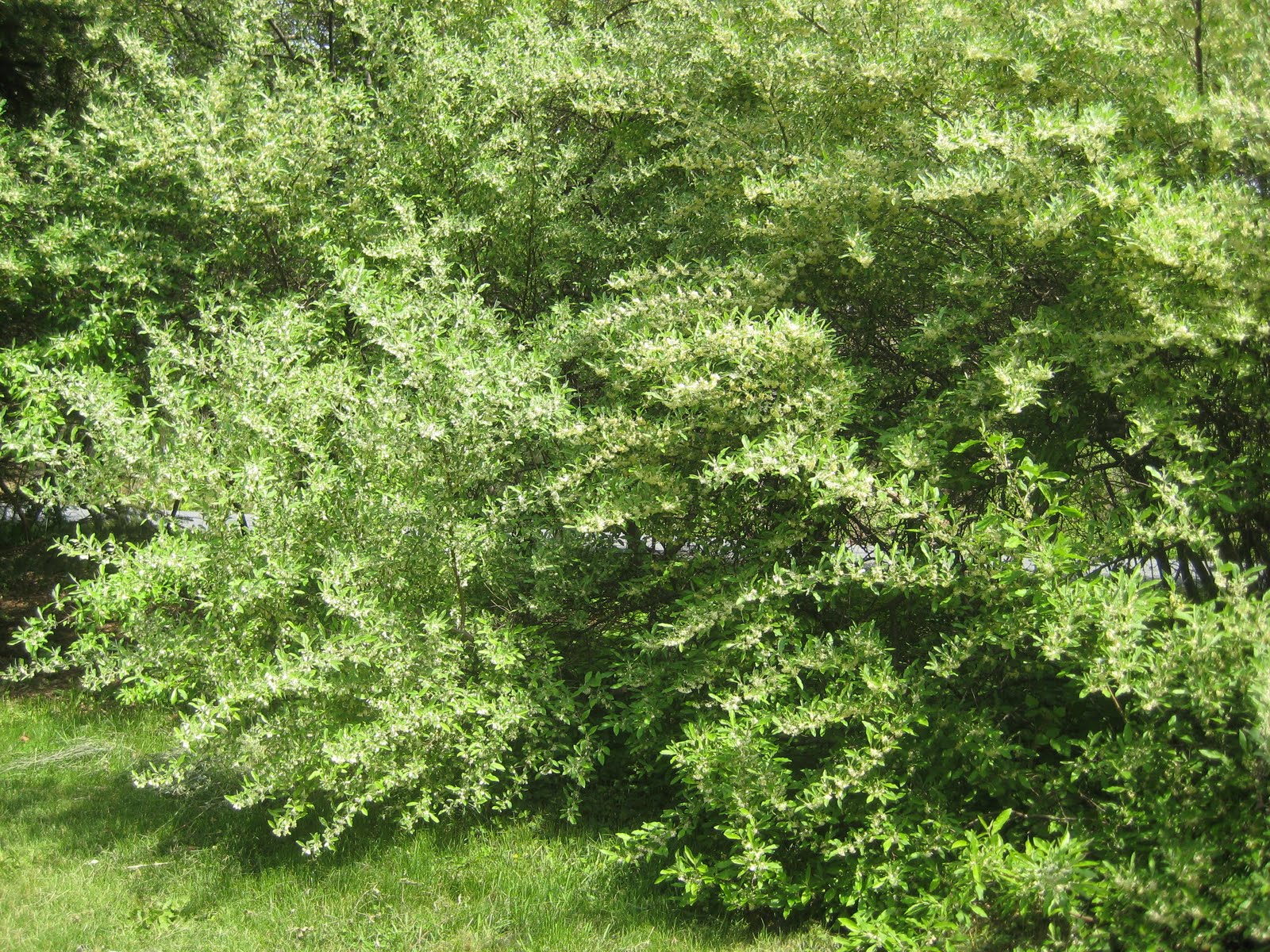
Autumn olive, Elaeagnus umbellata, is a deciduous shrub from 3-20 ft. in height. It is easily recognized by the silvery, dotted underside of the leaves. In early May, small, yellowish flowers are abundant and give off an exotic honeysuckle sweet aroma. Come September the fruits begin to ripen but are much too sour until they develop a speckled look to the red berries. Autumn olive invades old fields, woodland edges, and other disturbed areas. Autumn olive is native to China and Japan and was introduced into North America in 1830. Since then, it has been widely planted for wildlife habitat, mine reclamation, and shelterbelts. Though the Autumn Olive is ideal for a hedgerow shrub, (it grows every which way forming an intertwining safe haven of cover for wildlife and birds), it is now considered an invasive. The birds love its berries and therefore spread the seeds through their droppings. These bushes are tough, spiny to handle and hard to kill if you do want to get rid of them. If you do choose to plant this bush be aware that it will pop up elsewhere, much to the irritation of farmers.


Highbush cranberry, Viburnum trilubum, is not related to true cranberries; the name comes from its tart, edible red fruits. This northeast native grows best in sunny (does tolerate some shade), moist areas. In ideal conditions this shrub can grow 10 to 15 feet tall as well as broad.
A delight for every season, the show begins in May with dainty white flower heads that look like a delicate pinwheel. By late August the shrub is loaded with clusters of dark red berries. These are edible though very sour. They usually hang on throughout the winter supplying a great food source for winter birds. Any remaining berries are usually stripped clean in March by migrating cedar waxwings.
One of my favorites, this trouble free shrub is ideal for naturalizing. This species is hardy, doesn't outgrow its bounds, looks great as a yard specimen plant as well as out in the field for the wildlife. A visual display for every season, this shrub is a must for providing food and shelter to the birds.

Often confused with the much taller Chokecherry, the Chokeberry (Aronia arbutifolia), only grows to about 6 ft. Tolerant of poor or wet soil conditions, this deciduous shrub provides plenty; fruit for the birds, nectar for insects, cover for wildlife and multi-season beauty. Clusters of spring blooming white to pinkish flowers provide loads of nectar for pollinators. Dense clusters of glossy red fruit follow the flowers. The fruit ripens in late summer and persists through winter. The glossy foliage turns brilliant red in autumn, a wonderful visual.


The American Plum, also known as Wild Plum, (Prunus americana) are members of the Rose family and are also native to eastern and central United States. Its white, sweet blossoms emerge in early spring before the foliage breaks bud. It easily forms colonies and thickets in fields, fence rows, and along roadsides and woodland edges, where its suckers from roots and its germinated seeds create mass plantings. These small trees can reach 20 ft tall, grow best in moist, well-drained soils but do tolerate various conditions. Its fruits are sweet when fully ripe and are loved by the birds as well as those inclined to make jam.


You know it is spring when the early flowering Redbud, (Cercis canadensis), bursts into bloom with its bright pink blossoms. A relatively small tree, it has spreading brances and a small short trunk. Delightful heart shaped leaves are sure to please if you choose to plant this ornamental.
Redbud is also known as Judas-tree. According to legend, Judas Iscariot hanged himself from a branch of the European species Cercis siliquastrum.


The Cornaceae family of dogwoods has up to 110 types. The Common Dogwood, (cornus sanguinea), is a very popular ornamental planting but it is also a great understory tree grown in the wild or in naturalized settings.

There is a beautiful story about the dogwood tree being the wood used for the crucifixion of Jesus Christ. The story, generally told at Easter when the dogwoods flower, adds that Christ caused the flowers of the dogwood to be a reminder of the cross on which He died. He allegedly did this by giving the flower two long and two short petals, and to have what look like nail prints on the petals to remind us that Christ suffered on the cross with nails through His hands. The story is quite remarkable, but unfortunately the legend is not true.

“When Christ was on earth, the dogwood grew
To a towering size with a lovely hue.
Its branches were strong and interwoven,
And for Christ's cross its timbers were chosen.
“Being distressed at the use of the wood,
Christ made a promise which still holds good:
'Never again shall the dogwood grow
To be large enough for a tree, and so,
Slender and twisted it shall always be,
With cross-shaped blossoms for all to see.
“'The petals shall have bloodstains marked brown,
And in the blossom's center a thorny crown.
All who see it will think of me,
Nailed to a cross from a dogwood tree.
Protected and cherished this tree shall be,
A reflection to all of my agony.'”


Thursday, April 26, 2012

May is Lupus Awareness Month

The month of May is Lupus Awareness month, awareness about a chronic disease that affects at least 1.5 million Americans alone, 5 million worldwide, yet the majority of people know little to nothing about it. As a means to get the word out, below are a few options:
the usual textbook explanation, links to wonderful books, the link to purchase a touching movie, and a video to view on YouTube.
  
Lupus is a chronic, autoimmune disease that can damage any part of the body (skin, joints, and/or organs inside the body). Chronic means that the signs and symptoms tend to last longer than six weeks and often for many years. In lupus, something goes wrong with your immune system, which is the part of the body that fights off viruses, bacteria, and germs ("foreign invaders," like the flu). Normally our immune system produces proteins called antibodies that protect the body from these invaders. Autoimmune means your immune system cannot tell the difference between these foreign invaders and your body’s healthy tissues ("auto" means "self") and creates autoantibodies that attack and destroy healthy tissue. These autoantibodies cause inflammation, pain, and damage in various parts of the body.
  • Lupus is also a disease of flares (the symptoms worsen and you feel ill) and remissions (the symptoms improve and you feel better). Lupus can range from mild to life-threatening and should always be treated by a doctor. With good medical care, most people with lupus can lead a full life.
  • Lupus is not contagious, not even through sexual contact. You cannot "catch" lupus from someone or "give" lupus to someone.
  • Lupus is not like or related to cancer. Cancer is a condition of malignant, abnormal tissues that grow rapidly and spread into surrounding tissues. Lupus is an autoimmune disease, as described above.
  • Lupus is not like or related to HIV (Human Immune Deficiency Virus) or AIDS (Acquired Immune Deficiency Syndrome). In HIV or AIDS the immune system is underactive; in lupus, the immune system is overactive.
  • Lupus strikes mostly women of childbearing age (15-44). However, men, children, and teenagers develop lupus, too.
  •  
 Here are links to three very informative books:
Positive Options for Living with Lupus
Lupus Alternative Therapies That Work
The Sun is my Enemy

Writer/director Mark von Sternberg and producer John Casey wrote their movie, Love Simple, as a means of bringing attention to a disease that is anything but simple. Set in Brooklyn, N.Y., Mark chose to have his female lead portray a young woman in love, a young woman who also happens to have lupus. A serious autoimmune disease, lupus is so complicated that the FDA has only approved one drug to treat the disease in the last 50 years. The film takes the viewer into the lives of people struggling to seek out a future while having to deal with this haunting presence constantly interfering with their plans for a normal life.

Mark received his introduction to lupus when he was working in the nursing office in a Brooklyn, NY hospital. While there in 2003, he learned about a young patient with lupus. To his horror, she died. Fresh out of school, he wondered how he could not have heard of such a serious illness that could take the life of someone so young. He began to research lupus, discovering a mysterious disease that causes the immune system to turn from protector to betrayer. He also learned lupus causes a multitude of problems that vary from patient to patient, including some that can be managed and some that are life threatening.


Click here for a personal perspective on how this condition affects one's present life and outlook for the future for herself and her family. Very touching piece of work.

Sunday, January 29, 2012

Garden Catalogs are Here, Time to Plan


Many gardeners have been inundated with year 2016 garden catalogs during the holiday season and they've just piled up somewhere. But now that we're in the doldrums of winter, pull them out and give your spirit a boost and think ahead to spring.

Though the last frost date is a few months away, now is the time to start thinking and getting a rough idea of this year's garden plans. Hopefully you've taken notes last season on what worked and what didn't in seed and plant selection, crop rotations, and pest removal ideas.

Though you can buy what seed and plants you'll need at any Agway or farm supply store, if you're into heirloom seeds, new hybrids, or just want a great variety in which to choose, then catalogs are the answer and between now and the end of February is the time to get those orders in.

Below are a few very good gardening catalog companies. They offer a wide choice for gardeners seeking organic and heirloom seeds and plants.

THE COOK'S GARDEN
http://www.cooksgarden.com/

This company specializes in seeds and plants for gourmet gardeners. A true kitchen gardener's inspirational catalog. Not only do they offer a wonderful selection of vegetables, herbs and flower seeds and plants, they give information needed on how to grow for best results. Offered is a nice variety of lettuce types and mesclun blends, very gourmet. Tucked in are some very tasty recipes to encourage you to try new things.

THE FRAGRANT PATH
http://www.fragrantpathseeds.com/

This is a small company specializing only in seed orders. Don't expect a glossy, thick catalog. What they do is send a very personalized newsletter reflecting on their garden experiences with the seed they sell and a suggestion list of what is new. The seed isn't for the vegetable garden. Rather it is for annual, perennial, and biannual flowers, herbs, vines and flowering shrubs and trees. Great for those into fragrance or color themed flower gardens. Very quaint family company.

PINETREE GARDEN SEEDS
https://www.superseeds.com/

Pinetree Garden Seeds is a catalog with a bit of everything. They not only offer a great selection of vegetable and flower seeds, there is a section of vegetables for the cultural gardener. You can try Asian, Continental, French Italian, Latin-American, and Middle Eastern varieties. Listed are your Spring bulbs, tubers and plants such as rhubarb, asparagus and strawberries. Cover crops, sprouting seed, ornamental grasses, and herbs are all here. What is really cool is they offer such fun things such as soap making and body care supplies, gift ideas, unique books, and of course any gardening accessory or tool you may need.

TERRITORIAL SEED COMPANY
http://www.territorialseed.com/

A very well organized supply of organic, heirloom and rare plants and seeds. Each section has detailed educational information on the needs of each plant type, such as culture, disease, insects, harvest and seed specs. Loaded with what you may need in terms of natural fertilizers, irrigation, composting, disease and pest control. For those interested in preserving their harvest, there are plenty of supplies and how-to books offered. Just a wealth of information.

SEEDS OF CHANGE
http://www.seedsofchange.com

100% certified organic, this company is dedicated to help reconnect people with where their food comes from and how it is grown.  By donating organic seeds through a program called Sowing Millions Project, they've inspired many individuals to become passionate about growing their own food. Selection includes rare and heirloom seeds along with traditional, great for those into sustainable organic gardening and farming.

VERMONT BEAN SEED COMPANY
http://www.vermontbean.com

As expected, the Vermont Bean Seed Company has a variety of bean selections, but they certainly don't stop there. Catering to the consumer who seeks healthy food choices, they offer all you need for the environmentally conscious gardener. New this year is The Vermont Bean Garden Planner Software. They even offer a 30 day free trial. Based on your zip code, it becomes a personal tutorial for your own garden success.

BOUNTY BEYOND BELIEF
http://www.bbbseed.com/

BBB Seed is a small, family-owned company located in Boulder, Colorado.  They provide high quality, open-pollinated, Non-GE (genetically engineered) seed. BBB Seed specializes in wildflower seeds, pollinator mixes, native grasses and heirloom vegetable seeds. They strongly encourage heirloom seeds to avoid the common trend of mono crops where only one seed type is used to produce a worldwide crop. We now know this type of growing weakens genetic variations that can withstand emerging pathogens and climate changes.

NATIVE GARDENER'S COMPANION
http://www.nativegardeners.com

Prairie Moon Nursery presents this guide for readers of all experience levels to learn about popular native plants and seeds.  Most of the species offered are plants that had once thrived across the Upper Midwest and Northeast regions of North America. Insects are very plant-specific in their needs.  People have to realize that to attract the birds and butterflies, that includes attracting insects as well.  This catalog is perfect for those who want plants for more than just an ornamental pretty flower.

GARDENER'S SUPPLY COMPANY
http://www.gardeners.com

This is just a very fun catalog! Great for gift ideas for the gardeners on your list. This company shows you how you don't need a lot of space to enjoy a garden. Awesome ideas for container plants, bedding boxes and trellising to utilize small areas. Garden sculptures, gazing balls and bird supplies are all in there. Interested in composting or starting a worm bin, or maybe conserving water with a rain barrel?

GARDENS ALIVE
http://www.gardensalive.com

A catalog for the environmentally responsible gardener. Loaded with information and supplies on how to prepare and take care of your lawn and garden safely and responsibly. A must for the organic gardener or homeowner who desires a beautiful yet nontoxic lawn and flowerbeds.