Meadow Muffin Gardens logo
Showing posts with label shrubs. Show all posts

Saturday, August 18, 2018

The Spotted Lantern Fly, Invasive to Southeastern PA


The spotted lanternfly (Lycorma delicatula) was first detected in the U.S. in our own Berks County, PA in September of 2014. The bug established itself so quickly that by January 2018, quarantines were already in place to include portions of 13 counties. We're now in August 2018 and that quarantine has increased to 19 counties.

These insects came from Asia, notably China, Vietnam and Korea, and there are no known predators here in southeastern Pa. The Praying mantis and spiders have been seen eating them but for now the main source for control is left up to us. Any old insecticide won't do so don't just go spraying willy nilly or you'll do more harm than good. The last thing we need is to do more damage with the destruction of beneficial insects. The proper combination of chemicals are just recently being sold at garden centers.
Home methods that seem to work are a mix of dish soap and either neem oil or isopropyl alcohol. The nymphs can be killed or at least prevented from climbing into trees by wrapping the trunks with a band tape. The drawback to the bands is that it'll catch things we don't want to harm such as birds and squirrels. To help prevent that, chicken wire can be wrapped around the trunks.

An idea I recently learned about is to plant milkweed. The sap of the common milkweed is poisonous which deters predators from eating the plant, thus a means of self-defense. Since the lanternfly is new to the U.S. they do not yet know that, therefore destroy themselves. Plus, more milkweed is what we need anyway to help the plight of the monarch butterfly.

Lanternfly nymph


The favorite host tree is Ailanthus,which most of us know as the Tree of Heaven or Chinese sumac. Ailanthus (Ailanthus altissima) looks similar to smooth sumac (Rhus glabra).
Both plants have alternate compound leaves that droop but Tree-of-Heaven is a lot taller, up to 80 feet, whereas sumac grows to about 15 feet. Another way to tell the difference is through the berries. Smooth sumac has upright clusters of tiny red berries which last through the winter. Tree-of-Heaven has clusters of flat, winged seeds that also last through the winter but are yellow to green in color.

Smooth sumac

Tree-of-Heaven
Tree-of-Heaven is considered a scrap or weed tree and it is strongly encouraged that if you have them on your property, feel free to remove them. Other plants effected by the lanternfly are maple trees, poplar trees, sycamore trees, grapes, apples, blueberry, peaches, bittersweet and Virginia creeper.

As we approach the month of September, be on the lookout for egg masses and get rid of them. All smooth surfaces, not just plants, are sites for egg laying. The egg masses are easily scraped off. Patio furniture, grills and decks are all likely spots. The adult lanternflies will die by December with winter cold but the egg masses survive.


The lanternfly has devastated orchards and vineyards. The damage is from the loss of sap from stems and leaves. This reduces photosynthesis and the mess from the drippy sap promotes mold growth.
The life cycle involves four stages, from crawling to the flying stage. The first three have been found on 30 species, including oak, birch, blackgum and poison ivy. After that, the Tree of Heaven is sought out. Just crushing the nymphs is futile. Both the nymphs and adults are excellent jumpers and it is very difficult to just knock them into a jar as we can do with Japanese beetles.

By late July into August the nymphs are at the winged, flying stage and seek out the Tree-of-Heaven trees for egg laying, but any smooth surface will suffice.

Infested trees are a pitiful sight. The lanternflies suck the sap from the leaves and bark. Not all of that sugary sap is needed by the insect, therefore they excrete the extra in the form of honeydew which drips to the ground around the base of the tree. If you've ever seen this mess, it is in no better terms, gross. The bark and soil turns black and mushy and forms an actual fungal mat at the base of the tree. If you stand under the tree you can actually feel the dripping of honeydew secretions from the lanternfly activity above you. Further problems can arise since this sweet mess attracts ants, bees and hornets.

Learn all you can by contacting:
PA Department of Agriculture 
Penn State Extension offices.

Below are two videos, the first one is during the nymph stage and the second is the flying stage.


Lanternfly adult stage
view from underneath
Lanternfly with closed wings

Tuesday, November 15, 2016

Winterberry Holly, A Deciduous Native Shrub


Mention holly and most people think Christmas and holiday decorating. The image that comes to mind is the bright red berries and the glossy, pokey, evergreen foliage. But did you know there is a deciduous holly that doesn't have those glossy leaves and loses them every autumn?

The holly we are most familiar is Ilex opaca, the American Holly.
The deciduous holly is Ilex verticillata.
Both species are natives to eastern and south-central United States and very beneficial to our wildlife.

The Winterberry Holly is generally considered a wetland holly but it does grow just fine in drier soils. The difference is that in wetter soils it suckers to form a spreading thicket and in the typical garden soils it tends to be more of a clump.

 A tough, easy to grow shrub with few serious disease or insect threats, this shrub is a winner. The size ranges from a height of three to fifteen feet with a variable width as well.

There are male plants and female plants. Originally I didn't know this and only planted the one you see in the photos, so obviously there must be males around or this one wouldn't produce berries.

In the spring, Winterberry Holly produces tiny white flowers, not much to write home about. But by late summer, the slender branches are covered right to their tips with numerous berries. This photo was taken in November and you can see that the leaves are still hanging in there.


Then when the leaves do finally drop, the shrub is in it's glory all winter long.


The berries provide beautiful winter color to the landscape for months until they are finally stripped by the birds and small wildlife.
Keep in mind that though the berries provide an important food source for wildlife, they should not be eaten by humans as they are considered mildly poisonous.

Therefore, if you do cut branches of the Winterberry Holly and bring them indoors for holiday decorating, keep them out of reach of small children and pets. If the berries or leaves are ingested, they can cause vomiting and diarrhea.


Tuesday, October 4, 2016

Bluebeard Shrub, Late Summer/Fall Color Blue/Purple


For late summer to fall color, try planting the 
Bluebeard shrub or Blue Spirea
(Caryopteris clandonensis).


This non-native perennial shrub is a very well-behaved plant great for foundation planting or as part of a low hedge. It only reaches about 5 feet tall and gets about 3-4 feet wide. 
It needs about six hours of direct sunlight a day and alkaline, well-drained soil. 
The Bluebeard is a deciduous shrub meaning it loses its leaves by the season's end. 
Hardiness zones include Zones 5,6,7,8,9
The entire shrub should be cut back to about four inches from the ground in early spring. This encourages denser growth each year.
Propagate by taking softwood cuttings in the early spring.
Established plants can be divided in either spring or fall.

This beautiful bush is an attraction to both bees and butterflies.
The powder blue/purple flowers have a nice fragrance and if you rub the leaves they smell like eucalyptus.


Tuesday, March 15, 2016

Forcing Spring Twigs for a bit of Color


In a hurry for spring to arrive? Try cutting branches from flowering shrubs and force them to bloom a little early in the warmth of your home. Enjoy yellows, whites, pinks and purples!

This is a fun project to spark an interest in children to the wonder and beauty of our natural world.

During the months of February and March cut one to two foot long branches from such shrubs as:
pussy willow, dogwood, forsythia, redbud, plum, cherry, wild crab apple, apple, lilac and wisteria.
You can try tree types but shrubs tend to bloom much easier.
If you wait till March and the buds are starting to swell you'll get faster results.
Cut the branches on the diagonal.
Using a hammer, bruise the ends to allow the branches to soak up the water faster.
Put the branches in a vase and add water. Change the water every few days.

Below is a chart from the Farmer's Almanac as to the length of time you can hope to enjoy the blooms.


Buckeye5 weeks
Cherry4 weeks
Cornelian dogwood2 weeks
Crab apple4 weeks
Deutzia3 weeks
Flowering almond3 weeks
Flowering dogwood5 weeks
Flowering quince4 weeks
Forsythia1 week
Honeysuckle3 weeks
Horse chestnut5 weeks
Lilac4 weeks
Magnolia3 weeks
Pussy willow2 weeks
Red maple2 weeks
Redbud2 weeks
Red-twig dogwood5 weeks
Spicebush2 weeks
Spirea4 weeks
Wisteria3 weeks

Lilac

Red Bud
Forsythia
Crabapple
Dogwood
Pussy Willow

Monday, November 9, 2015

A bittersweet find is the Bittersweet Vine for Autumn Decor


 Gathering natural plant material for fall craft decorating ideas can be a fun and rewarding time spent outdoors. The materials are the real thing rather than craft store imitations, and cost us nothing except the time and energy to collect them. Acorns, pine cones, grapevines, milkweed pods, teasel cones and dried grasses are just some of the treasures you may discover. There is another that is a bittersweet find... the Bittersweet Vine.

Bittersweet is an ornamental climbing vine that is running rampant across the United States, strangling anything in its path that it can wrap itself around.

Celastrus orbiculatus

There are two types which look very much like. The one that is native to North America is called "American bittersweet" or "false bittersweet", Celastrus scandens. This plant has smooth stems and is well-behaved.

Celastrus scandens

The other is called "Oriental or Asian bittersweet", Celastrus orbiculatus, an exotic invasive brought over to the United States in the 1860's as an ornamental. It was purposely planted for years as a form of erosion control and for wildlife food and habitat. Discovered a little too late was that this vine literally takes over anything in its path. It looks different from the American bittersweet in that it has stems with blunt thorns and its flowers and fruits appear in small clusters along the branches where leaves are attached, whereas the American bittersweet has larger flower clusters but they are only at the branch tips.

The reasons why the Oriental bittersweet is so successful at displacing the endangered American bittersweet is because:
The bright orange/red berries are more appealing to birds who then spread the seeds around wherever the birds eliminate.
The seeds of the Oriental bittersweet have a higher germination rate than the American.
The Oriental bittersweet is better at photosynthesizing therefore grows very rapidly.


From the picture above, it is understandable why people would want to gather this plant in the fall. It's berries burst open in late September and are very pretty with the red/orange centers surrounded with the yellow skins. People like the vines for crafts for the seasonal color but also because the vines are easy to conform to almost any shape, allowing them to be a part of whatever craft project, wreath or floral arrangement in mind. 

Keep in mind two things if you are going to use them for fall decorating. Once brought indoors into warm temperatures, the flowers and fruits will eventually fall off and create a potential mess on the floor if stepped on. If used for outdoor decorating, remember that wherever the berries end up on the ground you may discover a vine growing come spring. Seeds germinate best in low light environments.It spreads by both the seeds and the sprouting roots.

The problem with Oriental bittersweet is that it doesn't distinguish among plants to climb over. It'll smother herbaceous plants on the ground as well as climb the tallest trees. 


It's sprawling growth monopolizes light and water and literally forms a canopy over shrubs and small trees, eventually becoming top-heavy and causing the tangled mess to collapse on itself. Its vines can reach four inches in diameter and as it wraps around other plants, it literally strangles them to death. 


 Yes, there are small trees under there


For light infestations the vines can be pulled or dug out by the roots and removed. Fruiting vines should be bagged and removed. To leave them lay is just going to result in the seeds resprouting. 
To deal with large, established plants, there are two ways to do it.  Cut the vines close to the ground and apply a foliar spray later when they resprout.  Or, cut the vines close to the ground and chemically treat the stumps. Cutting the vines without removing the roots or chemically treating the stems will stimulate regrowth. 
 The best time to treat is in early spring or fall when the native plants are dormant and there is much less chance they'll be affected. 
Check with your County Extension Office for advice on what herbicides are the safest to use.


Thursday, May 28, 2015

All the Buzz about Pollinators


When we think of bees, often the only ones that come to mind are honeybees, bumblebees, yellow jackets and hornets. But there are actually around 25,000 known species of bees worldwide, 4000 here in the United States. 

Buzzaboutbees offers a lot of further information about the bee world. According to this site, "These 25,000 species can be divided into over 4000 genera (types of bees) belonging within 9 groups or 'families', all under the banner - or 'Super-family' - 'Apoidea'.
Apoidea also includes 'sphecoid wasps', from which bees are believed to be descended."


The Honey Bee -(Family: Apidae)
Honey bees are classed as ‘social’ bees, as they live in colonies usually consisting of around 50,000 – 60,000 workers.


 We hear so much about colony collapse disorder that studies have been done to learn whether native pollinators can supply the pollination needed for food crops.

 While honeybees are social insects that live in large colonies, or hives, most native pollinators are solitary bees that nest in the ground or inside vegetation.

Natives pollinators can do a lot of benefit, but you can't manipulate them like honeybees. You can't throw them on a truck and move them across country to get pollination services. Native bees have evolved in a specific region and have adapted to the climate and forage of that region. Human influence on habitats have greatly affected the bees.

With so many of our crops being large monocultures, only a few weeks of abundant food is available. Baseline habitat guidelines encourage the inclusion of at least three different plant species that bloom at an given time during the growing season. In the natural scheme of things, a much greater variety of plants are available.

Harm to pollinators through pesticide use could be greatly reduced if farmers and homeowners would consider the bees before spraying. Avoiding treatments around blooming plants or areas where bees are nesting would help enormously. Or reduce harm by waiting to spray till evening when bees are less active. Of course, the best action would be to not spray at all, especially to gardeners for whom insect damage is cosmetic rather than economic.

Here are some of the pollinators we are most familiar:

Bumblebee

The Bumblebee (Family: Apidae)
Most bumblebee colonies are fairly small, from 50 to 400 workers, but usually around 120 to 200.
Bumblebees are fuzzy. There is a saying that goes, "If it's fuzzy it's friendly."  I've worked plenty with these bees just doing their thing around me amidst the flowers.
For their homes they use burrows and openings in buildings.


Digger bee
 Digger Bees and Carpenter Bees (Family: Apidae –originally, they were classified in the family ‘Anthophoridae’)
These are also solitary bees, and are good pollinators.
Digger bees usually make their nests in soil. They have hairy bodies, and can be up to 3cm long.


Carpenter bee
 Carpenter bees (Xylocopinae) are frequently a pest to homeowners who dislike the large holes they burrow into wooden eves, decks or other wooden garden structures.
Bumblebees often get mistaken for Carpenter bees. Bumblebees are fuzzy, whereas the abdomens of carpenter bees are shiny black.


Mason bee
Leafcutter and Mason bees (Family: Megachilidae)
These types of bees are solitary bees. With solitary bees, usually, a single female mates, then constructs a nest alone (though near each other) and provides for the egg cells that will become larvae.  Mason bees lay their egg within a hole and separates that egg with mud, resin, leaf bits, pebbles, or chewed up vegetation/mud. Leaf cutter bees like hollow stems and ready made holes in wood. These solitary bees typically have life spans of about 6 weeks and are active only a part of the season.


Yellow Jacket
It is incorrect to call a wasp a bee. Bees have branched hair and look fuzzy, while wasps usually have smooth single hairs or no hair at all. Wasps don't actively collect pollen, but pollinate incidentally while foraging for food. Bees actively collect pollen to feed to their offspring. Wasps hunt for bugs to feed to their offspring. The stinger in a bee is attached to the end of the digestive system. Once a bee uses that stinger it will die because the barb stays in the skin of the victim. Whereas wasps are more aggressive and can sting over and over again.

Yellow Jackets and Hornets, though they're presence is generally not appreciated, they are beneficial in that their carnivorous ways do help control the insect population.The main reason Yellow Jackets become a pest is that they are social and defensive. They are very attracted to anything sweet. Being they dwell in the ground where grass is mowed and people walk, they tend to get stirred up and irritated.
Hornets are often feared but unless the nest is in an area where there is a good chance of disturbing them, it is best to just leave them alone. Here is a good post about whether hornet nests should be disturbed. The comment section is very informative.
Wasps control many insect populations with their carnivorous ways.

Read more : http://www.ehow.com/how_4578394_difference-between-wasps-bees.html
most common are honeybees and bumblebees for the bees and paper wasps, yellowjackets and hornets for the wasps.

Read more : http://www.ehow.com/how_4578394_difference-between-wasps-bees.html

most common are honeybees and bumblebees for the bees and paper wasps, yellowjackets and hornets for the wasps.

Read more : http://www.ehow.com/how_4578394_difference-between-wasps-bees.html
Paper Wasp


Hornet


Like them or not, we need the bees! Food doesn't just appear on our tables, we have to take an interest! As with most wild creatures, leave them alone and they'll leave you alone.
Help the pollinators by providing plants that will offer food throughout the growing season. These are just a few choice selections:

Redbud, small tree, blooms in the spring


Crabapple, small tree, blooms in the spring

Carolina Rose, blooms in the spring
Ironweed, a perennial, blooms during the summer
Globe Thistle, a perennial, blooms during summer
Lamb's Ear, a perennial, blooms during summer
Lavender, a perennial, blooms during summer
Coneflowers, a perennial, blooms during the summer
Beebalm or Monarda, a perennial, blooms during the summer
Sunflowers, these are perennial Helianthus, blooms during the summer
Catmint, a perennial, blooms during the summer
Lemonbalm, a perennial, blooms during the summer
Goldenrod, a perennial, blooms in the fall

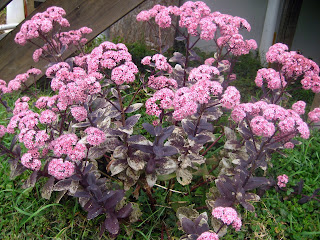
Sedum, a perennial, blooms in fall
New England Aster, blooms in the fall


To deal with pesky yellow jackets during summer outings try not to encourage them in the first place. Once picnic food has been served, cover or put away exposed food and dirty dishes. Sweet soda is going to attract wasps therefore cover the top of the can with a lid if it is going to sit around and dispose of the empty cans and bottles. Gently brush away any wasps buzzing around the table, don't swat or you'll anger them. Remember, yellow-jackets can sting over and over again if angry.

If you find a honeybee colony nesting on your property leave them alone since they are endangered and non-aggressive or call  a local beekeeper to safely remove them and relocate the nest somewhere else.

If you find a hornet or wasp nest there are a few ways to handle them. 
Worker wasps will die off with the arrival of winter, so if it is late in the season you can just use caution around the nest and leave it alone. The nest is not reused in the spring so it can be safely removed at a later time. 
Commercial sprays can be used to kill bees and wasps. If you choose this route, wait until evening when the wasps are all back in the nest and quiet. Follow the instructions on the can. If over the next few days you still see activity, repeat the spray application.
A way to get rid of the nest without using chemicals would be to wait until evening and carefully cover the nest with a plastic bag. Leave as little opening at the top as possible.and cut the branch holding the nest. Move slowly and then place the bag in the freezer or lay it in the hot sun. Either method will kill the wasps within a day or two. 

Use caution when around bee activity. They are necessary so we need to just respect their presence and be knowledgeable of their behavior.