Meadow Muffin Gardens logo
Showing posts with label spring. Show all posts

Thursday, April 13, 2017

Annual Flowers for Container Gardening


By the time spring rolls around, many of us are more than ready to jump full swing into the planting season. Just don't be overly anxious and not pay attention to the end frost dates for your zone. Though we have some beautifully warm days, it is the nighttime temperatures you have to worry about. Plants that get nipped by frost may be killed outright or be stunted. If you do want to get a jump start on your plants, at least pay attention to frost warnings and cover your plants at night with a sheet to protect them.

Here in zone 6 the general rule for gardening is to wait till April 15th and for those tender annuals to wait till around Mother's Day.

Yard sales, flea markets and estate sales start up again with warmer weather and offer the perfect opportunities to take advantage of searching out inexpensive "finds" for your planting containers.
You can get creative with the arrangement utilizing various containers for your plants. Keep an eye out at farm sales or flea markets for old galvanized pots and wash tubs. I save those flexible black nursery pots that young trees come in to use inside the larger tubs. You can just fill the tub itself with potting soil and plant directly in them but realize how heavy those tubs will be to move around. Also, come the end of the season it is so much easier to just lift the smaller pots out then to try to empty the tub to store for the winter. To leave the dirt in the tub encourages the bottom to rust and eventually break through. As the plants grow and fill in the plastic pots will be hidden from view.


Though tempting to just go to the nursery and buy a little of everything, it is best to have a plan. Below are photos and a little info about several great annuals for container gardening. When you research your container or window box plantings, keep in mind three things: thrillers, fillers, and spillers.

First shown here is the African Daisy, a tough plant that can tolerate drought and poor soil. It has a profusion of brightly colored flowers all season.  Pinching early in the season encourages a bushy plant and deadheading as the season progresses encourages new growth. Full sun to partial shade. Grows to about 1 foot.
     Osteospermum or African Daisy

Ageratum or Floss Flower does well in sun to partial shade. They don't like to dry out so water regularly. Very pretty in mass plantings, these bushy flowers get anywhere from 6 to 24 inches tall, depending on their type. Pinching them back will encourage branching out and remove the spent flowers to keep them producing new flowers.

            Ageratum or Floss Flower

Lantana can tolerate neglect. If put right into the ground this butterfly, bird and hummingbird attraction will grow into shrub like proportions. In a pot you'll have to pinch and prune to keep it shapely. Preferring slightly acidic soil, pine needles added to the pot will help.

                          Lantana

Heliotrope not only smells wonderful, but is loved by hummingbirds and beneficial insects. Deer leave it alone. Prefers sun to partial shade. Will follow the sun like does the sunflower. Heat brings out the fragrance so put where it'll get the hot afternoon sun. Pinch in the spring and deadhead as the season goes along. Gets 1 - 2 ft high and wide. Heliotropes can be brought indoors over the winter.

              Heliotrope or Cherry Pie plant

Nicotiana, or Tobacco flower, are wonderful night bloomers to attract Sphinx moths. Shown here is the smaller type not known for its scent. If you want the type with the large white tubal flowers that emit a wonderful sweet fragrance in the evening, plant N. sylvestris directly in the soil, as these are much bigger plants. Tubular flowers attract hummingbirds. Prefers sun to shade and well drained soil. If ingested the plant is toxic. Reseeds easily.

           Nicotiana or Tobacco flower

Salvia blooms it spiky flowers all season, attracts butterflies and pollinators, and the deer leave it alone. Grows 1 - 2 feet tall and likes sun to partial shade. If plant looks tired by midsummer prune it back by a third.

            Salvia or Sage for some types

Nemesia prefers a cooler climate, so once the heat of summer kicks in, blooming will decrease. Chop them back by one-third and they will bounce back. Available in a wide array of colors, they are one of the fillers. Keep it well watered and cut back to keep the blooms coming.

                              Nemesia

Actually a tender perennial, Lobelia looks beautiful for a while then will peter out by midsummer. You can cut it back by half and it will rebound, or you can just let the neighboring plants fill in the gaps as they grow. Lobelia prefers more shade if grown in very hot and sunny climates such as the South. Color shades range from blue to purple to pink and white. Pictured here it is blue.

                             Lobelia

New Guinea Impatiens have beautiful foilage and flowers. They love the sun, unlike the impatiens we select for shady areas. Low maintenance flowers that reach about a foot tall and wide. Great for containers.

               New Guinea Impatiens

Calibrachea, trailing 1 inch petunias that bloom profusely until they slowly peter out by late summer. They come in a choice of colors ranging from yellow, peach, pink and purple. Keep them well watered. Like the ever popular annual petunias of which we are so familiar, these beautiful flowers prefer full sun and offer a fabulous array of color.

                        Calibrachoa

Bidens is a trailing yellow flowered plant that is both heat and drought resistant. Looks great with many container plantings. Loves the sun. Deadheading will encourage continuous bloom. In mild climates Bidens easily reseeds itself.
                               Bidens

Diamond Frost Euphorbia is a light airy plant with little white flowers great to use to fill in the gaps. Tiny, delicate leaves and flowers adorn this 12 to 18 in. plant which looks a bit like Baby's Breath.

Euphorbia

Trailing Verbena, a trailing perennial often planted as an annual can grow to 12 inches tall and 2 feet wide. The leaves are medium to dark green, ovate in shape with coarse toothed margins and grow to one inch long and half as wide. Beautiful plant as it spills over the edges of its pot, basket or over rocks. Colors options are in the red, pink and purple range.

Trailing Verbena

Bacopa is one of the spillers. It is low growing, reaching no more than 6 - 12 inches. Great for trailing over baskets or rock walls and filling in gaps under larger plants. Likes sun to partial shade.

                           Bacopa

Sweet Potato Vine is grown for its trailing green or magenta foilage, both of which blend beautifully with other plants for container planting. Does well in sun or some shade. These ornamental types will not produce actual sweet potatoes.

                         Sweet Potato Vine

Thumbergia or Black-Eyed Susan Vine is such a colorful and well-behaved trailing vine. The yellow to orange flowers with their dark brown tubular centers are interesting to look at. This plant is great when a vine is desired but not one that is overly aggressive. Does best in full sun.

Thumbergia or Black - Eyed Susan Vine

Last we have the accent plants, such as Fountain Grass, Bloodgrass or Dracaena Spikes. Planting either of these in the center of a pot can really add the height and focal point to the arrangement.
Utilizing height, filling in the gaps, and the spilling effect brings it all together.

                               Bloodgrass


                           Dracaena Spike


Thumbergia
Bacopa
Calibrachoa
Ageratum
Osteospermum
Nemesia
Heliotrope
Sweet Potato Vine
Fountain Grass
Blodgrass
Dracaena spikes
New Guinea Impatiens
Verbena
Salvia
Petunias
Euphorbia
Bidens
Lantana
Lobelia
Nicotiana


Monday, February 27, 2017

Tea Garden...It's What the Doctor Ordered


Themed herb gardens can be a lot of fun and many of these plants are not only suitable for a tea garden, but are also right at home in a kitchen theme, cosmetic theme or medicinal theme.

Most of us have only ever had tea from dried plants. Think how good it could be if picked fresh from your own backyard! Below are some ideal plants to get to know as they grow and it'll soon become apparent why people develop such a connection with their gardens. There is a certain pride in the nurturing, harvesting, storing and utilizing your own food, and knowing the conditions and quality of the plants makes it all the more satisfying.


Chamomile
For many, the introduction into the world of herbs all started with the famous children's book, The Tale of Peter Rabbit by Beatrix Potter. Most mother's can relate with how to handle mischievous children who don't listen and then come whimpering to Mom when hurting or upset. Mama rabbit simply put her little bunny to bed with a cup of chamomile tea and let him reflect on his lesson learned after such an adventurous day.

Be it frazzled nerves or an upset tummy, chamomile tea was the best remedy to calm both conditions at the same time. Better yet, chamomile tea lulled little Peter Rabbit into the la la land of sleep.
Much of chamomile's medicinal effects are targeted toward the digestive tract and the nervous system.


Chamomile tea can be a godsend for parents pacing the floor with a colicky baby. The build-up of intestinal gas is very painful. Just a teaspoon of cooled chamomile tea given every ten minutes can relieve a baby's misery amazingly fast. Catnip and lemon balm are two other wonderful herbs safe for babies.

Combine a hot water bottle placed over the lower abdomen and sipping chamomile tea every 15 minutes for a sure relief from those dreaded PMS menstrual cramps. 

Be it a child or an adult, everyone has occasional trouble falling asleep. A cup of chamomile tea with a spoonful of honey can become a nightly ritual to look forward to in readiness for bed. The nerve relaxing properties of this herb are wonderful for settling down overtired children and the cluttered minds of over stressed adults.

Growing your own chamomile is fairly easy. Chamomile is an annual which once it is planted and gets established, it will pop up on its own every year. The flowers are the parts collected and if you harvest on a regular basis during the growing season the flowers will continue before finally going to seed.


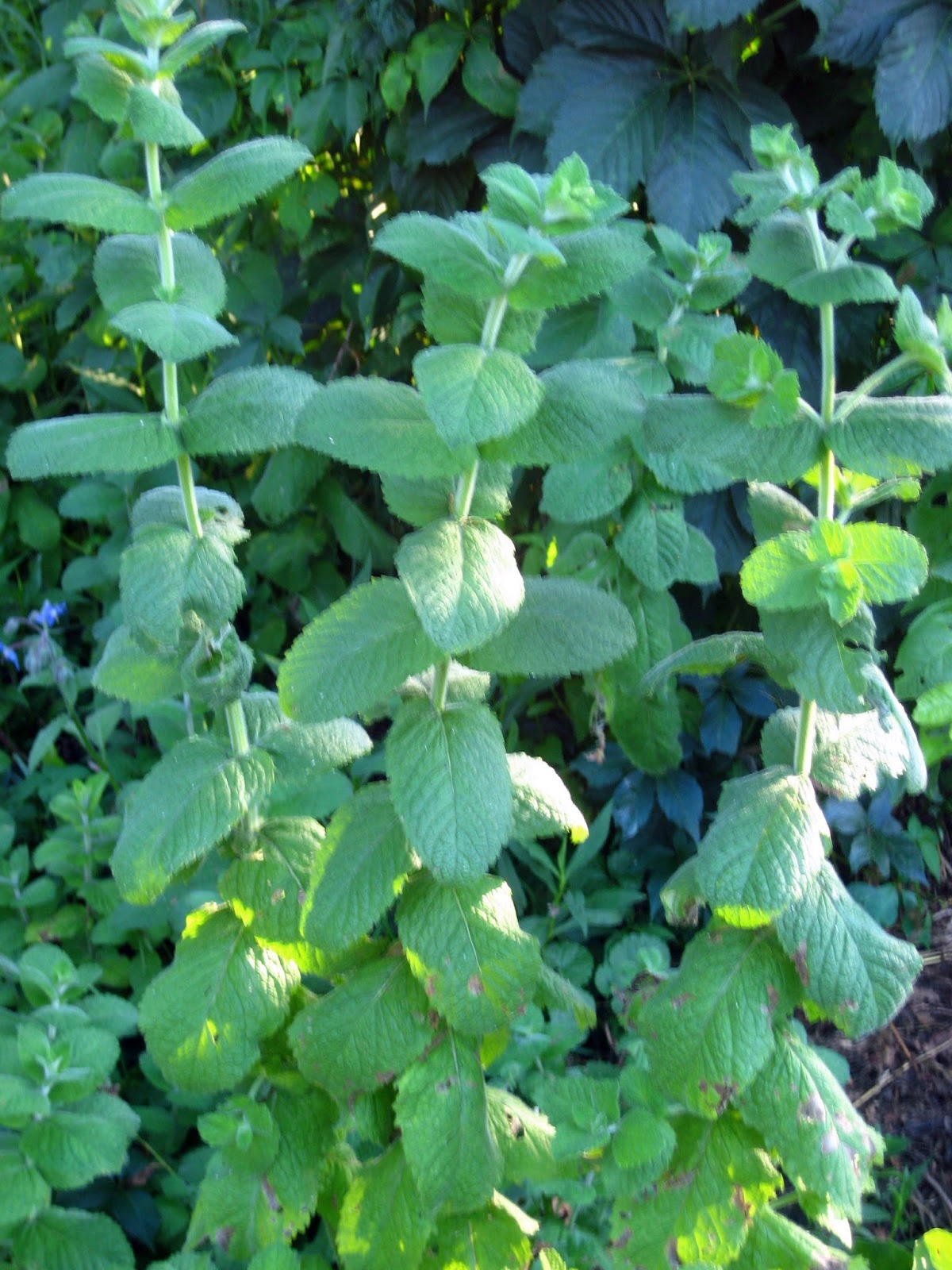
Apple or Woolly Mint
Spearmint and Peppermint

Peppermint and Spearmint are just two of many types of mint in the Lamiacae (Labiatae) family.
Known as the herb of hospitality, mint has long been used everywhere from the kitchen to the sickroom. Peppermint and spearmint are the most common types of mint, but there are several varieties that can be found at your local nursery in the herb section. You can find apple mint, chocolate mint, mimosa mint, mountain mint, pennyroyal, orange mint, catnip, etc A good way to identify whether a plant is in the mint family is to feel the stem. If it is squared rather than round it is in the mint family. Mints are low to no maintenance perennial plants. They are so hardy, they'll be happy to take over your entire garden. The roots spread by way of runners, so if you don't want it to continue to creep along, it is best to plant it in buried containers. These plants like the sun but do tolerate some shade. Another perk with mints is that the bees adore the flowering tops.

Peppermint in particular has a powerful, menthol aroma that refreshes, energizes and improves mental clarity just by inhaling the steam from a cup of hot tea. So many ailments can be eased with this one type of plant. Nausea can be relieved, cramping belly aches can be settles, pounding headaches can fade away, congestion can open up, aching feet can perk up, heat flashes can be cooled, and sore muscles can relax.


Lemon Balm is wonderful for relaxing children or anyone under stress. Called the "happy tea", lemon balm is invaluable for not only snapping a child out of a cranky mood, but can help anyone feeling down in the dumps. With it's hint of lemon, add some honey and you have a delicious tea most people really enjoy. With anti-viral properties, lemon balm is great for colds and fever blisters (cold sores). Also called Sweet Melissa, if you let it flower as in the photo below, you'll be making a lot of bees very happy. This type of mint spreads as any other mint but it is easier to control since it grows in clumps. One thing with lemon balm is that if you do dry it, don't crumble the leaves until ready to use or you'll lose a lot of the lemony scent.

Lemon Balm


Catnip
Catnip is great for colicky babies, upset tummies, jangled nerves and to bring down a fever. And of course you can grow it as a great treat and source of greens for your cat. Catnip spreads on its own but like lemon balm, it grows in clumps so is easier to control than some mints that creep over the ground. Without cutting back, catnip actually becomes almost shrub-like with woody stems.


Monarda
Bee Balm or Monarda is often grown in butterfly, bee and hummingbird gardens. It's red or pink tubular flower petals are beautiful when in bloom. Monarda gets taller than the usual 2 ft. mints. This plant reaches 3 - 4 ft. so makes a great backdrop plant. Also known as Oswego, this plant was used extensively by Native Americans as a medicinal tea. During the American Revolution, Bee Balm was the replacement for black tea after the Boston Tea Party. And you can guess why the word "bee" is in the name. Great beneficial plant.


Anise Hyssop
The last mint we'll mention is Anise Hyssop (Agastache foeniculum) which smells and tastes like anise. Although it is called a hyssop, it isn't the same plant as the Hyssopus officinalis, which is in the mint family, but of European descent. Anise hyssop is a must for anyone who wants a scent garden. Even if you don't like it as a tea, to resist the urge to take a moment to pick a leaf for a sniff is nearly impossible. 

Pineapple Sage
Any of the sages can be used as a tea but Pineapple Sage tastes much better than regular garden sage. This tea is a good remedy for indigestion and heartburn. Sage makes a good gargle for a sore throat, especially if first infused in vinegar. Garden Sage is a perennial but Pineapple Sage is a tender perennial which in colder areas is grown as an annual. This plant grows much larger than garden sage. It actually becomes like a shrub and by September it flowers beautiful red tubular flowers adored by the hummingbirds, a great late season food source.


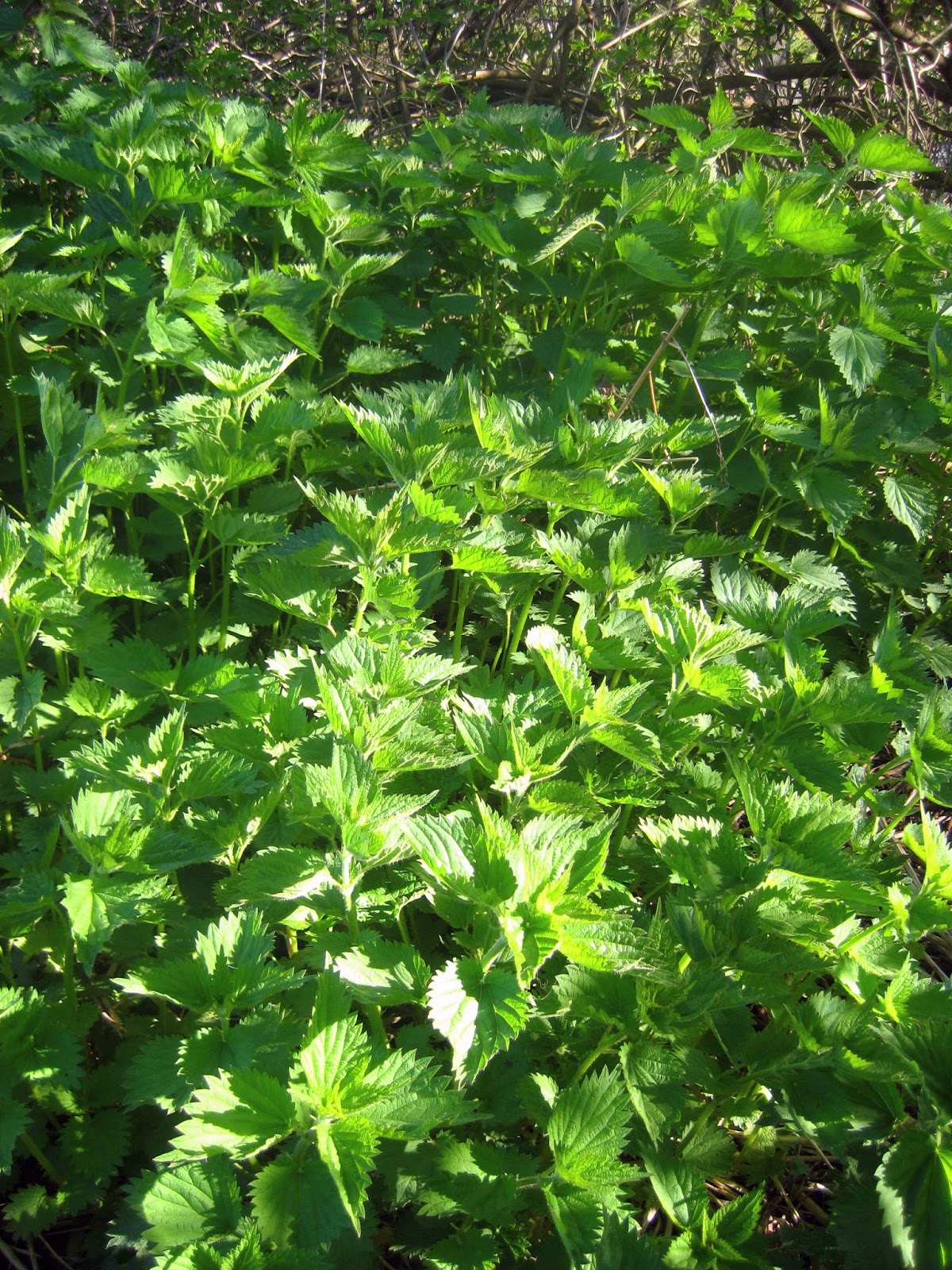
Stinging Nettles

Nettles, (Uritica dioica), are invaluable if you want one of the most nourishing plants around for your health. A word of caution though with stinging nettles, they sting due to the formic acid they contain. Nettles need to be grown somewhere where no one will be wandering around touching all the plants. It is a spreading perennial that will take over if allowed. But having access to the health benefits of nettle plants is wonderful for anyone needing a boost of energy or help with blah skin, hair or nails. Nettles make a great cooked green like spinach but best in the spring when the plants are young and tender. Be sure to wear long sleeves, long pants and gloves when in your nettle patch. Nettles are important as a food source for the larvae stages of many butterfly types, namely the peacocks, red admiral, commas, painted lady and tortoiseshell butterflies.


TIPS ON HOW TO HARVEST YOUR HERBS

Harvest late morning after they've dried off but before the heat of the day.

Most fresh herbs are highest in potency right before they bloom. But using the flowering tops is fine as well.

To dry, you can bundle small bunches by the stems and hang to dry in an airy, cool area out of direct sunlight. When dry, strip off the leaves and store in paper bags.
Don't crumble the leaves until you are ready to use them or you'll lose much of the essential oils.

Or you can spread your herbs out on the trays of a kitchen dehydrator for much quicker drying.

Before the arrival of frost, harvest all the herbs you desire and dry for storage. Herbs like basil are best if the leaves are frozen in ice cubes. Basil doesn't dry well without losing potency.

When ready to use the usual rule is 1 teaspoon dry herb to 1 cup of hot water.
If using fresh, use 3 teaspoons herb to 1 cup hot water.

You don't want to boil tender teas. You pour the hot water over them and let simmer. On average, teas only need about 3 - 5 minutes to simmer. then sweeten with honey and add a wedge of lemon if desired.

A very simple, yet delicious way to enjoy mint is to simply add a few fresh stems to a pitcher of water. The water will have a subtle, refreshing minty taste. Start with fresh plant material with each refill of the pitcher. If the water hasn't been drunk within about 3 days, toss and start again because it'll start to taste funky.

 A memory I have as a child is being sent down to the water's edge of a pond to collect enough fresh mint to fill a large soup pot. If you do collect plants outside of your own yard, be sure the plants you are cutting were not sprayed with pesticides or herbicides. Mint shouldn't need either one but just know for sure before using the plants. Rinse off the stems of any dirt, cut to fit in the pot (stems, leaves and any flowering tops), add enough water to cover the plants, cover the pot and gently bring to the boiling point but don't boil, Cock the lid so it doesn't overflow and let the tea simmer about 5 to 10 minutes, depending how strong you like your tea. You don't want to simmer it too long or you'll lose the important essential oils in the steam. Strain out the plant material and add sugar to taste. For sweet tea, 1 cup sugar to a gallon of tea is tasty. Enjoy a cup of hot tea right away and let the rest cool and store in the refrigerator for ice tea. This is wonderfully refreshing on a hot day.


Find a spot to set up a little table and chairs and enjoy your serenity time with a cup of tea. You'll soon discover that once your tea garden is established it returns every spring with little effort on your part. Annuals such as chamomile, fennel and dill reseed themselves and perennials such as the mints, lavender, sage, nettles and thyme return from the established root ball. If you had rosemary overwintering in the house, it can be brought back outside in the spring.


Friday, April 29, 2016

Paintbrush of the Fairies...Periwinkle


"In the language of flowers, the periwinkle is the symbol of pleasures of memory and early friendship."
Sharon Lovejoy

Periwinkle or Creeping Vinca or Myrtle (Vinca minor) is a dense forming ground cover excellent for erosion control and can often be seen growing around foundations or down embankments. It was introduced into North America in the 1700's as an ornamental. It grows best in partial shady areas which is why if it escapes cultivated areas can be a problem when it covers the forest floor. It is very hardy and drought resistant so if it likes where it is established, can compete with native species.

Personally, I love this plant, as it brings back a lot of memories of my childhood home. My mother originally got her starts from her own mother and over the years it wound its way around the house and the little summerhouse that was at one time used for the summer canning season.

When I had my own children and discovered Sharon Lovejoy's books on gardening with children, I loved the flower stories and little games that could be played.

This is the story of the periwinkle as is told in the book "Sunflower Houses" by Sharon Lovejoy:

PERRY WINKLE'S PAINT BRUSH

The first Spring descended upon the earth, and all of the new, young animals and shimmering green plants and trees were healthy and happy. The view from a hilltop across mile after mile of wildflowers with all different blossom and leaf shapes revealed one startling, glaringly obvious thing. Somehow, the finishing touch had been overlooked! All the flowers were one color-WHITE!

The very last flower to have been created was the humble periwinkle. thus, he was the one called upon to solve the problem of coloring all of the flowers.
"Goodness gracious," said Perry in a small, blue voice. "I am depressed. There is just no way a little flower like me could color all the flowers in the world."

"Perry," a deep, soft voice resounded, "what you need is a little faith! In this world everyone has a job and is expected to work. The job for you and your family will be to paint all the flowers every color to be found on our earth and in our sky."

"But how can I do such a thing? There are not enough brushes or paint in the world to color the millions of flowers you have strewn on this planet," Perry said in a defeated tone.

"The rainbow will be your never-ending supply of colors. And listen closely: Slip your petals off, and you will see that I have given every periwinkle in my kingdom its very own paintbrush."


This is the magical part while telling your child this story. When you slip off the last pale blue petal you will discover the tiniest, most fairy-like paintbrush imaginable!

After gently removing the petals, carefully take off the outer wrapping of the pistil/stamen and you'll find the little paintbrush. Children love this story and will never see this simple flower the same way again.


To Purchase

Wednesday, April 20, 2016

Flowers and Folklore....Bleeding Hearts


If there is a flower that brings out the child in us, it has to be the bleeding heart (Dicentra spectabilis). It is inevitable that anyone who has never seen these before will bend to get a closer look at the dancing little hearts that line up along the slender branches. The bleeding heart actually does look like a dripping heart, and if you turn it upside down and pull it open a bit, it looks like a lady in a bath. In fact, lady in a bath is another name for it.

Bleeding heart was originally from China. In 1842, Robert Fortune set out to explore an unknown world and sent back many of our garden treasures. He had with him carrying cases that were accidentally invented by Nathaniel Ward. Ward used a closed bottle to bury a chrysalis and observe the development of a moth. When he noticed plant growth in the closed environment he figured this would be the perfect way to transport plants and protect them from lack of water, changes in temperature and sea spray during long sea voyages to the home destination. This discovery completely revolutionized the transportation of live plants from far away.

Robert Fortune disguised himself as a Chinese man to get into the forbidden areas around China. He collected and smuggled out many plants that were the result of centuries of China's select breeding and cultivation. He called China the "central flowery land."

These delicate old-fashioned plants emerge in the spring, display their chains of hearts, and too soon the plant dies back till next year.

Children love this plant. The flowers encourage the imagination with creative pretend as they become earrings, heart hair tiaras, dancing ballerinas, lady in the bath play or man in a gondola play.

Many flowers have stories attached to them and bleeding heart is certainly no exception. Here we have two stories from folklore:

 The first is the story of Princess Dicentra. This beautiful princess wandered away from her walled garden home and became lost in the darkness of an ancient forest. An evil crone, angry at being disturbed, took out her vengeance on the vulnerable Dicentra. The crone reduced Dicentra's size to a fraction of her normal self and the princess became entrapped in the satiny pink folds of an oddly shaped flower.

The crone told Dicentra that she'll only escape if by chance she is discovered by an innocent youngling. What the crone didn't realize is how attractive these flowers were to any passing child. It took only three days before travelers stopped for water in the forest. A little boy noticed the dancing wand tipped by a pink and white heart, and as predictable with children, he plucked it. When the child started to play with the flower, the princess was freed when he pulled back the pink skirt.


The second story is called "Ann's Story of the Bleeding Heart" by Elma Lang.
This is exactly as the story goes so the full credit goes to Elma Lang.

Ann thought she was the most unhappy girl in the world. Although she had gone to her new school for a whole week, she hadn't made a single friend.

Things might have been different if she hadn't been so frightened that first day. Some of the girls had spoken to her, but her throat had become so tight that she hadn't been able to answer them. Maybe after that the girls has thought she was stuck up or unfriendly. At any rate, they had left it up to her to make the next move.

Ann stopped to pick a bouquet of lilies of the valley and bleeding hearts for her new teacher. Many were growing in the garden of her new home.

As soon as she was in their classroom after the morning bell rang, Ann took the flowers to her teacher.

"My what lovely bleeding hearts!" exclaimed Miss Johnson, smiling at Ann. "Isn't that a sad name for such pretty flowers? Why do you suppose it was given that name?"

"Don't you know the story?" asked Ann in surprise. "My mother told it to me when I was just a little girl."

"Perhaps you can tell the story to the class," suggested Miss Johnson.

Ann looked at the class and felt horrified. Then she thought, I know the story well, and I love it. Of course I should share it.

Both her hands and her knees were shaking as she broke off one of the flowers, but she bravely stood before the class and told her story.

"Once upon a time there lived a beautiful princess. Young men from far and near came to pay her court. But the princess was very vain and would have nothing to do with any of them. A young prince fro the neighboring country fell deeply in love with her. She ignored him like the others, though he tried and tried to win her heart. One day the prince found a pair of pretty pink rabbits at the market. He sent them to the princess thinking 'these will surely melt her heart.'"
 Ann carefully broke off the two outside petals of the flower in her hand. She placed them on the teacher's desk. Sure enough they looked like a pair of pink rabbits.
"But the princess went right right on ignoring him," Ann continued with her story.
"Then the prince sent her a pair of beautiful Oriental slippers." From the front and back of the flower, Ann took off the two long petals. One could easily imagine the dainty heels, the slender insteps, and the widened toes. They looked like a pair of real Oriental slippers.

Ann had to wait until the oh's and ah's of the class had quieted down before she could go on.

"Still the princess would have nothing to do with him. The young prince was so heart broken that he took his dagger and drove it into his heart." The remains of the flower in Ann's hand made the outline of a heart with a line down the center. Ann broke out the stamen, which had made the line. It looked like a dagger. She put it through the center of the heart. Ann held her hand so that the class could see the perfect heart pierced by the dagger.

Ann went on with the story. "As soon as the prince was dead, the princess realized that she had really love him. 'As long as I live, my heart shall bleed for my prince.' she wept".

"That" finished Ann, "is the story of the bleeding heart.

"Show me how to do it," said Donna, who sat in the front seat.

"Me too, me too!" cried the other girls.

"Ann may show you at recess," Miss Johnson stated firmly.

My story has made everything all right, Ann thought happily as she went back to her desk. I won't have any trouble making friends now.


For those who love to save their flower collections by pressing them, the bleeding heart is perfect. Picked early in the morning after the dew has dried, tuck between the pages of a thick book and after a few weeks the flower is transformed into a perfect flat, papery little heart.


Information for this post came from "100 Flowers and How They Got Their Names" by Diana Wells and "Sunflower Houses" by Sharon Lovejoy


Below are three wonderful books to spark a child's imagination and love of gardening:
To purchase

To purchase

To purchase


Saturday, March 26, 2016

How to use Plant Leaves to Dye Easter Eggs


Dying Easter eggs can be a time for fun, creativity and a little kitchen chemistry.
To get started you'll need white eggs, not brown.
Use a size pot to accommodate the number of eggs you want to boil. Too few eggs for the size pot will result in the eggs rattling around and increase the chance of them cracking.
Add enough water to fully cover the eggs.
Bring them to a boil, cover the pot with a lid, turn off the heat and let sit on the burner for 15 minutes.
Put the pot in the sink and run cold water to cool off the eggs. This works better than tipping the pot to strain off the hot water since that may cause the eggs to bump and crack.

Gather your plant material.
This time of year you'll probably have to rely on houseplants or herbs purchased from the grocery store. Parsley and cilantro leaves are pretty.
As far as houseplants use whatever you have. Boston fern, English ivy and Pothos have pretty shapes and work nicely.
Choose and snip off the tinier leaves.


Use an old pair of nylon stockings.
Cut it up into sections of about 5 inch lengths
Spread out the leaf so it lays flat onto the egg and carefully stretch the nylon over the egg to hold it tight.
Twist the nylon ends to close and tie shut with a twisty tie (the kind from loaves of bread)

To dye your eggs you'll need:


Small glass or metal bowls, one for each color you'll be using
Into each bowl add 1 cup boiling water
2 tsp. vinegar
10 - 20 drops food coloring (single colors or various blends and shades)
Using a slotted spoon or tongs lower the eggs into the dye
Let sit for at least 5 - 10 minutes or until satisfied with the strength of the colors
If dying a large number of eggs you may  need to increase and adjust the water, vinegar and dye amounts.

To remove the stocking from the eggs:


Work over your kitchen sink so all drips, stockings and plant material stay in the sink and you won't risk staining your countertop.
Using a scissors, carefully snip off the stocking and peel away the stocking and the plant leaf.
Lay the egg on a cookie sheet to dry.
Repeat for each egg.
Once all the eggs are dry the eggs can be put into an egg carton and stored in the refrigerator.
Hard-boiled eggs are good for about a week.

If you want to take the time and use all natural dyes for your eggs, this is a great tutorial.
Tumeric gives you yellow
Beets give you purple
Onion skins give you a brownish orange
Red cabbage gives you a blue

Happy Easter and Happy Spring!