Meadow Muffin Gardens logo
Showing posts with label ecoetsy. Show all posts

Tuesday, August 21, 2012

Your Own Business?! Quips and Tips

The Home Business AESOP

What is usually the first bit of advice with having an at home office?
Get the cat off the desk!

Part of me is flattered that they seem to think that the minute someone takes a seat it means lap time for them.  Not pictured here but it is a given that there is a dog somewhere under the desk as well.
Their content, blissful snoozing helps keep me calm and focused. I think we all carry around that nagging voice of doubt which tries to plant seeds of insecurity. The fear of failure can be crippling enough for many people to not even attempt that first step towards a dream. Frustration is a given, and as long as we remember the "this too shall pass" philosophy, we will gain two steps forward for every step backwards. Failure should not be thought of as a waste of time.

Long a fan of the wisdom behind children's books, I particularly like Dr. Seuss and Winnie the Pooh. By gathering  a few quotes I came up with a little food for thought about business success. 

AESOP

A is for Attitude
E is for Education
S is for Social Networking
O is for Organization
P is for Perseverance

Attitude
"You have brains in your head.  You have feet in your shoes.  You can steer yourself any direction you choose.  You're on your own.  And you know what you know.  And YOU are the one who'll decide where to go..."  Dr. Seuss

We know the saying about being the masters of our fate.  All we need is to put fear aside and get out of our own way.  God gave us the tools we need, we just have to recognize and believe it enough to act on it.

Education
"The more that you read, the more things you will know.  The more that you learn the more places you'll go."  Dr. Seuss

Also remember the words of wisdom from this childhood poem:
"There was an old owl who lived in an oak,
The more he saw, the less he spoke,
The less he spoke, the more he heard,
We should all be like that wise old bird"

No matter what our age, we should never stop learning.  Not only will you become more knowledgeable in your field, you'll have plenty of sources for pulling up information when needed.
Making mistakes is all part of that education.  If we're observant we'll learn from the mistakes of others before we have to pay the price by making those same mistakes ourselves.


 Social Networking
"You can't stay in your corner of the Forest waiting for others to come to you. You have to go to them sometimes."  Winnie the Pooh

With the internet and social networking sites it is a mistake to assume that just being a part of the world wide web means you will automatically find exposure.  It is a rude awakening when you realize how quickly a website or shop becomes buried in cyberspace.  An on-line business is ideal for someone who is more of an introvert and prefers to reach people through the written word rather than physically getting out there in person to sell yourself verbally.  But if that is your path of choice you have to take advantage of networking sites such as Facebook, Twitter, Google+, Blogs, and means of advertizing. 

Organization
 "The hardest part is what to leave behind,...It's time to let go!"  Winnie the Pooh

Having organizational skills and a daily schedule is paramount to a successful business.  This is especially true if you work out of your home.  Look closely at your habits and change what is necessary to stay on top of things.  A home business can easily become chaotic with constant interruptions, lack of work space and lack of organization with supplies and bookkeeping.
Find a balance between family and business.  Carve out a set amount of hours in the day that the message is clear to everyone else that you are "working" and demand respect for your time.


Staying on top of the bookkeeping can very easily become one's downfall. Take advantage of modern technology to help you keep everything straight. To help you, here is an awesome source of information from the Team EcoEtsy Blog.

Perseverance
"Don't Go Straight, Go Forward"  The Mighty Manatees (an awesome band)
Expect to make mistakes since that is the way to learn and improve in anything.
Give yourself a break when things don't go easily.  No one said this road would be an easy one.

Hold onto your values, and your customer base will eventually grow.  People appreciate honesty and consideration.  Say what you'll do and do what you say.  Your business will be defined by those values, so keep your focus, eye on the goal, and stay motivated. 

Last, surround yourself with positive energy.  So what if some people think you a bit odd or crazy for taking on the unknown.  My husbands favorite bit of advice for me has always been,
"When in doubt, go for it."    We all have the right to seek out a dream.  To each his own.

Tuesday, July 24, 2012

Flying Flowers, the love of the Butterfly


Butterfly Haven

Hershey Gardens in Hershey Pennsylvania is the home of a magical butterfly sanctuary.

The Butterfly House is part of the children's area but with the butterflies, the bird observation area, the ABC garden and all the little extras to attract kids to the plant world, this section is a fascination at any age.

Listed below are some of the numerous types of butterfly species housed within the greenhouse type structure. The attendants for the butterflies watch over them with great care. It is very important that they don't escape so visitors are inspected before exiting for any butterflies hitching a ride. Strollers are not allowed due to space restrictions and also since the butterflies are everywhere it is easy to harm them by accidentally stepping on them. Without predators, these flying flowers float around without a care. They have food, shelter, water, warmth...what a life during their short adult life spans which averages two weeks to a few months depending on the type. Included was a display of all the various types of chrysalis' so amazingly camouflaged to look like leaves and bird droppings.


The buckeye caterpillar is part of the brushfooted family. It is found throughout most of the U.S. except for the Rocky Mt. states. It is found in open areas with low vegetation, such as along roadsides, railroads, fields and meadows. To attract them plant snapdragons as a food source for the larvae and a variety of flowers for nectar for the adults.


The julia is a subtropical butterfly from Brazil to southern Texas, Florida and Mexico. They feed on the nectar of firebush and lantana.


The malachite is a tropical butterfly widespread in Central and South America. In America, they can be found in Texas and Florida. The caterpillars feed on green shrimp-plant and the adults feed on fermenting fruit.


 Several types within Hershey's Gardens are from the swallowtail family. This family contains species that are the largest butterflies in North America. Swallowtails get their name from the "tails" on the back edge of their wings that reminded people of the forked tails of Swallows.


The tiger swallowtail butterflies can be found all throughout Alaska, Canada south through the U.S. east of the Rockies. Swallowtails favor broadleaf trees and shrubs. Birds avoid them due to a chemical in its body that makes it distasteful. Very common among gardens, farmland and meadows.


The spicebush swallowtail is such a beauty with its blue and black markings. Sassafras and Spicebush are North American natives and are the needed host plants for the caterpillars. The eyespots and big head make this caterpillar ferocious looking to predators. Adults feed on honeysuckle, butterfly bush, Joe Pye wee, zinnias and coneflowers. Birds avoid this type as well due to its foul taste.


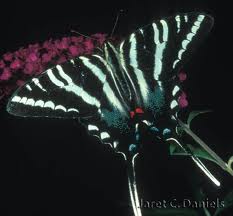
The zebra swallowtail has a favorite location around the Potomac area near Washington, D.C. and into Virginia along rivers, but they do extend westward to the Great Plains. A host plant for the eggs to be laid is the paw-paw tree. Adults dine on a variety of sources with sweet nectar. These butterflies can live for up to six months.


Another swallowtail, the eastern black swallowtail, has a range all the way west to the Rockies and then the western black swallowtail is found. Plant preferences are parsley, carrot and dill and nectar sources include phlox and milkweed. Very common among gardens and farmland but avoids wooded areas.


Viceroy butterfly
is often confused with the monarch butterfly. There is an extra black line across the viceroy's hind wings that distinguishes it from the monarch. Milkweed butterflies such as the monarch are distasteful to predators, therefore similar looking types are also avoided. Viceroys live throughout most of the U.S. and Canada. They frequent moist areas as well as open meadows seeking thistles, asters and goldenrod. The larvae eat the leaves of trees such as the aspens, poplars, willows and fruit trees.


Easy to identify because of the stripes and long wings, the zebra longwings are normally found in the south and mid-western U.S. They prefer the edge of forests. Passionflower is the sought after host plant for the larvae. The flowers are toxic but harmless to the longwings and makes them distasteful to predators. This type of butterfly can live up to three months. They are the only butterflies known to eat pollen, which is a form of protein, enabling them to live longer than living on only nectar (sugar) sources.


Being a tropical resident, the white peacock is active throughout the year. They are closely related to the buckeyes and are native to the very southern Florida and Texas areas and like wet, swampy habitats. Caterpillars feed on ruellia and water hyssop plants.


Hershey Gardens included a few moths as well. Moth larvae develop in cocoons rather than chrysalises. Moths can be distinguished from butterflies in that they are night dwellers, have heavier bodies, and have feathery antennae, whereas butterlies' are wiry with clubbed tips.


Luna
moths are widespread across the U.S. and Mexico and often can be as large as 4 inches across. With its long tail and eyespots as a distraction from its head, they can often escape predators. Luna caterpillars feed on the foliage of broad-leaved trees such as birch. As adults they do not feed at all, so only live a few days.


Looking surprisingly like a butterfly, the cecropia moth belongs to the family of silk moths. Its range extends east of the Rocky Mountains of the U.S. and southern Canada. Also known as the robin moth, this moth is the largest in North America with a wingspan of six inches. Having no mouth parts they only survive long enough to find a mate and breed, from one to two weeks. The caterpillars feed on shrubs and trees, such as dogwood, box elder, willow, sugar maple, alder, birch, and fruit trees.


About the same size wingspan as a hummingbird as well as rapidly beating its wings as it feeds, the hummingbird clearwing moth is also called sphinx moth or hawk moth. These moths can reach speeds of 30 miles per hour. Common in the eastern U.S. and Canada these moths feed on hawthorns and flower nectar during the day. Caterpillar food source include shrubs such as the viburnum. Rather than spinning a cocoon, the caterpillar digs into the soil.


I'm not sure if this type of moth was at Hershey Gardens but it frequents our area and it is so cute I had to mention it.
Its common name is Rosy Maple Moth
The habitat is deciduous forests but its eggs are laid in maple trees.
They range from Canada down to Florida over to Texas.


The many plant types throughout the butterfly house included:
Butterfly bushes, lantana, coneflowers, rubeckias, verbena, lobelia, joe-pye weed, salvia, phlox and the shrub called spicebush.
Other valuable plants include dill, fennel, nettles, butterfly weed, milkweed, aster, marigold, zinnia, tithonia and the shrub buttonbush.
Water was supplied by way of a little pond and puddling areas.
Fresh fruit was offered on plates at ground level.

A great source for more information:
Host plants for caterpillars 
Nectar plants for butterflies 


Friday, August 26, 2011

Nature's Fury


"Mom, people say when bad weather hits it is "God's fury". Does that mean He is mad at us?"

Oh, from the mouths of babes. A classic moment when the child becomes the teacher in that such questions make us adults think enough to perhaps learn something.

With Hurricane Irene swirling around the web and utmost on the mind's of most people who live along the eastern part of the United States, that question from years back popped into my head. I'm not sure what exactly I had said in response at that time, but with seemingly one natural disaster after another, it does make one wonder.

Is this normal and it's just that with the media we are exposed to every bit of news?
Are we humans the cause of the chaos by upsetting our ecosystem?
Has God had enough of our messing up His creation and sending us a clear message of the consequences?

Out of curiosity I looked up man's history of thinking about such events.

Prior to 1500 BC world events were governed by the gods of a particular religion or mythology. Everything in nature contains a spirit and the earth is like a Great Mother. Prayer and sacrifices were made in efforts to make life a bit easier.

Classical Greece (400 - 100 BC) brought us Aristotle and Plato who established the foundation for the development of science and the traditions of the western world.

By Medieveal times (400 - 1400 AD) a Christian God reigned over everything. Life was a strict hierarchy where God ruled at the top with children and animals at the very bottom. The "Will of God" was paramount; what the Church dictated was how life was or the person suffered the consequences. Human actions were not explained, only judged as good or evil. God was feared in the literal sense. When bad things happened people felt somehow they deserved to be punished.

During the Renaissance (1500 - 1850 AD), God was still to be behind everything and set things in motion, but science provided an objective view of the universe. By the late 19th century all spiritual forces were removed from the universe and everything was explained objectively through science.
Since nature was thought to have no meaning, it was common thought to exploit it for whatever it was worth to enhance the life of humans. It was thought that technology could solve all of our problems.
As people became more literate and had access to reading material they began to think for themselves about matters of spirituality and behavior.

So as our population has grown to nearly seven billion people, we can now deal with the consequences of our actions and try to clean things up and find alternative sources of energy to fuel our modern wants and needs.

Christians today feel they can have a personal relationship with God and the term 'fearful' not to be interpreted literally, but rather a matter of respect and awe.

To interpret our weather patterns as God's way of punishing us is not the mainstream thought in today's modern thinking. We may jokingly kid about "God's fury" but few of us really believe we humans are a central focus to the point that even the weather revolves around us.

It makes more sense that the weather patterns are along Newton's thinking. Every action has an equal and opposite reaction. The goal of mother nature is to survive and if at all possible she will amidst consequence and change. Whether we as a species survive that change, only time will tell.

Life is what it is. Take the advice of Harold Kushner, the Conservative rabbi who wrote the book, "When Bad Things Happen To Good People". Stuff happens.
The trick to not getting down is to not expect a bed of roses, things just happen and we have to deal with them.

Ecclesiastes 3:1
There is a time for everything, and a season for every activity under heaven

A talented and committed group of environmentally conscious artisans with shops on http://www.etsy.com/ is a team called Ecoetsy.

Below is a treasury of beautiful items from those encouraging us to Reuse, Renew and Recycle.

"Look deep into nature and then you will understand everything better."
Albert Einstein