Meadow Muffin Gardens logo
Showing posts with label treasuries. Show all posts

Thursday, February 21, 2013

You are You, that is Truer than True

Dr. Theodor Seuss Geisel, pen name Dr. Seuss, was born March 2, 1904. He was an American poet, writer, cartoonist, but most widely known for his children's books.

Initiated by the National Education Association, Seuss' birthday, March 2nd, has been designated as the date for National Read Across America Day.

Countless story hours and bedtimes are fondly remembered by children and adults alike with the sing song lines from Seuss' classic books.
Below is a collection of these 13 titles compiled into one volume. They include:

And to Think That I Saw It on Mulberry Street, Horton Hears a Who!, McElligot's Pool, If I Ran the Zoo, Happy Birthday to You! Dr. Seuss's Sleep Book, Yertle the Turtle, The Cat in the Hat, How the Grinch Stole Christmas!, Green Eggs and Ham, The Lorax, The Sneetches, and Oh, the Places You'll Go!

Buy on Amazon
 The one day of the year each of us sets aside to call our very own, is our birthday. A quote by Seuss says, "Today you are You, that is truer than true. There is no one alive who is Youer than You."
Each of us should put that phrase to memory and recite it at the beginning of every new day. A reminder that though we walk out the door, and feel one with the world as we all make it through another day, we are still individuals. Unique individuals born with a distinct personality, temperament, ambitions and abilities.

Let us not become too immersed in the cultural soup pot of society that we become followers of everyone else. The person you are was a gift at birth, your birthright to pursuing your passions and dreams. Have the confidence to be a doer, not a pleaser, and a leader, not a follower.

A person once told me "When in doubt, just go for it. What's the worst that can happen? You fail? So what, check it off and try something else. Someday you'll look back and laugh." That advice certainly is better than torturing yourself with the "what ifs" in life and never knowing what could have been.


If you're looking for craft ideas as to how to celebrate Dr. Seuss day, here is an excellent tutorial by The Tip Junkie.  Forty-four fun ideas involving games, food, crafts and the love of books.


Celebrate Dr. Seuss Tutorial


Happy Birthday Dr. Seus!

Monday, November 5, 2012

National Caregivers Month

A handshake and/or a hug to all those who can relate to this proclamation. This recognition is wonderful for those wondering where their source of strength will come from with each new day.


November is National Caregivers Month

Presidential Proclamation -- National Family Caregivers Month, 2012

NATIONAL FAMILY CAREGIVERS MONTH, 2012
- - - - - - -
BY THE PRESIDENT OF THE UNITED STATES OF AMERICA
A PROCLAMATION

Our Nation's health care professionals provide essential medical services to millions of Americans, yet they do not shoulder their responsibilities alone. Family members, friends, and neighbors devote countless hours to providing care to their relatives or loved ones. During National Family Caregivers Month, we recognize and thank the humble heroes who do so much to keep our families and communities strong.

Across America, daughters and sons balance the work of caring for aging parents with the demands of their careers and raising their own children. Spouses and partners become caregivers to the ones they love even as they navigate their own health challenges. Mothers and fathers resume care for children returning home as wounded warriors. Friends and relatives form networks to support loved ones with disabilities. All of them give selflessly to bring comfort, social engagement, and stability to those they love.

Family caregivers have an immeasurable impact on the lives of those they assist, but their hours are long and their work is hard. Many put their own lives on hold to lift up someone close to them. That is why my Administration continues to support these committed individuals through programs like the National Family Caregiver Support Program and the Lifespan Respite Care Program, and through new initiatives like the National Plan to Address Alzheimer's Disease. These efforts help caregivers access services, provide quality support, and reinforce their support through respite care options. Additionally, my Administration has pursued workplace flexibility initiatives that help caregivers balance their responsibilities to their employers with their responsibilities to their loved ones. I was also proud to sign the Caregivers and Veterans Omnibus Health Services Act, which has helped our most seriously injured post-9/11 veterans and their family caregivers through financial support; access to health insurance, mental health services, and counseling; and comprehensive caregiver training and respite care.

National Family Caregivers Month is a time to reflect on the compassion and dedication that family caregivers embody every day. As we offer our appreciation and admiration for their difficult work, let us also extend our own offers of support to them and their loved ones.

NOW, THEREFORE, I, BARACK OBAMA, President of the United States of America, by virtue of the authority vested in me by the Constitution and the laws of the United States, do hereby proclaim November 2012 as National Family Caregivers Month. I encourage all Americans to pay tribute to those who provide for the health and well-being of their family members, friends, and neighbors.

IN WITNESS WHEREOF, I have hereunto set my hand this first day of November, in the year of our Lord two thousand twelve, and of the Independence of the United States of America the two hundred and thirty-seventh.

BARACK OBAMA

Below are two collections of shops featuring items to give caregivers needed  support. Click on any box to enter that seller's shop.


Tuesday, July 24, 2012

Flying Flowers, the love of the Butterfly


Butterfly Haven

Hershey Gardens in Hershey Pennsylvania is the home of a magical butterfly sanctuary.

The Butterfly House is part of the children's area but with the butterflies, the bird observation area, the ABC garden and all the little extras to attract kids to the plant world, this section is a fascination at any age.

Listed below are some of the numerous types of butterfly species housed within the greenhouse type structure. The attendants for the butterflies watch over them with great care. It is very important that they don't escape so visitors are inspected before exiting for any butterflies hitching a ride. Strollers are not allowed due to space restrictions and also since the butterflies are everywhere it is easy to harm them by accidentally stepping on them. Without predators, these flying flowers float around without a care. They have food, shelter, water, warmth...what a life during their short adult life spans which averages two weeks to a few months depending on the type. Included was a display of all the various types of chrysalis' so amazingly camouflaged to look like leaves and bird droppings.


The buckeye caterpillar is part of the brushfooted family. It is found throughout most of the U.S. except for the Rocky Mt. states. It is found in open areas with low vegetation, such as along roadsides, railroads, fields and meadows. To attract them plant snapdragons as a food source for the larvae and a variety of flowers for nectar for the adults.


The julia is a subtropical butterfly from Brazil to southern Texas, Florida and Mexico. They feed on the nectar of firebush and lantana.


The malachite is a tropical butterfly widespread in Central and South America. In America, they can be found in Texas and Florida. The caterpillars feed on green shrimp-plant and the adults feed on fermenting fruit.


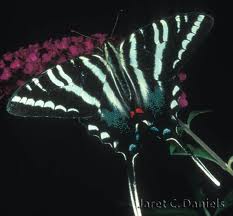
 Several types within Hershey's Gardens are from the swallowtail family. This family contains species that are the largest butterflies in North America. Swallowtails get their name from the "tails" on the back edge of their wings that reminded people of the forked tails of Swallows.


The tiger swallowtail butterflies can be found all throughout Alaska, Canada south through the U.S. east of the Rockies. Swallowtails favor broadleaf trees and shrubs. Birds avoid them due to a chemical in its body that makes it distasteful. Very common among gardens, farmland and meadows.


The spicebush swallowtail is such a beauty with its blue and black markings. Sassafras and Spicebush are North American natives and are the needed host plants for the caterpillars. The eyespots and big head make this caterpillar ferocious looking to predators. Adults feed on honeysuckle, butterfly bush, Joe Pye wee, zinnias and coneflowers. Birds avoid this type as well due to its foul taste.


The zebra swallowtail has a favorite location around the Potomac area near Washington, D.C. and into Virginia along rivers, but they do extend westward to the Great Plains. A host plant for the eggs to be laid is the paw-paw tree. Adults dine on a variety of sources with sweet nectar. These butterflies can live for up to six months.


Another swallowtail, the eastern black swallowtail, has a range all the way west to the Rockies and then the western black swallowtail is found. Plant preferences are parsley, carrot and dill and nectar sources include phlox and milkweed. Very common among gardens and farmland but avoids wooded areas.


Viceroy butterfly
is often confused with the monarch butterfly. There is an extra black line across the viceroy's hind wings that distinguishes it from the monarch. Milkweed butterflies such as the monarch are distasteful to predators, therefore similar looking types are also avoided. Viceroys live throughout most of the U.S. and Canada. They frequent moist areas as well as open meadows seeking thistles, asters and goldenrod. The larvae eat the leaves of trees such as the aspens, poplars, willows and fruit trees.


Easy to identify because of the stripes and long wings, the zebra longwings are normally found in the south and mid-western U.S. They prefer the edge of forests. Passionflower is the sought after host plant for the larvae. The flowers are toxic but harmless to the longwings and makes them distasteful to predators. This type of butterfly can live up to three months. They are the only butterflies known to eat pollen, which is a form of protein, enabling them to live longer than living on only nectar (sugar) sources.


Being a tropical resident, the white peacock is active throughout the year. They are closely related to the buckeyes and are native to the very southern Florida and Texas areas and like wet, swampy habitats. Caterpillars feed on ruellia and water hyssop plants.


Hershey Gardens included a few moths as well. Moth larvae develop in cocoons rather than chrysalises. Moths can be distinguished from butterflies in that they are night dwellers, have heavier bodies, and have feathery antennae, whereas butterlies' are wiry with clubbed tips.


Luna
moths are widespread across the U.S. and Mexico and often can be as large as 4 inches across. With its long tail and eyespots as a distraction from its head, they can often escape predators. Luna caterpillars feed on the foliage of broad-leaved trees such as birch. As adults they do not feed at all, so only live a few days.


Looking surprisingly like a butterfly, the cecropia moth belongs to the family of silk moths. Its range extends east of the Rocky Mountains of the U.S. and southern Canada. Also known as the robin moth, this moth is the largest in North America with a wingspan of six inches. Having no mouth parts they only survive long enough to find a mate and breed, from one to two weeks. The caterpillars feed on shrubs and trees, such as dogwood, box elder, willow, sugar maple, alder, birch, and fruit trees.


About the same size wingspan as a hummingbird as well as rapidly beating its wings as it feeds, the hummingbird clearwing moth is also called sphinx moth or hawk moth. These moths can reach speeds of 30 miles per hour. Common in the eastern U.S. and Canada these moths feed on hawthorns and flower nectar during the day. Caterpillar food source include shrubs such as the viburnum. Rather than spinning a cocoon, the caterpillar digs into the soil.


I'm not sure if this type of moth was at Hershey Gardens but it frequents our area and it is so cute I had to mention it.
Its common name is Rosy Maple Moth
The habitat is deciduous forests but its eggs are laid in maple trees.
They range from Canada down to Florida over to Texas.


The many plant types throughout the butterfly house included:
Butterfly bushes, lantana, coneflowers, rubeckias, verbena, lobelia, joe-pye weed, salvia, phlox and the shrub called spicebush.
Other valuable plants include dill, fennel, nettles, butterfly weed, milkweed, aster, marigold, zinnia, tithonia and the shrub buttonbush.
Water was supplied by way of a little pond and puddling areas.
Fresh fruit was offered on plates at ground level.

A great source for more information:
Host plants for caterpillars 
Nectar plants for butterflies 


Friday, June 22, 2012

Don't Let The Garlic Scapes Escape!


Growing up my father always had a large garden, known then as a "truck patch". Yet, I don't ever remember growing garlic. Hard to imagine now since I can't imagine cooking without garlic.

Though many healing herbs can be labeled "wonder drugs", garlic deserves a special distinction. It is the second oldest medicine (after ephedra)and is even in the world's oldest surviving medical text, the Ebers Papyrus, an Egyptian medical papyrus dating to circa 1550 BC.

Before the Age of Antibiotics with the discovery of penicillin in 1928 by Alexander Fleming, garlic was relied heavily upon for the treatment of infection. The source ingredient in this wonder herb was discovered in the 1920's when researchers at Sandoz Pharmaceuticals in Switzerland isolated alliin. When garlic is chopped or chewed, the alliin comes in contact with a garlic enzyme, allinase, which transforms it into another chemical, allicin, a powerful antibiotic.

Known to reduce blood pressure, lower cholesterol, reduce the chance of blood clots, garlic's allicin and ajoene content stand the test of time for a healthy heart.
Diabetics use garlic to reduce blood sugar.
There is growing evidence that garlic can be used in the treatment of cancer.
AIDS patients can even see an improvement in immune function by taking daily galic cloves.

Those who grow hard-neck garlic know to snip off the flowering tops which encourages more energy to go to the growing bulbs beneath the ground. These tops are called scapes. They are considered a gourmet delicacy by chefs with their short 2-3 week season. By the end of June, farmer's markets have a good supply of these scapes, but since they are eagerly sought out by cooks, they soon sell out.

These young spikes have a very mild garlic flavor and can be used in any of the ways we typically use garlic. Sauteed, grilled, chopped for omelettes, chicken, fish, pizza, delicious all the way around. They can be frozen fresh for later use if desired.

If you grow your own garlic and time slips by and those scapes flower, you'll still get a good crop of garlic, though they may not be as large. The flowering tops are also edible or you can let them dry up along with the rest of the garlic leaves and then save them to plant for spring garlic greens (like scallions).

Three popular recipes to use these scapes are in a pesto, a pizza, and pickled:

GARLIC SCAPE PESTO
1/2 pound scapes chopped into 1 inch pieces
1 cup olive oil
2 cups parmesan cheese

In a blender, combine the scapes and olive oil. Pour mixture into a bowl and blend the cheese in by hand. Serve on crackers, pasta, pita, or potatoes.


GARLIC SCAPE, RICOTTA AND ZAATAR PIZZA
Toss the scapes with olive oil and sea salt and grill.
Spread ricotta cheese over a pizza dough shell.
Arrange the grilled scapes over the ricotta.
Optional is additional mozzarella or cheese of your choice.
Bake at 400 degrees for 18 - 20 minutes
Sprinkle with zaatar (a middle eastern herbal blend)


PICKLED GARLIC SCAPES
2 pounds garlic scapes
1/4 cup canning salt
2 1/2 cups vinegar
2 1/2 cups water
1 tsp. cayenne pepper, divided
4 tsp. dill seed, divided
optional is one whole cayenne pepper per quart

Trim flower pods off of the garlic scapes and chop so that they will fit in the jars. To make it easier to fill the jars, separate the straight from the curly sections.

Combine salt, vinegar and water in a large saucepot.
Bring to a boil. Pack scapes into hot jars, leaving 1/4 inch headspace
Add 1/4 tsp cayenne pepper and 1 tsp dill seed to each pint.
Ladle hot liquid over beans, leaving 1/2 inch headspace.

Remove air bubbles by dipping a chopstick around edges.
Adjust metal caps and rings.
Process pints and quarts 10 minutes in a boiling water bath canner

Yield: about 4 pints or 2 quarts

Monday, November 14, 2011

Gift Idea for Teacher Appreciation at Christmas


The holiday season is an ideal time to display our gratitude and appreciation to those special people involved in the lives of our children.

When my own two were young I can remember going on a baking frenzy to arrange cookie plates for everyone and it seemed no matter how many I made there never seemed enough to store away for my own freezer.

Not everyone has the time, skills or interest in holiday baking yet still want something special to give to all the various teachers and instructors.


A personal body care arrangement would be a great idea as it is all ready for gift giving and portrays the message that you have empathy for what they experience with their job.

To check out this gift idea click here


1.  A crowded classroom is a breeding ground for germs on those surface areas commonly touched, such as door knobs, bathroom faucets, toilet handles and light switches. Also great as a room spray to fight airborne germs and freshen stuffy indoor air, this Germ Fighting Air and Surface Spray just may be a mainstay on his/her desk. Contains powerful essential oils, tea tree, thyme and eucalyptus which are known for their antibacterial and antiviral properties. Free from the synthetic fragrances typically found in air sprays, there is the reduced risk of irritating the allergies of sensitive students to chemicals. This spray comes in a 4 oz. size plastic spray bottle.

2.  Frequent hand washing is the first line of defense against catching or spreading germs. Unfortunately, chapped hands are often a result from the continuous cycle of soap, water and the hot air of the hand dryer. Our healing, herbal all-purpose balm can be such a relief for red, chapped skin. Containing no water, this balm is superior to a typical hand lotion. Due to its herbal healing properties this balm can also be used for minor wound care.

Plantain is a common overlooked weed, but it contains amazing medicinal properties which are released in an olive oil infusion. Added to that is coconut oil, which is known for its ability to help skin retain moisture, a wonderful hydrator often used with chronic dry skin. Chamomile essential oil is added for its gentle and popular use in treating inflamed skin conditions. This balm comes in a 2 oz. size white plastic jar.

3.  Maintaining control over a classroom while keeping their attention so they learn something would be enough pressure to keep many of us awake at night. This linen and/or air spray contains nerve calming, sleep inducing essential oils: chamomile, sweet orange, lavender and ylang ylang. Too many things still on the 'to do' list, too many thoughts bouncing around, can easily take their toll and contribute to sleep deprivation. A light spritz onto the bedding just may become an anticipated nightly ritual. This spray comes in a 4 oz. size plastic spray bottle.

4.  A good lip balm is always a good thing to have on hand. Chapped lips are not pleasant, especially when there is the need to talk as frequently as does a teacher. This tubal lip balm utilizes the healing properties of the herb calendula to help heal and protect the delicate skin around the mouth.

5. Last, included in this assortment is a touch of femininity. A solid perfume eliminates the risk of a leaky bottle in a handbag. Listed here is a 1/2 oz. jar of the patchouli and lavender blend, but if the ylang/ylang and vanilla blend or the spice blend is preferred, let me know. Should this gift be for a male teacher just look through the shop and substitute something under a $10 value or I can add two extra lip balms.

Boy Scout leader
Girl Scout leader

Sports coach or instructor
Musical instrument teacher


Babysitter


Petsitter


Sunday School teacher


Tuesday, September 27, 2011

What Do Spiders Have To Do With Halloween?

Out with the dogs in the early morning hours I noticed the multitude of spider webs seemingly everywhere. The two types of webs most prevalent were that of the grass spider, who weaves the funnel type webs, and the garden spider, who weaves the round web we are most familiar.

I'm usually ok with spiders as long as they aren't actually crawling on me. Being a gardener I come across the orb spider fairly frequently. I know they won't hurt me but being the size they are, it always gives me a jolt. Spiders are beneficial arthropods, that survive by feeding on insects. Oftentimes they are the most important biological control of insect pests in gardens, fields, forests, and homes.

In fall and winter, spiders might be found lurking in dark corners of the house or the basement. For a female spider getting ready to lay eggs, she’d need to catch enough food so she would have the energy necessary for laying eggs. Then, she’d need someplace to tie up those eggs. For spider that makes webs, all this extra work would leave quite a few cobwebs around.

Click here for an interview with our local Penn State Horticulture Educator Emelie Swackhamer.

So why the connection with Halloween? Mainly it is a matter of association with that which people fear. People often are afraid of the dark, creepy, hidden places and any creatures lurking in such places. Walking into a spider web is rarely a pleasant experience.

The spider web is said by some pagans to represent the wheel of life and time, the turning of the seasons. In addition the spider has eight legs - and there are eight major festivals in the pagan/Wiccan year. One of them is Samheim, which is a time to reconnect with our ancestors, and honor those who have died. This is the time when the veil between our world and the spirit realm is thin, so it's the perfect time of year to make contact with the dead.

Below are just a few of common spiders who are contentedly living amongst us just trying to survive. If we leave them alone, usually they try in earnest to leave us alone. Spiders are more common in our homes than we think. According to David Bodanis in his book "Secret House" the typical clean and tidy home still houses many, many spiders. These beneficials prefer to stay hidden in the dark corners of our cabinets and basements and quietly give us a hand in keeping those insects at bay who can do us harm. To destroy their webs and then spray liberally with poisonous insect spray just seems ludicrous.
Wolf spiders are common spiders outdoors and are occasionally seen indoors. They are moderate to large-sized spiders (1/4 - 3/4 inch long). Wolf spiders are found on the ground or under stones in a wide variety of habitats, such as forest floors, grassy meadows, swamps, and bogs. Some even like to live underground. They commonly hunt during the day or at night when it is warm. Wolf spiders are dark-colored, usually brownish or grayish, with white markings.
The bite of the Wolf Spider is poisonous but not lethal. Although non-aggressive, they bite freely if provoked and should be considered dangerous to humans. The bite may be very painful. First aid and medical attention should be sought as soon as possible, particularly as to children or the elderly.
Orb spiders are common spiders outdoors near buildings, but are usually not found indoors. They range in size from small to large (1/8 - 1 inch long) and are found in a variety of colors, with some being brightly colored. Orb spiders have large, swollen-looking abdomens, including some that are oddly shaped. They make the classic round, flat, wheel-like web familiar to most people.
The black and yellow argiope (are-JI-o-pee) spider, also known as the garden spider, is familiar to many. It is large (up to 1 inch long) and brightly colored black and yellow.
Another common orb spider is the barn spider (figure 9). It is large (4/5 inch long) and brownish in color.
The bite of Orb-Weaving Spiders is of low risk (not toxic) to humans. They are a non-aggressive group of spiders. Seldom bite. Be careful not to walk into their webs at night - the fright of this spider crawling over one's face can be terrifying.


Grass spiders, a type of funnel weaver, are common outdoors and are occasionally found indoors. They are generally brownish or grayish with light and dark stripes near the head. They have long spinnerets and are moderate-sized (3/4 inch long). Grass spiders construct a large sheet web with a funnel they use as a retreat. These webs are commonly built on the ground, around steps, window wells, foundations, and low shrubs.

These spiders are non-aggressive and the bite of these spiders is of low risk to humans.

Sure spiders are ghoulish but if you really look close at them they are fascinating. Certainly not so ugly they're cute as goes the saying, but we sure can't say mother nature is dull.