Meadow Muffin Gardens logo

Tuesday, June 26, 2012

Deal With The Pit Falls of Summer, Naturally


Don't let snags and set-backs result in this season becoming a bummer of a summer!
Things happen, we just have to be prepared for those unexpected occurrences that can sideline the fun. Put together an all-natural "to the rescue" kit.

Below is a list of things to be prepared for during the heat and bustle of summer activities:

1. OVERHEATING
During exertion and exposure to the summer sun and high temperatures it is important to seek methods of keeping the body hydrated and cool. The following three items feel so good to freshen-up during a hot, sweaty day. Rosewater, Herbal vinegar, and Peppermint all make wonderful body mists.

Roses contain cooling properties therefore rosewater is a wonderful thing keep on hand.
Roses contain a substantial amount of vitamin C which results in an acidic rosewater wonderful to use as a facial toner or facial mist. Fresh rose petals are allowed to infuse in distilled water under the heat of the sun and then added to refreshing witch hazel. Feels wonderful and smells great.
Rosewater facial toner 


Roses and Elderflowers can be combined with a good quality apple cider vinegar to bring you an awesome treatment for soothing sunburn or a skin balancing facial astringent. Vinegar restores the natural acid balance to the skin and also acts as an antiseptic.
Rose & Elderflower facial toner

Rose & Elderflower sunburn soother


Utilize peppermint's minty cooling sensation to bring some relief and perk up on those hot, humid days. Also helps relieve the throb of a headache often brought on by the heat.
Peppermint body spray


 2. BELLY ACHES
Peppermint has a great reputation for aiding in the relief of cramped tummy muscles and well as the headaches and nausea that often accompany motion sickness.
Peppermint tummy oil also contains the essential oils of chamomile and fennel, great aids for calming upset stomachs.
Peppermint belly massage oil


 3. POISON IVY
We are told about the rule "if 3 leaves, let it be" but still it may seem every time we work outside or go hiking we somehow brush up against this plant. Nature's antidote, jewelweed, can often be found growing nearby but if not, keep a bottle of this Jewelweed Vinegar on hand to spray onto the affected areas to help neutralize the itch of the urushiol.
Jewelweed vinegar body spray


 4. SUNBURN
Combine the cooling gel of the aloe vera plant with Lavender essential oil and you have a fantastic antiseptic and pain reducer to help nip sunburn in the bud. Applied as soon as you notice the burn and you just may avoid peeling.
Aloe & Lavender sunburn body spray


St. Johnswort, Comfrey and Lavender are wonderful for healing minor burns caused by sunburn or an accident. This balm is very healing for damaged skin but needs to be applied only after the skin has been cooled from the heat of the burn. Anything beyond a first degree should be seen by a physician.
Minor burn, sunburn salve


  5. OVEREXERTION
Weekends and vacations can be over scheduled with fun activities but overdoing it can result in muscular pain.

Rosemary has long been depended upon for relief from rheumatic and muscular pain. Used as a liniment this sharp, earthy smelling herb helps warm the muscles and increase circulation.
Rosemary herbal liniment 


Called the living medicine chest, both the leaves and roots of the comfrey plant are used to stimulate and accelerate tissue repair. Comfrey helps reduce swelling and bruising as it strenthens ligaments and tendons.
Overexertion balm


6. BUG BITES AND STINGS
Insects, bees and ticks are a part of our natural environment but we'd rather they leave us alone. Help deter them without the potential risk to yourself of bug sprays containing pesticides. There are aromatic plants in nature that insects detest and avoid. Three good ones are Yarrow, Geranium, and Plantain.

Yarrow acts as a bug deterrent and soothing for skin irritations in this alcohol based body spray. Catnip and Citronella essential oils are added for additional repelling action.
Herbal deet free insect deterrent body spray


Geranium essential oil is detested and avoided by ticks. This aromatic oil is utilized as a body spray to help keep these dreaded parasites off of your family and dogs.
Herbal tick deterrent body spray


 Plantain is amazingly efficient at neutralizing the sting of bugs and bees. It has astringent, soothing, antimicrobial properties that make it a beneficial addition to an herbal bug body spray. Plantain, Comfrey and Yarrow blend well together in this vinegar based deet free bug deterrent body spray.
Herbal vinegar bug deterrent body spray


7. ATHLETE'S FOOT

Public swimming pools, showers, bathrooms, camp facilities
all put one at risk of picking up the fungus, tinea pidas. A few good foot soaks with this salt foot bath containing anti-fungal tea tree, cooling peppermint, and healing lavender essential oils should help with this annoying condition.
Fungal Foot Salts


8. BUMPS AND BRUISES
Summer activities and the occasional boo boo are inevitable. Herbs are nature's medicine chest for aiding and healing those skinned knees and elbows, or irritating mysterious rashes. They also make great healing lip balms for the tender skin around the mouth. Calendula, Comfrey, Plantain and Chickweed are all wonderful for first aid salves and balms.
Comfrey, Calendula Healing Balm


Chickweed, Plantain, Comfrey Healing Balm


Friday, June 22, 2012

Don't Let The Garlic Scapes Escape!


Growing up my father always had a large garden, known then as a "truck patch". Yet, I don't ever remember growing garlic. Hard to imagine now since I can't imagine cooking without garlic.

Though many healing herbs can be labeled "wonder drugs", garlic deserves a special distinction. It is the second oldest medicine (after ephedra)and is even in the world's oldest surviving medical text, the Ebers Papyrus, an Egyptian medical papyrus dating to circa 1550 BC.

Before the Age of Antibiotics with the discovery of penicillin in 1928 by Alexander Fleming, garlic was relied heavily upon for the treatment of infection. The source ingredient in this wonder herb was discovered in the 1920's when researchers at Sandoz Pharmaceuticals in Switzerland isolated alliin. When garlic is chopped or chewed, the alliin comes in contact with a garlic enzyme, allinase, which transforms it into another chemical, allicin, a powerful antibiotic.

Known to reduce blood pressure, lower cholesterol, reduce the chance of blood clots, garlic's allicin and ajoene content stand the test of time for a healthy heart.
Diabetics use garlic to reduce blood sugar.
There is growing evidence that garlic can be used in the treatment of cancer.
AIDS patients can even see an improvement in immune function by taking daily galic cloves.

Those who grow hard-neck garlic know to snip off the flowering tops which encourages more energy to go to the growing bulbs beneath the ground. These tops are called scapes. They are considered a gourmet delicacy by chefs with their short 2-3 week season. By the end of June, farmer's markets have a good supply of these scapes, but since they are eagerly sought out by cooks, they soon sell out.

These young spikes have a very mild garlic flavor and can be used in any of the ways we typically use garlic. Sauteed, grilled, chopped for omelettes, chicken, fish, pizza, delicious all the way around. They can be frozen fresh for later use if desired.

If you grow your own garlic and time slips by and those scapes flower, you'll still get a good crop of garlic, though they may not be as large. The flowering tops are also edible or you can let them dry up along with the rest of the garlic leaves and then save them to plant for spring garlic greens (like scallions).

Three popular recipes to use these scapes are in a pesto, a pizza, and pickled:

GARLIC SCAPE PESTO
1/2 pound scapes chopped into 1 inch pieces
1 cup olive oil
2 cups parmesan cheese

In a blender, combine the scapes and olive oil. Pour mixture into a bowl and blend the cheese in by hand. Serve on crackers, pasta, pita, or potatoes.


GARLIC SCAPE, RICOTTA AND ZAATAR PIZZA
Toss the scapes with olive oil and sea salt and grill.
Spread ricotta cheese over a pizza dough shell.
Arrange the grilled scapes over the ricotta.
Optional is additional mozzarella or cheese of your choice.
Bake at 400 degrees for 18 - 20 minutes
Sprinkle with zaatar (a middle eastern herbal blend)


PICKLED GARLIC SCAPES
2 pounds garlic scapes
1/4 cup canning salt
2 1/2 cups vinegar
2 1/2 cups water
1 tsp. cayenne pepper, divided
4 tsp. dill seed, divided
optional is one whole cayenne pepper per quart

Trim flower pods off of the garlic scapes and chop so that they will fit in the jars. To make it easier to fill the jars, separate the straight from the curly sections.

Combine salt, vinegar and water in a large saucepot.
Bring to a boil. Pack scapes into hot jars, leaving 1/4 inch headspace
Add 1/4 tsp cayenne pepper and 1 tsp dill seed to each pint.
Ladle hot liquid over beans, leaving 1/2 inch headspace.

Remove air bubbles by dipping a chopstick around edges.
Adjust metal caps and rings.
Process pints and quarts 10 minutes in a boiling water bath canner

Yield: about 4 pints or 2 quarts

Wednesday, June 20, 2012

Summer Solstice, St Johnswort

June 21st is the summer solstice and it is time to celebrate the peak of the season with all its life and energy. click here for a neat post about summer solstice rituals and ways to use symbolism as a means to connect with the sun, the source of our light.

A solstice is when the rays of the sun directly strike one of the two tropical latitudes. There's 24 hours of daylight at the North Pole and areas north of 66°30' N, and there's 24 hours of darkness at the South Pole and areas south of 66°30' S. The equator receives twelve hours of daylight.
This marks the start of summer in the Northern Hemisphere and also their longest day of sunlight. The Southern Hemisphere begins their winter along with their shortest day of sunlight.

Traditionally the summer solstice was known as "midsummer", but our modern society now uses it as the first official day of summer.
The word solstice derives from the Latin sol sistere - "sun stand still". The sun is associated with life and the first harvest of crops has always been a reason to celebrate.

Prior to Christianity, pagan celebrations were very symbolic throughout many traditions and cultures.
Fire was seen as an honor to the sun and symbolically encouraged and strengthened it.
Stonehenge on Wiltshire has an entranceway aligned with the solstice sunrise and is a popular gathering point for modern druids and others on midsummer's day.

Shakespeare's play "A Midsummer Night's Dream" has Oberon and Titania as the fairy king and queen. Such spirits were thought to make an appearance on the solstice.

Tolkein's "Lord of the Rings" celebrates the marriage of Aragorn and Arwen in Minas Tirith on midsummer's day.

In the Christian faith, the summer solstice is close to the feast day of St. John the Baptist.
Combining the pagan and Christian celebrations was the result of the early church's attempts to put a stop to the pagan festivals. The people continued to celebrate them regardless of the church's efforts, therefore the solution was to substitute Christian meanings and Saints to the holidays and continue to celebrate them.
Therefore, the celebration of the summer solstice became the Festival of St. John the Baptist and the celebration of the winter solstice became the Festival of St. John the Evangelist.


St. Johnswort is a summer solstice-blooming yellow wildflower that blooms around June 21st here in the Northeast. The buds and flowers contain hypericin, a treasure responsible for the plants healing powers. You know you have the correct plant if the buds bleed red when squeezed.
St. Johnswort oil is used for nerve related conditions, sore muscles, abrasions and as a sunburn remedy.


St. Johnswort herbal infusions result in a wonderful red healing oil used extensively in natural remedies.

Below are three such remedies utilizing this wonderful plant.
The listings below will take you into the Etsy.com site or you can find them at http://www.meadowmuffingardens.com


Sunburn and Minor Burn Care Salve can significantly aid in healing damaged skin and help prevent the likelihood of peeling, but if you suspect your burn is deeper than first degree consult your physician before treating it yourself.

This St. Johnswort based salve is also wonderful for your pets. Not all breeds have the skin protection of thick body fur and are susceptible to sun burn. Very healing for those tender noses and ears if over exposed to the sun. Check with your veterinarian before using on cats. Essential oils can be toxic to a cat's liver if ingested.

First step is to cool the damaged skin with wet, cold compresses. Once the burn is cool, it is ok to apply applications of this soothing salve. You don't want to apply it before the skin is completely cooled or you'll be trapping in the heat. The advantage of a salve is that it stays put and provides protective coverage without needing a bandage, therefore the burn has needed exposure to the open air.

Radiation cancer treatment usually results in reddened, painful skin at the site of the exposure. The healing, anti-inflammatory properties of this herbal salve can help relieve and heal such irritation.


An herbal anti-inflammatory liniment can be very effective at relieving the swelling, discoloration and pain resulting from strains, sprains or chronic inflammatory conditions.

St. Johnswort helps you recover when your nerves are inflamed or damaged, as this herb is a nervous system relaxant.
For sore, stiff muscles, St. Johnswort acts as a cellular oxygenator that helps remove lactic acid build-up in muscles and can release nerve tension.

Herbs and essential oils work as a team to help relieve pain during the healing process of bruised and strained muscles or to help manage chronic conditions with or without the use of prescription medication.


That time of the month can easily be describes as mensus misery.  St. Johnswort infused in sweet almond oil combines with an essential oil blend for a very relaxing abdominal, back or legs massage oil to help relax the tight muscle cramping associated with PMS.


Thursday, May 24, 2012

Deal With Pet Anxiety Over Fireworks, Thunderstorms

With the accessibility of  fireworks available for home use, the booming might be a little too close. The unexpected explosion of noise may send your pets scurrying with fear for the nearest place to disappear from perceived danger.

Don't overdo it with the fussing in trying to console your pet. That just sends the message that he/she has good reason to be so anxious. And never show anger or raise your voice in your own frustration over thinking you have a wimpy dog.

The best thing to do is use the power of distraction. Offer a favorite toy or perhaps one of those toys you can fill with small snacks or peanut butter; something that will take a while to eat.  Have soft music playing or just the sound of the normal atmosphere of family conversation.

Linen sprays are great to keep on hand for those times when we want our pets to calm down from fearful anxiety, whether real or imagined. Or perhaps just to settle down a high energy pet.


The Anxiety Relief, Sleep Aid Mist and Linen Spray consists of a combination of essential oils therapeutically known for their value in relaxing nervous excitability and emotional conflict.

Lavender, chamomile, sweet orange, and ylang ylang are an excellent combination for anxiety, trouble sleeping, settling down overstimulated children, and calming the fears in your dogs from such things as thunderstorms, fireworks, gunshots, and even separation anxiety.

Spray the linens of your sleeping area or pet bedding but do so sparingly at first in case you find the aromatics too strong. The spray can always be diluted by adding distilled water. Spritz a bit onto your dog's paws and massage it in to help him/her relax. Essential oils are easily absorbed by way of the feet, be it people or pets. Spritz a bit right onto the fur and give your pet a rub down. The power of touch has amazing therapeutic value.


Rescued pets have no way to actually tell us the origins of their fears and anxieties. We try to help these emotionally based behavioral disorders by offering secure, safe havens free of stress. But past traumas are buried deep and all it takes is the loud bang of gunfire, fireworks or even door slamming, to send a shaking pet under the bed. Or perhaps with your companion it is dealing with separation anxiety, and our dog exhibits inappropriate chewing, either of his own tail or paws or your home furnishings. Before relying on anti-anxiety medication, try the power of herbal remedies. Lavender and chamomile are safe for pets and are great for calming fears.


A remedy great to have on hand, though you hope never to have to use it for an emergency, is Bach Flower Rescue Remedy. It is a remedy to give in situations of shock and fear, such as in the case of an accident, or to calm down pets who getting to the veterinarian is usually a stress-filled ordeal, or for those with extreme anxiety over things like fireworks or gunfire.  It is made up of five flower essences known for their calming properties: Impatiens, Clematis, Rock Rose, Cherry Plum and Star of Bethlehem. Found at a health food store, this remedy developed by Dr. Edward Bach, should be in every first aid kit and every car glove compartment. Preventing shock at the time of an emergency can save lives. Give two to four drops on the tongue or gums every 10 - 15 minutes en route to the veterinarian.

Being prepared is the key to nip a problem situation in the bud before it escalates to the next level of stress for everyone.

Tuesday, May 22, 2012

Catnip, Entertain Kitty, Deter Mosquitoes

Catnip Kitty
Our cats are primarily kept indoors but are much more content if allowed a little time outside once in a while to enjoy a chew on some grass (unsprayed) and a romp in the herb garden's catnip.

This is a case where one species' intoxicant is another's relaxant. In people, catnip helps to soothe the digestive tract, relieve cramps and calm one down. A colicky baby can be consoled by offering a weak catnip tea from a bottle. Catnip can also help bring down a fever and help a child sleep.

If you have no reason to plant catnip for a cat's delight, plant it anyway for your own purposes. Catnip (any mint for that matter) deters pesky mosquitoes. Placed near entrance ways to your home or near outdoor seating areas, the plants should help keep biting insects out of the house.

Catnip has no history as a human intoxicant, but with felines it is another matter. All cats are attracted to the plant, buy only about two-thirds show euphoria. 

Polo in her element
Catnip is a gray-green perennial with an aromatic smell you'll soon learn to distinguish from other plants in the mint family. It grows to about 3 feet tall with a square stem and fuzzy leaves. It thrives in any well-drained soil under full sun to partial shade. Kept on the dry side produces more aromatic plants. Even though catnip won't spread like your typical mints by way of underground runners, it will pop up here and there if it finds a location to its liking. It grows in a clump so it is easy to control.

Plants that are unbroken or bruised may not hold any attraction for cats, but bruising releases the aromatic oils, and then the entire plant may be at risk for destruction. Let your cat have a little fun, the plant will bounce back.

The best time to gather the leaves and flower tops is when the plants are in bloom. What gives the plant its aroma are the essential oils, and the leaves are at their most potent when the plant is in flower. Once cut back, the plant will  regrow and bloom again a few times over the summer season. If it isn't cut back, the plant will eventually get somewhat lanky and woody.
Using a sharp shears, cut the stems down to about 3 - 4 inches above the ground. Gather the stems into small bunches and tie with a piece of twine for hanging. Hang in an airy place, such as a garage, attic or shed. Somewhere with nice circulation but not in direct sunlight, you don't want to destroy the essential oils. Once dry, strip off the leaves with your fingers, crumble and store in a tightly sealed container to keep out moisture.

Catnip is so easy to grow and one plant can supply your cat with an entire winter's supply. So grow your own for a very inexpensive, you'll know it's fresh, kitty treat. We just scatter a small pile on the floor and let the cats have a ball. Eventually the aromatics will evaporate and the cats won't bother with it any more. Then just vacuum or use a dust pan to clean it up.

Take it one step further and make little cat toys utilizing fabric scraps. Make them small enough for kitty to grab and toss around. For each toy, cut out two pieces into your desired shape, lay the printed sides together so the wrong sides face outwards. Add a few straight pins to hold them still. Hand sew with tiny stitches to avoid leakage of the plant material or machine sew all around leaving just enough of an opening to stuff in the dried herb. Turn the fabric right side out again by carefully pushing the fabric through the opening. Use a spoon to add the dried catnip. Once the catnip is inside close up the hole with additional stitches. There you go!
A moment when Pearl actually gets along with other cats

Saturday, May 19, 2012

A Canvas of Color with Container Planting

There is just something about wandering around a nursery this time of year when it is finally safe to plant shop till you drop!

Resist the temptation to just grab whatever catches your fancy. Have in mind what you want or make a list before you make the trip. Have an idea where you'll be putting these plants. Will they be in full sun or partial shade? Will they be in containers, bedding plants, window boxes?

Pictured here are ideas for container plantings. When you plan container or window box plantings, keep in mind three things: thrillers, fillers, and spillers.

 You can get creative with the arrangement utilizing various containers for your plants. Keep an eye out at farm sales or flea markets for old galvanized pots and wash tubs. I save those flexible black nursery pots that young trees come in to use inside the larger tubs. You can just fill the tub itself with potting soil and plant directly in them but realize how heavy those tubs will be to move around. Also, come the end of the season it is so much easier to just lift the smaller pots out then to try to empty the tub to store for the winter. To leave the dirt in the tub encourages the bottom to rust and eventually break through. As the plants grow and fill in the plastic pots will be hidden from view.


The plants shown in these two pictures like sun to partial shade.

This old wash tub contains four types of heat tolerant annuals requiring full sun. I used one spike and two each of the other three types.

In the center is the accent plant, Dracaena spike, a tall, upright growing, grassy annual.

Around them are Calibrachea, trailing 1 inch petunias that bloom profusely until they slowly peter out by late summer. They come in a choice of colors ranging from yellow, peach, pink and purple.

Trailing Verbena, a trailing perennial often planted as an annual can grow to 12 inches tall and 2 feet wide. The leaves are medium to dark green, ovate in shape with coarse toothed margins and grow to one inch long and half as wide. Beautiful plant as it spills over the edges of its pot, basket or over rocks. Colors options are in the red, pink and purple range.

Diamond Frost Euphorbia is a light airy plant with little white flowers great to use to fill in the gaps. Tiny, delicate leaves and flowers adorn this 12 to 18 in. plant which looks a bit like Baby's Breath.


 In addition to the Calibrachea, Verbena and Euphorbia, this arrangement includes Sweet Potato Vine, Nemesia, Lantana, Lobelia, Bidens and Nicotiana.

Lantana can tolerate neglect. If put right into the ground this butterfly, bird and hummingbird attraction will grow into shrub like proportions. In a pot you'll have to pinch and prune to keep it shapely.

Nemesia prefers a cooler climate, so once the heat of summer kicks in, blooming will decrease. Chop them back by one-third and they will bounce back. Available in a wide array of colors, they are red in the picture.

Actually a tender perennial, Lobelia looks beautiful for a while then will peter out by midsummer. You can cut it back by half and it will rebound, or you can just let the neighboring plants fill in the gaps as they grow. Lobelia prefers more shade if grown in very hot and sunny climates such as the South. Color shades range from blue to purple to pink and white. Pictured here it is blue.

Bidens is a trailing yellow flowered plant that is both heat and drought resistant. Looks great with many container plantings. Deadheading will encourage continuous bloom. In mild climates Bidens easily reseeds itself.

Sweet Potato Vine is grown for its trailing green or magenta foilage, both of which blend beautifully with other plants for container planting. These ornamental types will not produce actual sweet potatoes.

Nicotiana, or Tobacco flower, are wonderful night bloomers to attract Sphinx moths. Shown here is the smaller type not known for its scent. If you want the type with the large white tubal flowers that emit a wonderful sweet fragrance in the evening, plant N. sylvestris directly in the soil, as these are much bigger plants.


This assortment consists of aromatic cooking herbs. Great combination to have near the kitchen door. Herbs are heat and drought tolerant, requiring sun and well drained soil.

Garden oregano does best in the ground due to its size so for this arrangement I used Greek Oregano. A much smaller plant, this oregano smells as you'd expect and is perfect for snipping as needed.

There are several choices of basil. Typical Garden Basil also does best in the ground. Here we have Thai Basil which has smaller leaves, with purple stems and flowers.

Purple Sage looks great with the Thai Basil as it has a purple tinge to the leaves.

There is a difference between Marjoram and Oregano. Though similar, marjoram is actually a member of the mint family. It is considered a meat herb, complimenting many types of dishes. Marjoram is a bit sweeter than oregano.

Lemon Thyme is a favorite for those who love to add these sprigs to fish or just enjoy the citrus aroma of the leaves. There a many types of Thymes in which to choose.


Lemon Verbena is a wonderful plant for snipping the leaves to add to teas, cooking and making toiletries. For those who love lemon this plant is a favorite to just have around. It will grow into a 2 - 3 foot shrub unless pruned throughout the season.

Rosemary is a favorite woody perennial that can overwinter in cold climates if the potted plant is brought indoors. Known as the plant of remembrance these aromatic needles are loved in cooking, soapmaking as well as medicinal and cosmetic herbal treatments.

Last there is Parsley which is always handy to have nearby for cooking as well as a quick breath freshener.


Potted herbs need to be trimmed regularly or the plants get leggy and woody. Trimming helps them get bushier which is more attractive as a grouping.

For shady spots needing a splash of color, think Colelus. These attractive plants are grown for their beautiful foliage. Coleus or Painted Nettle, offer a variety of leaf shapes from smooth to deeply cut, and color from green to purple to red to white, from solid to splotched Coleus will survive in the sun but the color of the leaves is most enhanced in the shade. Small flower spikes appear in late summer. Pinch off these blooms and growing shoots of young plants to encourage bushier plants.

The center spike plants add a bit of height and are available in green or magenta. The magenta type is called Cordyline Australis and it blends very well with the other plants, though doesn't get as tall as the green type.

The trailer for this pot is known as Ipomoea or Sweet Potato Vine. Deeply veined dark magenta leaves drape over the edge.


Finally we have the old standby for easy color, Impatiens. These plants will let you know when they need water, but then quickly bounce right back. Impatiens bloom the entire season right up to frost, which turns them to mush, requiring little effort in fall clean-up.

Tuesday, May 1, 2012

The Marvels of May

When people think of Spring flowers often times they don't think about the trees and shrubs filling the air with their color and perfumes. The month of May is wonderful as everything bursts back into life and the air is filled with the buzz of insects and chatter of excited birds.


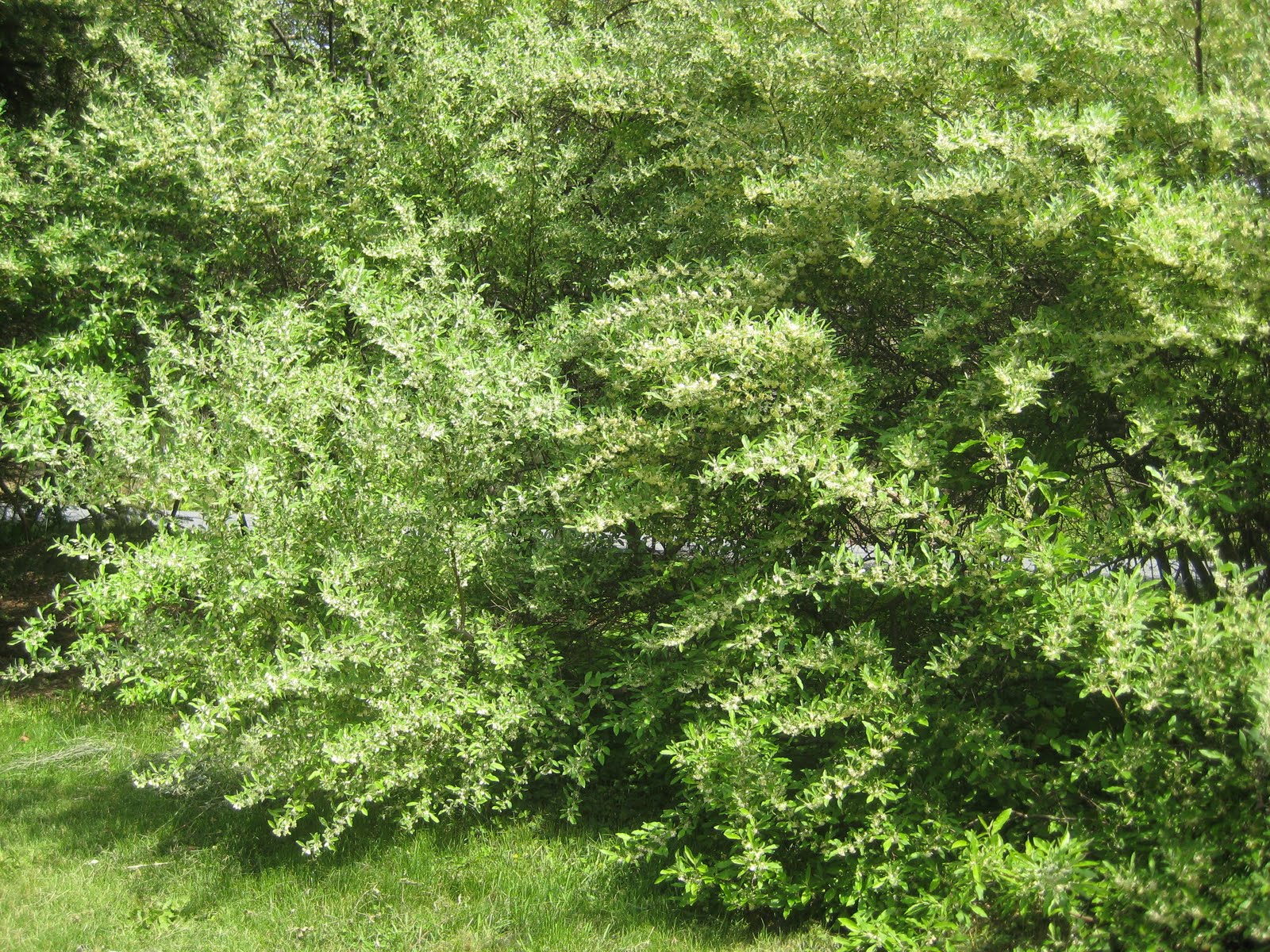
Autumn olive, Elaeagnus umbellata, is a deciduous shrub from 3-20 ft. in height. It is easily recognized by the silvery, dotted underside of the leaves. In early May, small, yellowish flowers are abundant and give off an exotic honeysuckle sweet aroma. Come September the fruits begin to ripen but are much too sour until they develop a speckled look to the red berries. Autumn olive invades old fields, woodland edges, and other disturbed areas. Autumn olive is native to China and Japan and was introduced into North America in 1830. Since then, it has been widely planted for wildlife habitat, mine reclamation, and shelterbelts. Though the Autumn Olive is ideal for a hedgerow shrub, (it grows every which way forming an intertwining safe haven of cover for wildlife and birds), it is now considered an invasive. The birds love its berries and therefore spread the seeds through their droppings. These bushes are tough, spiny to handle and hard to kill if you do want to get rid of them. If you do choose to plant this bush be aware that it will pop up elsewhere, much to the irritation of farmers.


Highbush cranberry, Viburnum trilubum, is not related to true cranberries; the name comes from its tart, edible red fruits. This northeast native grows best in sunny (does tolerate some shade), moist areas. In ideal conditions this shrub can grow 10 to 15 feet tall as well as broad.
A delight for every season, the show begins in May with dainty white flower heads that look like a delicate pinwheel. By late August the shrub is loaded with clusters of dark red berries. These are edible though very sour. They usually hang on throughout the winter supplying a great food source for winter birds. Any remaining berries are usually stripped clean in March by migrating cedar waxwings.
One of my favorites, this trouble free shrub is ideal for naturalizing. This species is hardy, doesn't outgrow its bounds, looks great as a yard specimen plant as well as out in the field for the wildlife. A visual display for every season, this shrub is a must for providing food and shelter to the birds.

Often confused with the much taller Chokecherry, the Chokeberry (Aronia arbutifolia), only grows to about 6 ft. Tolerant of poor or wet soil conditions, this deciduous shrub provides plenty; fruit for the birds, nectar for insects, cover for wildlife and multi-season beauty. Clusters of spring blooming white to pinkish flowers provide loads of nectar for pollinators. Dense clusters of glossy red fruit follow the flowers. The fruit ripens in late summer and persists through winter. The glossy foliage turns brilliant red in autumn, a wonderful visual.


The American Plum, also known as Wild Plum, (Prunus americana) are members of the Rose family and are also native to eastern and central United States. Its white, sweet blossoms emerge in early spring before the foliage breaks bud. It easily forms colonies and thickets in fields, fence rows, and along roadsides and woodland edges, where its suckers from roots and its germinated seeds create mass plantings. These small trees can reach 20 ft tall, grow best in moist, well-drained soils but do tolerate various conditions. Its fruits are sweet when fully ripe and are loved by the birds as well as those inclined to make jam.


You know it is spring when the early flowering Redbud, (Cercis canadensis), bursts into bloom with its bright pink blossoms. A relatively small tree, it has spreading brances and a small short trunk. Delightful heart shaped leaves are sure to please if you choose to plant this ornamental.
Redbud is also known as Judas-tree. According to legend, Judas Iscariot hanged himself from a branch of the European species Cercis siliquastrum.


The Cornaceae family of dogwoods has up to 110 types. The Common Dogwood, (cornus sanguinea), is a very popular ornamental planting but it is also a great understory tree grown in the wild or in naturalized settings.

There is a beautiful story about the dogwood tree being the wood used for the crucifixion of Jesus Christ. The story, generally told at Easter when the dogwoods flower, adds that Christ caused the flowers of the dogwood to be a reminder of the cross on which He died. He allegedly did this by giving the flower two long and two short petals, and to have what look like nail prints on the petals to remind us that Christ suffered on the cross with nails through His hands. The story is quite remarkable, but unfortunately the legend is not true.

“When Christ was on earth, the dogwood grew
To a towering size with a lovely hue.
Its branches were strong and interwoven,
And for Christ's cross its timbers were chosen.
“Being distressed at the use of the wood,
Christ made a promise which still holds good:
'Never again shall the dogwood grow
To be large enough for a tree, and so,
Slender and twisted it shall always be,
With cross-shaped blossoms for all to see.
“'The petals shall have bloodstains marked brown,
And in the blossom's center a thorny crown.
All who see it will think of me,
Nailed to a cross from a dogwood tree.
Protected and cherished this tree shall be,
A reflection to all of my agony.'”